Ronaldo Vs Messi

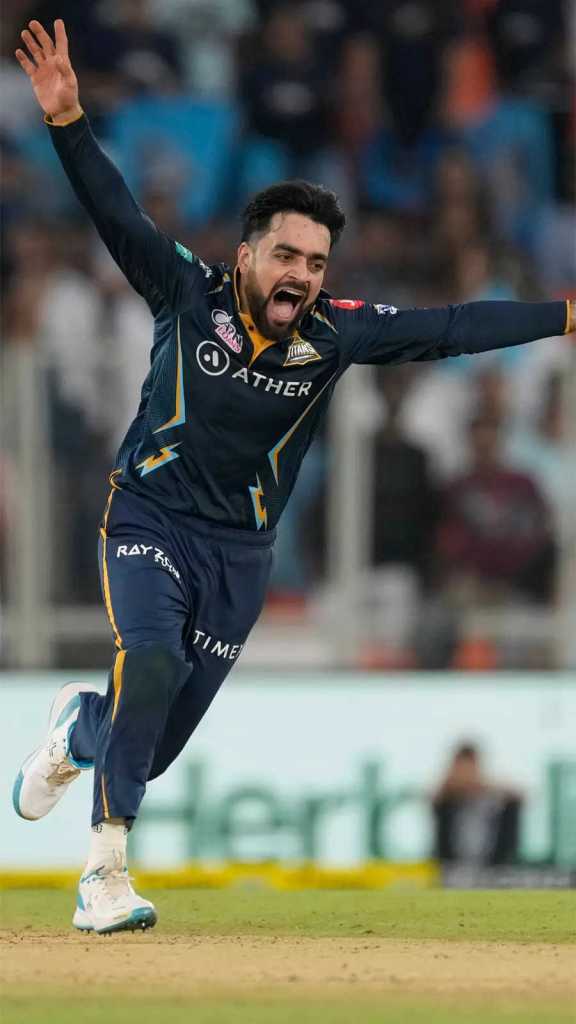
Lionel Messi and Cristiano Ronaldo

Recently Cristiano Ronaldo (CR 7) commented that the Ballon d’Or and the FIFA Best Player awards were ‘losing their credibility.’ You guessed right! The recipient of both these honours was none other than Lionel Messi.

Let’s get it straight. The Ballon d’Or has been presented by the French Magazine, ‘France Football’ since 1956. 30 names of top performing footballers ‘in the last season’ are shortlisted by a jury of seasoned football correspondents. Then, senior, accredited football journalists from the top 100 FIFA-ranked nations select their top 5 players in order of ranking with 6 points being given to the top player. For Ballon d’Or 2023, 66 out of 92 participative journalists voted for Messi as their No 1 player. They represented major football powers like Germany, Italy, England, Spain, Belgium and Brazil and the world’s 2 most populous nations- India and China. Erling Haaland, the hero for Man City got 22 nominations as the best footballer in the world. Messi vs Haaland was 462 points to 357, a significant margin.

The FIFA Best Men’s Player 2023 trophy was a much closer affair with both Messi and Haaland tied at 48 points. An equal weightage of 25% is given to the deciding panels of Coaches, National team captains, Media and accredited fans. The National team captains’ votes swung it in Messi’s favour as per accepted practice and procedure.

The intense rivalry between Ronaldo and Messi over the last 16 years has taken the stock of European and World football through the roof. Not since the days of Pele and Maradona has the sport captured such global interest and fervour. To concisely wrap up the silverware won by these 2 Icons- Ballon d’ Ors, Messi 8- Ronaldo 5; Best FIFA Men’s Player, Messi 3- Ronaldo 2; European Golden Shoe for the top goal-scorer in all European Leagues in a season, Messi 6- Ronaldo 4; World Cup Golden Ball for the Best Player in the World Cup tournaments, Messi 2- Ronaldo 0. The Argentine maestro won the Golden Ball at the 2022 Qatar WC and earlier at the 2014 WC in Germany. Lionel Messi had carried an average Argentina squad to the finals which they lost in a 1-0 heart-break defeat to the hosts Germany.

As regards laurels at the highest levels, CR7 captained the Portugal side to a 1-0 win over France in the European Championships of 2016. In 2021, Messi inspired his team-mates to success in the Copa America final after beating arch-rivals Brazil 1-0 at Maracana.  His first international title since the Olympic gold medal at Beijing 2008.

Ronaldo is a goal-scoring phenomenon-128 goals for his country in 205 matches since his debut in 2003. At elite club levels with Man U, Real Madrid and Juventus – a staggering 696 goals in 918 games. A little-known fact is that more than 150 of his League goals have come through headers. The average vertical jump of NBA basketball players is 30 inches. CR 7 highest recorded goal-header jump was 41 inches in a Real Madrid vs Man U match in the 2012-13 season. Only ‘HIS AIRNESS’ Michael Jordan surpasses him with jumps of 48 inches.

A rare specimen of physical fitness, his 6ft 2’ frame and tremendous pace terrorise the defence of opposing teams. Add an almost unstoppable free kick to the arsenal. A unique feature of this champion player is the exhibition of the double scissors and drop moves which allow him to quickly change directions. In 2018, the Turin medical staff did medical tests on the super athlete and found that his condition at 34 was the same as a 20-year-old – with an incredible 50% muscle and 7% body fat. Ronaldo played for 4 seasons with the Italian club Juventus.

His handsome physique, sensational exploits on and off the field and his fitness regimen make him the most followed sportsperson on Earth. 618 million followers on Instagram and 100 million followers apiece on Facebook and X. To maintain peak fitness and endurance on the football field he engages in high-intensity interval training (HIIT), running, sprinting drills and cycling. The dedication is exemplified by 5 visits to the gym per week with workouts lasting 3-4 hours. HIIT is a complete physical regimen that combines aerobics, strength (resistance) exercises and targeted weight to increase muscle. However, it’s imperative to remove the misconception of CR 7’s speed. In the Sky Sport’s serial ‘Tested to the Limit’ in 2011 he was pitted against Angel Rodriguez, Spain’s fastest sprinter. Suffice it to say that the footballer would have run the 100 metres in 11.4 seconds.

French legend Zinedine Zidane, who managed Real Madrid, had this to say, “When you play with Ronaldo in your team you are already 1-0 up.” Over to Sir Alex Ferguson ( Man U), “We have had some great players at this club in my 20 years but he’s up with the best.” Portuguese great Eusebio’s observation hits home, “Ronaldo has great ball control and his technique is excellent. He believes that he can do anything with the ball and that confidence makes him very special indeed.”

Now to the controversies. The explosive TV interview with Piers Morgan led to his abrupt exit from Man U. He openly castigated Eric ten Hag, Manager, for benching him in some games and even blasted the owners of the hallowed club- the Glazer family. At the Qatar WC, Fernando Santos the Portugal Manager, substituted him in the match against South Korea, benched him in the match against Switzerland which Portugal won 6-1 and brought him on only in the 51st minute for the Q/F against Morocco. Possibly the lowest moment was when he claimed the 54th-minute goal against Uruguay in a group-stage match. The goal was credited to his team-mate Bruno Fernand and the decision was confirmed by Adidas Ball Technology. Unfortunately, CR7 continued to claim it over the next couple of days with support from his friend Piers Morgan.

The 5ft 7’ Lionel Messi with his ordinary looks and shy demeanour is a global football Icon only because of the magic he weaves on the football field. At the Qatar WC, he scored 7 goals and had 3 assists in 7 matches. But hold your breath! At age 36, he was one of only 3 Argentinian players to play every single moment of their WC winning campaign-690 minutes in total after 2 games went extra-time. Messi made 347 passes, 5 tackles and attempted 32 shots at goal.

The Argentine talisman has 106 goals in 178 caps for his country and 61 recorded assists. He spent almost his entire professional career with FC Barcelona (2004-21) where he won a record 34 trophies. His jaw-dropping club stats of 672 goals in 778 appearances with 269 Assists kicked in. A distraught Messi had to leave the Catalan club as they did not have enough of a wage budget left to offer him a new contract. Due entirely to financial profligacy and incompetent management. In his 2 seasons with PSG thereafter he scored 32 goals in 75 matches with a solid 35 Assists. Assists are what adds to Messi’s creative aura and mystique. Assist refers to that final, definitive pass to a team-mate or setting up a team-mate to take the goal shot. The stamp of the ultimate team player in the ultimate team sport. Listen to France and PSG superstar Kylian Mbappe, “I still miss not playing with him. For an attacker like me who likes to devour spaces, with him you can go with the certainty that you will receive the ball. It was a luxury that only he could give you. Playing with Messi was special.”

Messi, to millions of his fans across the world, transcends awards and stats. He is the modern maestro of The Beautiful Game. The biggest box-office draw even today. His artistry and ball skills have often been called ‘Insane’ and ‘Alien’.  His vision, balance, sudden turns and acceleration have stupefied both defenders and spectators. His saucy dribbles, sublime free kicks and the art of the chip finish have brought gasps, smiles and jaw-drops even from seasoned commentators and yesteryear greats.

He is adored by his national team-mates. They passionately worked hard and played hard to hold aloft the Holy Grail of football for their country, their team and especially for their captain. Angel de Maria who impressed and scored a goal in the final with a Messi assist has said, “I always dream of playing with him, having him by my side every day. Every time we go with the national team it seems very short.” Martinez, who won the Golden Glove award as goalkeeper of the tournament, is even more heartfelt, “I want to give him life. I want to die for him.”

Arsene Wenger, the famous Arsenal Manager, has observed, “Messi is a footballer from a PlayStation game. Things that are impossible to do he makes them possible.” Dutch great Frank Rijkaard says “Messi’s goals are a piece of art.” Former England star Wayne Rooney shouts out, “Messi is a joke, the best joke that my eyes have ever seen.” Radomir Antic, who managed several La Liga teams in Spain, stated “Messi  is the Mozart of football.” Let’s leave the final word to ex-Barca and now Man- City’s formidable Manager, Pep Guardiola-“I tried making Lionel Messi the best player in the world. He ended up making me the best manager in the world.” Argentina’s World Cup-winning manager, Luiz Scolari emotionally echoes similar sentiments.

Ronaldo playing for Al Nassr in the Saudi Pro League and Messi turning out for Inter-Miami in US Major League Soccer are now at the twilight of their careers. The standards are much lower there than at the elite European clubs and leagues. At best, we can hope for ‘The Last Dance’ at the next European Championships and the Copa America.

CR 7 is undoubtedly in the pantheon of all-time football greats. What about MESSI? I wished that he had been honoured with the Super Ballon d’Or 2023. In recognition of being the best football player of his generation.  A title only and last conferred on the Real Madrid legend Alfred Di Stefano in 1989.

Notes & Records of some Iconic Hindi Film Songs

The Golden Age of Hindi Film Music is considered to be the period from the 1950s to the 1970s. Song and dance were always considered to be a part of Indian Nautanki and drama and became an integral part of the narrative structure of popular Indian cinema. By the 1970s, Hindi film songs had reached out to a humongous audience across India but were also resonating in Asia, Africa, Russia, and Eastern Europe. This amazing era was defined by the exceptional creativity, talent, passion, and innovation of not only the Musical Trinity of Iconic Singers, Composers, and Lyricists; song and music also flourished because it was exquisitely imagined and projected by visionary filmmakers and directors.

Flashback to ‘Shree 420’ (1955). ‘Ramaiya Vastavaiya’ sung by Lata Mangeshkar, Mohammad Rafi and the voice of Showman Raj Kapoor- Mukesh. RK’s music team – Shankar Jaikishan, Hasrat Jaipuri, and Shailendra frequented Khandala to compose music for his films. They used to stop at a roadside hotel run by a Telugu guy Ramaiah for tea and snacks. Shankar, who was conversant in Telugu, placed the orders. One time around there was a delay in service and Shankar started humming  ‘Ramaiya Vastavaiya’ – calling Ramaiah to come quickly. His partner Jaikishan started drumming on the table. Shailendra piped in with ‘Maine dil tujko diya’ – indicating that all 4 were waiting for Ramaiah. As they hummed the lines they felt that this could be a song. Raj Kapoor liked the idea and created a street situation for the song and the lyrics were written keeping these lines intact. The original Telugu words were retained even though the Hindi audience could not understand its meaning. The song became a chartbuster.

Lata Mangeshkar sang the ‘Pyar Kiya to Darna Kya’ song for recording at 3 different locations. Mughal-e-Azam was released in 1960 and had been a few years in the making. “There was no technology to create’ the echo effect’,” writes Srishti Magan in an article for the magazine Bollywood probably alluding to a grand palace setting. “The only way out was to record the song at different places and overlap the recording. ” This was achieved to splendid effect by music-director Naushad and Lata Mangeshkar.

OP Nayyar (OP) is lauded as ‘The Rhythm King’.  His music had a robustness and rhythm; his songs were bewitching and easy on the ears. He brought the folk and modern together in perfect harmony. But the OP name is associated with the melodious use of Western instruments like the guitar, accordion, claret, cello, and piano. Author Ajay Mankotia reveals surprising facts through his meetings with and articles on this maverick composer. He changed the rules of Hindi film music. Please listen to ‘Yeh Kya Kar Dale Tune’ from ‘Howrah Bridge’ (1958) and ‘Ankhaon hi ankhon mein ishaara ho gaya’ from ‘CID’ (1958). He brought the Sarangi out of its limited role- either in kothas or as a mournful accompaniment to melancholic songs. He transformed it into an upbeat musical instrument. He gave it a feel-good melody and a fast pace. “The poor Sarangi was joyfully released from typecasting.”

Take the Santoor. The beat allotted to it by music directors was gentle. OP Nayyar used it as a fast-flowing brook- soft but more insistent in the prelude to ‘Jayenge Aap Kahan Jayenge’ from ‘Mere Sanam’ (1965). Never had been the santoor used like this. Shades of fusion music in the 1990s brought forth by the upbeat rhythm of traditional Indian musical instruments. Take ‘Yeh Haseen dard de do’ from ‘Humsaya’ (1968). For the song an accomplished tabla player would provide a beat pattern that would be simple and linear. OP’s beat patterns are complex yet riveting. The beat patterns certainly shook up the music aficionados of the time.

In an episode of KBC, Big B revealed that the exuberant yell “Yahoo!” in the song ‘Chahe Mujhe Junglee Kahe’  from ‘Junglee’ (1961) was recorded by writer Prayag Raj who happened to be in the studio and not by the singer Rafisaab. Later in Amitabh Bachchan’s own ‘Coolie’ (1983) Prayag Raj provided vocalization by shouting “Allah Rakha” in a song. The ‘Yahoo’ song picturized on the ‘Rebel Star’ Shammi Kapoor is considered a turning point in Hindi cinema. It solidified his image as an untamed screen presence, an unshackled freedom-seeking soul. Much akin to contemporaries Elvis Presley and James Dean. The singer in a later interview commented that he sang this exuberant song on a high scale whilst visualising the persona of the rocking Shammi Kapoor. In his foreword to the biography ‘Mohammad Rafi- Golden Voice of the Silver Screen’ by Sujata Dev, Dilip Kumar writes, “With Rafisaab it was a mystical bonding.  As if he was part of me when he sang for me without being told how I would perform the song during the filming of the sequence.” Think also of Kishore Kumar. His years as an actor helped him to project his voice to captivatingly express the emotions of other actors.

A musical giant Salil Chowdury or Salilda, enriched us with his music over 5 decades. From Bengali to Hindi films, Malayalam, Tamil, Telugu, Gujarati, Marathi, Assamese and Odia films. Agnivo Niyogi when writing for the Telegraph mentions quite a few Bengali masterpieces introduced to Hindi audiences. We check out some of these compositions of Salilda which are memorable both in Hindi and Bengali. “The wistful melody ‘Na Jaane Kyun’ from ‘Chhoti Si Baat’ (1976) set to Yogesh’s words and brought to life by Lata Mangeshkar was a recreation of his Bengali song  ‘Pagol Hawa’ which Jaitleshwar Mukhopadhyay sang with great finesse. ‘O Sajana Barkha Bahaar Aayee’  from Bimal Roy’s 1960 classic ‘Parakh’ is another gem from the composer-singer duo of Salilda and Lata Mangeshkar. The latter also sang the Bengali version, ‘Na Jeo Na’. ‘Kahin Door Jab Din Dhal Jaye’ from ‘Anand’ (1971) captures the melancholy of a terminally ill cancer patient who is watching his life slip by. Penned by Yogesh the heartfelt lyrics as rendered by Mukesh touches our hearts. The original Bengali version ‘Amay Proshna Kore Neel Dhrubo Tara’ in Hemant Kumar’s deep, rich voice has etched its place in the annals of Bengali music.”

‘Ek Chatur Naar’ one of the most loved songs from the1968 laugh-riot ‘Padosan’ was actually made up of 3 different songs. A puzzle perfected by bits and pieces brought in by the versatile Kishore Kumar. As composed by RD Burman it was a combination of Carnatic and Hindustani classical music. Manna Dey, a trained classical singer rendered the Carnatic part whilst self-taught Kishore da sang the Hindustani counterpart.  The Alaap ‘Ek Chatur Naar Karke Shringar’ was taken from Ashok Kumar’s original version in ‘Jhoole’ (1941). The tune used in ‘Sant Tulsidas’ (1939) song  ‘Ban Chale Ram Raghuram’ was adapted as ‘Are Dekhi Teri Chaturai.’ The tune used in ‘Chanda Re Jaa Re Jaa Re’ sung by Lata Mangeshkar  ‘ Ziddi’ (1948) was the final piece of the puzzle, ‘Kaale Re Jaa Re Jaa Re Are Nale Mein Jake Tu Munh Dhoke Aa.’  The famous reel battle remains as humorous and entertaining as it was 55 years ago. Rajendra Krishan’s lyrical fluidity, RD Burman’s creative mastery, the class of Manna Dey, and the genius of Kishore Kumar all contributed to the timeless track we have today. The humorous on-screen presentation by Sunil Dutt, Mehmood, and Kishore da himself remains till today as a favorite repeat watch for movie buffs, Manna Dey in his interviews has mentioned his fond memories of the making of this crazy, rollicking duet. The rehearsal over 8 days and good food at each other’s house. The final recording in 2 phases. Manna Dey in his interviews admiringly speaks about the mad-cap genius of Kishore and his improvisations which made the song into a cult classic.

Indian Railways is a recurring character in countless Hindi songs of that era. Shakti Samanta’s 1969 romantic drama ‘Aradhana’  gave Hindi cinema an evergreen romantic song in ‘Mere Sapnon Ki Rani’.  The filmmaker’s son Ashim Samanta recounts what went into the making of the iconic song. The number was to introduce the lead pair of Rajesh Khanna and Sharmila Tagore. The song was visualized with the hero driving a jeep through a scenic hill station whilst the heroine is sitting in a slow-moving passing train. The Bagdogra to Darjeeling toy train route was selected for the song. But just a few days before the actual shoot, Sharmila Tagore informed the director that she had already allotted the dates for a Satyajit Ray film. The filmmaker was livid but she convinced him to go ahead with the scheduled shoot without her. As the hero proposes to her in the song the heroine is seen sitting in the train trying to read a novel and sneaking glances at the Romeo. Whilst watching the film it seems that it was all shot at the same Darjeeling location. In reality, it had to be re-shot on a set at Nataraj Studios, Bombay. Art Director Shanti Das recreated a set to match the toy train compartment. The scenes were edited and interspersed so seamlessly to seem one with the outdoor location shoot. Another important reveal is that all the songs were supposed to be sung by Mohammad Rafi. As he was on a 3-month world tour, Sachin Dev Burman and Shakti Samanta brought in Kishore Kumar. The rest is history.

‘Khaike Paan Banarasiwala’ became the USP for the 1978 hit film ‘Don.’ The lyrics were written by Anjaan for a Dev Anand film ‘Banarasi Babu’ (1973). Kalyanji-Anandji (KA) were the music directors for both the films. However, the star disliked it as it did not go with his urbane, debonair image and hence it went into the KA song bank. After the completion of the rushes, ‘Don’s’ director Chandra Barot screened the film for his mentor Manoj Kumar. He was advised that the film script was going too fast and that a song be introduced post-interval to give the audience a breather. Hence, the famous song picturized on Amitabh Bachchan, where he was inspired by some of Bhagwan Dada’s dance moves a la ‘Albela’. Kishore Kumar agreed to sing the song after much persuasion by the music director duo but insisted that he would only give one take. He asked for a paan at the studio, and chewed the paan, and also spat it during the recording. Please check out the song again to get the real feel and flavor of it again. These incidents were recounted in the radio show Suhana Safar with Annu Kapoor’.

In a Facebook video, Asha Bhosle recalls the recording of the song ‘Inteha Ho gayi Intezar Ki’ when Kishore Kumar sang the song whilst lying on a table. This superhit song featured in Prakash Mehra’s film ‘Sharabi’ (1984) with the camera panning on Big B and another top heroine from the South, Jaya Prada. Anjaan captured the mood of the song in his lyrics which was composed by Kishoreda’s nephew, Bappi Lahiri. The singer decided that he would sing the song lying down as a fallen drunkard. A teetotaller, the artist in him decided to reach the high by lying down flat.

During her last concert tour to Britain in 2016, Asha Bhosle spoke with the Hindustan Times about how she immersed herself into the role of a Lucknow courtesan to prepare herself for the rendering of the mellifluous ghazals from the 1981 film ‘Umrao Jaan’. The soulful lyrics were penned by Shahryar and the music of the film was composed by Khayyam. She mentioned that normally her focus is on 2 things- who is singing the song on the screen and what the screen persona of the actress is. For ‘Dil Cheez Kya hai’ the gestures and expressions of Rekha came to her mind. Then she read an Urdu novel ‘Umrao Jaan Ada’ (1905) to understand the character and situation. “After imbibing all that I became Umrao Jaan myself. I could translate her feelings into my rendition of the song.” We have all heard of Method Acting- the technique for an actor to get into the skin, mind, and even soul of a character. How about, ‘Method Singing?’

Eminent lyricist and filmmaker Gulzar is full of anecdotes about Pancham. 116 of his songs were set to music by R D Burman. “He used to be at his wit’s end about my lyrics. Ek to bechare ki Hindi weak thi aur oopar se meri poetry,” says Gulzar- The poor man’s Hindi was weak and to top it he had to grapple with my poetry. “When I gave him ‘Mera Kuch Saaman ‘ (Ijazat-1987) he threw away the sheet saying that next time you will give me a headline from the Times of India and tell me to tune it.”

Such iconic songs are known for their timeless melodies and poetic lyrics which resonate with people across generations. They have stood the test of time. They take us back in time to a period when music-directors Laxmikant-Pyarelal (LP) flawlessly conducted an 80-piece orchestra and when music arrangers played a vital role. The lyrics were meaningful and had universal themes and appeal. These classic melodies touched millions of hearts and spread cheer and goodwill. Tapping into the entire spectrum of human mood and emotions- uplifting, philosophical, sad, reflective, wistful, upbeat, naughty, and seductive. During a recent episode of a reality show, Sanjay Dutt shared that his father Sunil Dutt had told him to listen to 4-5 select inspiring and motivational songs when he felt down and desolate. One of the booster-dose numbers, ‘Ruk Jaana Nahin Tu Kabhi Haar Ke’- Do not stop after a defeat from the film ‘Imtihaan’ (1974). Another stirring song by Kishore Kumar,  curated by the LP- Majrooh Sultanpuri team and featuring an idealistic and resolute teacher Vinod Khanna who triumphs over the travails and challenges that life has in store for him. The Golden Oldies numbers have this subtle power to relax and refresh, revive and reinforce.

Ram Janma Bhoomi- An Epic Saga

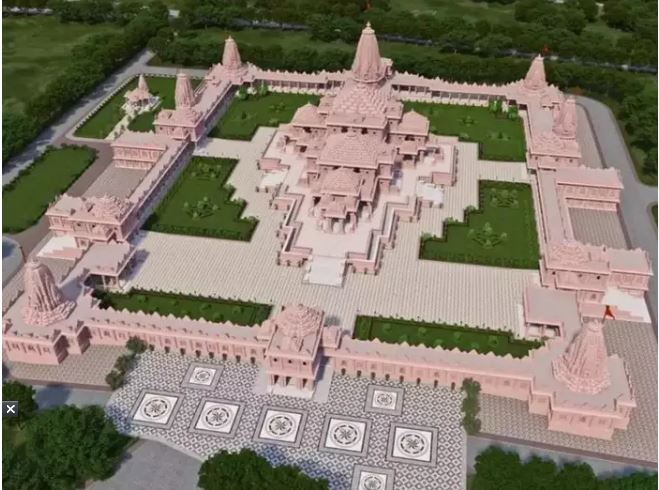
On the 22nd of January 2024, Ayodhya will resonate with the euphoric chants of ‘Jai Shree Ram.’ The Pran Pratishtha ceremony leading up to the installation of the Ram Lalla idol, followed by the first Aarti will be performed by the Prime Minister-guided by Hindu Pandits- with 7000 special guests invited by the Temple Trust in attendance. The Consecration ceremony will illuminate and reverberate not only across our vast nation but also with millions of devotees across the world

Flashback. In 1885, Mahant Raghubir Das filed the first suit to build a temple on the land adjacent to the mosque. Denied permission by the District Magistrate, Faizabad. In December 1949 a Ram idol was found in the mosque and the faithful started offering prayers. The Indian Government declared the site ‘a contested area’ and locked the gates. The following year permission was granted by the Faizabad Court to conduct pooja for Sri Ram Lalla but only in the minor courtyard with the main gates remaining closed. In 1961, the UP Sunni Wakf Board filed a suit seeking possession of the Babri Masjid and demanding the removal of the Hindu idols.

It was in 1984 that the Vishwa Hindu Parishad (VHP) started the Ramjanmabhoomi movement as we know it now. BJP leader Mr LK Advani took the reins of the campaign. In 1986, the Babri Masjid Action Committee (BMAC) was formed as the opposing party. In the meantime, the Shah Bano case made headlines with the Supreme Court (SC) ruling in favour of the elderly, divorced Muslim woman- that she gets monthly maintenance from her re-married husband.  This was contrary to Muslim Personal Law and to appease the conservative elements in the community, the Mr Rajiv Gandhi government with 400+ MPs in the Lok Sabha overturned the SC judgement by amending the law itself.  In this balancing act political drama, the Government in 1986 allowed the Hindus to do Pooja and have darshan after opening the gates. A tipping point of sorts happened in November 1989 when the VHP was permitted to perform Shilanyas (lay foundation stone) near the Masjid.

On to the Rath Yatra led by Mr Advani in September 1990 from Somnath (Gujarat) to Ayodhya ( Uttar Pradesh). The movement mobilised huge public support leading to the 6th of December 1992 – when Hindu karsevaks demolished the Babri Masjid and left behind a makeshift temple. More than 50 of this violent mob were killed in police firings. Communal riots broke out in many parts of the country. More than 900 died in the Mumbai riots of December 1992 and January 1993. Culminating in the deadly Mumbai serial blasts of March 1993, orchestrated by Dawood Ibrahim from Dubai. To control a volatile situation the Congress-led government passed an ordinance to acquire the ‘contested land.’

All the suits related to the Ayodhya land title dispute had been transferred to the Allahabad High Court in 1989. The needle moves to 2003. The Court authorises the Archaeological Survey of India (ASI) to excavate the land and give its findings with evidence. The 574-page report was submitted in August 2003. The only public takeaway was that ‘of a very large structure that considerably pre-dated the Babri Masjid’. In September 2010, the Lucknow bench of the Allahabad High Court split the land 3 ways- Ram Lalla Virajman, UP Sunni Wakf Board and Nirmohi Akhara (a Hindu order of warrior saints who managed many temples in the region).

Finally on the 9th September 2019, when a full bench of the Supreme Court of India ordered the Government of India to create a Trust to build the Ram Mandir and to form a Board of Trustees within 3 months. The entire 2.77 acres of disputed land was passed to the custody of the Trust. 5 acres of land was allotted to the UP Sunni Wakf Board at a suitable place within Ayodhya to construct a mosque.

The commonly accepted narrative is that the first Mughal Emperor Babur ordered the demolition of the Ayodhya temple in 1528 and got the Masjid built on its ground,( hence the Babri Masjid). During the arguments in the SC a reference to Babur’s visit to Ayodhya (as mentioned in Baburnama- a book by Babur) was brought up. However, the Advocate for the opposing side clarified that 2 pages of the Baburnama were missing (whether about the Ayodhya temple remains unclear). Kishore Kunal, former IPS officer, in his book ‘Ayodhya Revisited’, is of the firm opinion that the temple was not destroyed in 1528 but in 1660 by Fidayi Khan, a governor appointed by Emperor Aurangzeb. This timeline seems to be in sync with the accounts of English travellers William Finch (1608-11) an English merchant with the East India Company (EIC) and Captain William Hawkins (EIC Ambassador) who both landed in Surat in August 1608 and spent more than 2 years at Emperor Jahangir’s court. Finch visited the fort in Ayodhya where Hindus believed Lord Ram was born and mentions it in his accounts. Hawkins also refers to the sacred town of Ayodhya in his travelogues (William Foster’s book “ Early Travels in India’- accounts of 7 English travellers in India).

Perhaps, most significantly, Austrian Jesuit missionary Joseph Tiefenthaler suggests in his works that the Ram temple was demolished by Aurangzeb. This European geographer came to India in 1743 and visited Ayodhya in the 1760s.’ He refers to a particularly famous spot called Sita Rasoi- or table of Sita- the revered wife of Shri Ram. He states that Aurangzeb demolished the fortress and erected a mosque in its place to prevent heathens from practising their ceremonies. However, they have continued to practice their religious ceremonies knowing that they have been to the birthplace of Ram by going around it 3 times and prostrating on the ground. On the left is a square box called Bistar palana (cradle) where Ram (Vishnu) and his 3 brothers were born. In the month of Chaitra, a large number of people gather together to celebrate the birthday of Ram, extremely popular throughout India.’

The Ayodhya Kanda Recitation was recorded in writing by Mr Robert Montgomery after the 1857 Uprising or Mutiny as he calls it. He was the Chief Commissioner of Oudh or Avadh in 1858-59.

In 1975-76 Mr B B Lal, Director General ASI and his team started excavating the Archaeology of Ramayana- Ayodhya, Bharadwaj Ashram, Nandigram, Chitrakoot, Shringverapur In his 2008 book, ‘Rama- His Histrocity, Mandir and Setu’ he states that ‘attached to the piers of the Babri Masjid there were 12 stone pillars which carried not only typical Hindu motifs and mouldings but also figurines of Hindu deities. It was self-evident that the pillars were not an integral part of the Masjid but were foreign to it.’ Another eminent archaeologist Mr K K Muhammed who was part of the team reveals in his book, “An Indian I Am” that he found the remains of the temple on the western side of the mosque. The 12 pillars were constructed with Hindu symbolism including Ashtamangala signs (8 auspicious objects as per Hindu practice and astrology.) They also found terracotta figurines of humans-men and women- and animals.’ Mr Muhammed clearly states that ‘his findings were suppressed by Marxist historians like Prof Irfan Habib who was very powerful and influential with the Indian Council of Historical Research and with many leading newspapers’. Irfan Habib and his powerful supporters even spread the lie that Mr KK Muhammed had not been a part of the ASI excavation team at Ayodhya. This coterie also went all-out to tarnish the image of the ASI after they submitted their 2003 report to the Allahabad High Court. In the early 1980s also the ASI was under tremendous pressure to play down and not to reveal the excavation findings. Recommend that you read Mr Muhammed’s book as a tribute to his passion, courage and integrity as a professional and to learn about his other interesting digs and excavations.

The Jawaharlal Nehru University (JNU) clan led by Irfan Habib had 25 influential intellectuals including Dr Romila Thapar. They hyped up the narrative that the legendary Ayodhya of the Ramayana was a purely mythical city and was not the same as present-day Ayodhya. However, they fumbled with the name Saket which historically is one and the same as Ayodhya. Their overwhelming influence with the powers that be and the Sunni Wakf Board ensured that there could not be any out-of-court compromise solution as some moderate Muslim leaders recommended. Former Aligarh Muslim University (AMU) Chancellor Lt General (Retd) Zameeruddin Shaikh said that the Muslims should take the initiative of handing over the land to the Hindus and facilitate a harmonious out-of-court settlement. In November 2019, before the Supreme Court judgement the then AMU Chancellor and Professor Tariq Mansoor cautioned the students against false propaganda. They should accept the decision of the highest court with maturity, respect and restraint.

The Nay-Sayers and Obstructionists were in for a shock when during the demolition of the Masjid in 1992, 3 inscriptions on large stones were found. The most important was the Vishnu-Hari inscription of 20 lines in the Nagari script on a 1.10m by 0.56m stone. Shri Ajay Shastri, Chairman of the Epigraphical Society of India examined the inscriptions and observed, ‘Line 15 clearly tells us that a beautiful temple of Vishnu-Hari built with heaps of stones and beautified by golden spires, unparalleled by any other temple built by earlier kings was constructed. This wonderful temple was built in the temple city of Ayodhya situated in the Saketmandala ( Saket district). Line 19 describes God Vishnu as destroying Bali and the 10-headed personage.’ Prof Meenakshi Jain again exposes Irfan Habib who first dismissed the inscription as from a private collection and then alleged that it was stolen from the Lucknow museum and surreptitiously placed at the site. In fact, the Lucknow museum inscription was the ‘Tretha ka Thakur’ one –another Ayodhya temple demolished at Aurangzeb’s orders. The Director of the Lucknow Museum refuted the canard spread by Habib and displayed the inscription in the custody of the museum.

After the Supreme Court judgement, it was decided by the Sunni Wakf Board and the Management Committee that the mosque would be constructed on a 5-acre land at Dhannipur, around 25 km from the temple. It will be named after the Holy Prophet of Islam- Mohammed Bin Abdullah Masjid. Top clerics from several countries would be invited including the Honourable Imam, who leads the prayers at the Grand Mosque of Mecca. It will be the largest mosque in India and will have the world’s biggest Quran- measuring 21ft high and 36ft wide.

It is imperative to see the Ram Janmabhoomi saga in the global context. In 2020, the Erdogan-led government in Turkiye converted the famous UNESCO-declared heritage site and cultural museum, Hagia Sophia, into a mosque. It had earlier been a Christian Orthodox Church and Mosque and a Museum since 1934. The Icons of the Virgin Mary and the Infant Christ were covered by fabric curtains. Since 2017, the authoritarian Chinese Communist Party has destroyed or closed down hundreds of mosques in Xinjiang province (North-West) and Ningxia and Gansu provinces in the North – where the majority of the Muslim populace live. Total silence from our Comrade intellectuals. Going back to 1490- the Spanish Crown ordered all the Muslims to convert to Christianity. Over the next 100 years 3 million Muslims fled from Spain to North Africa. The last of the Moors adhering to Islam were expelled in 1610. The Iconic Cathedral of Cordoba, dedicated to Santa Maria, had been a mosque till the 13th century. Unfortunately, world history is replete with such events. Hark back to the cautionary words attributed to Spanish-American philosopher George Santayana,’ those who don’t learn from history are doomed to repeat it.’ Discussion, Reconciliation and even some Compromise may be the only way out through difficult, divisive situations.

So on the 22nd of January, Ayodhyanagari will rejoice to the traditional sound of the conches and bells; the melodious bhajans and kirtans; the overwhelming fragrance of fresh flowers and incense. At night time, there will be thousands of lamps on the banks of the river Sarayu. In the months after the temple inauguration, around 1 lakh pilgrims each day are expected at Ayodhya.  Hotels, Hostels and homestays will be full to capacity and beyond. Buses and cabs will be on demand 24/7. Restaurants will have stand-and-eat tables and nukkad chai shops will struggle to keep pace with the relentless sipping of the beverage. Flower sellers and general merchants will be constantly stocking up their wares. The ancient town of Ayodhya, whilst retaining its spiritual core, will transform into a bustling city with a classic airport and railway station and with all the amenities.

The economic boom will be humongous for lakhs of local people in the city and the neighbourhood- transcending religion and communities.

The Uttarkashi Miracle – 41 Lives at the End of the Tunnel

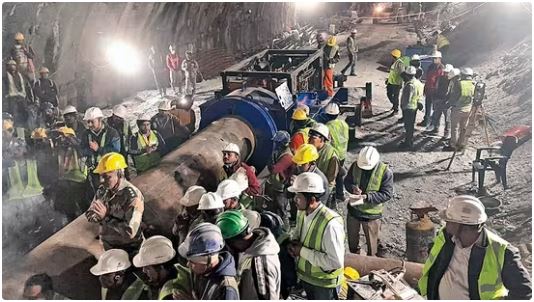
The Uttarkashi Rescue (PTI)

In the early hours of the 12th of November 2023, the under-construction Silkyara tunnel in the Uttarkashi region of Uttarakhand collapsed. For the next 17 days, the nation was transfixed by the humongous rescue efforts to bring out the 41 trapped workers alive and safe. Non-stop coverage on TV channels and on social media brought this intense story into every home. What made the entire experience so riveting and inspiring was the human heart-beat which throbbed right through. Plus the back-stories of the heroes who put their own lives at risk, and the experts and professionals who worked day and night at the site without rest or sleep.

Rat-hole mining was banned by the National Green Tribunal in India in 2014. It was the process of digging employed in Meghalaya and North East India to extract coal. It was a procedure that involved digging manually wherein the workers had to crawl and burrow in and out of a narrow passage or tunnel. The ban was due to the very high-risk working conditions and for causing damage to the environment. The technical and rescue teams at the disaster site were out of their depth as the state-of-the-art Auger horizontal dry drilling machine broke down more than 10 meters short of the 60-odd meter passage to the trapped workmen. The list of the heroic rat miners who cleared the final stretch to reach the workers reads as Munna Qureshi, Devendra, Monu Kumar, Feroze Qureshi, Wakeel Hasan, Nasir Khan, Rashid Ansari, Irshan Ansari, Ankur, Surya Mohan… Our heroes worked with Companies involved in contractual jobs with the Public Works Department and Municipal Corporations primarily in Delhi. They cleaned nallahs before monsoons, kept the sewer lines operational, and dug narrow tunnels and underground ditches for utility pipelines. Earning Rs 300/ to Rs 600/ per day for 12-hour shifts. Surya Mohan had this to say to a news channel, “We can squeeze ourselves and stay in that position longer than any normal and flexible person. We can work in holes with foul smells for 2-3 hours at a stretch. We can operate in conditions where oxygen levels are low. This is not an expertise but skills gained through practice since childhood.” Devendra Kumar, who was the first to reach the trapped workers and embrace them elaborates, “We can squat on our haunches and rest our body weight on our toes for 3 hours at a stretch. We can work like this in as little space as 2 feet and that is what we did as we sat in the pipe at Silkyara tunnel to clear the blocked portion. We held the drill machine right in front of us vertical to our chest with the heavier part where the motor is fitted touching the ride side of our chest.” Leaving the final word to Feroze Qureshi, “We expect nothing. We were so happy to save and help 41 fellow workers.” Real Heroes!!! Whilst hopefully some worthy financial rewards and honors will come their way it is refreshing to see that these saviors are being feted and applauded on prime TV shows like ‘Indian Idol.’

‘Rat miners surprised the world with their unique capability to bore around 13 meters and to fix and weld steel pipes- all this after cutting and extracting broken Auger parts.’ Lt General (Retd) Syed Ata Hasnain cited in his articles later. Local media and social influencers hailed it as a win for Indian Jugaad.

In an interview with the Free Press Journal, tunnel foreman Gabbar Singh Negi talked about how the 41 workers survived the 17 harrowing days without sinking into depression or hopelessness. Many workers later spoke about how he had kept them calm by practicing yoga and meditation and leading them on a morning walk of the 2000-meter stretch available. Negi, a local of Uttarakhand, rose to be a true leader for his team from Bihar, Odisha, West Bengal, Uttar Pradesh, Jharkhand, Assam, and Himachal Pradesh by motivating them to regroup as a unit for those long nerve-wracking days.

Australian Professor Arnold Dix became a national hero after all the workers were rescued unscathed. A geologist, engineer, and lawyer, he answered the SOS from the Indian Government and reached the site on the 20th of November. He inspected the collapsed tunnel, co-ordinated with all the Agencies on the ground, and suggested technical solutions to overcome challenges through the rubble. He was always on the forefront whether advising the rat mining operations or the final rescue mission by the NDRF (National Disaster Response Force). In a conversation with Business Today he talked about, “How keeping them warm and connected, providing proper food, and having all the emergency services around helped a great deal.” Prof Dix was also seen praying for the safe evacuation of the 41 workers and even performing Pooja at a small temple in the vicinity. He remains the most loved Aussie in India after the Australian cricket team broke a billion hearts by beating India in the WC ODI cricket final on the 19th of November.

Lt General Syed Ata Hasnain (Retd) as a Member of the NDMA (National Disaster Management Agency) stands out as another hero in this multi-agency, multi-approach, multi-options rescue mission. In his articles in the Indian Express and First Post, he lauds the Government of India’s dictum that “Every life is precious including those engaged in the rescue efforts. On a virtual war footing, no expense or effort was spared to save all the 41 lives at stake. A unique and outstanding example of how teamwork facilitated from the highest to the lowest levels. Bureaucratic hurdles were thrown aside. Perfect coordination between the Centre, the Uttarakhand Government, and other States left nothing to chance.”

The Uttarakhand State Disaster Management Authority (SDMA) and State Disaster Response Force (SDRF) reached the disaster location immediately and quickly estimated that the end-to-end distance of debris to reach the workers at approx. 58-60 meters. The NDRF quickly deployed 2 teams to the tunnel site. They conducted contingency drills to take out the workers in improvised stretchers with wheels using ropes. An 80-metre long, 900 mm wide steel pipe was used for the mock drill. Alongside, the Madras Sappers (Army Engineers) prepared for a side drift technology option and did all the fabrications on the spot.

In the initial days, a 4-inch compressed pipeline became the lifeline for the trapped workmen. Survival rations like almonds, dry fruits, chickpeas, and medicines were pushed through by compressed air. Around the 8th day, a 6-inch pipeline facilitated the supply of water, oxygen, cooked food, fruits, and communication lines. The conditions of entrapment revealed that the power cables had not snapped and there was some light inside the tunnel. BSNL set up a landline facility and with walkie-talkies, the workers could speak with their close family and friends. And perhaps for the first time in India, psycho-social advice was given to each worker in their own language by qualified professionals who were flown to the site. After the rescue many workers expressed their heartfelt thanks to the Chief Minister of Uttarakhand Shri Pushkar Singh Dhami, General VK Singh (Retd) Minister of State of Road Transport and Highways, and the Principal Secretary of the PMO (Prime Minister’s office) for their concern and for regularly boosting up their morale.

The scale of the operation can be gauged by the fact that the Indian Government reached out to Norway’s Norwegian Geotechnical Institute (NGI) and the Thailand cave rescue team. Micro-tunneling expert Mr Chris Cooper, already a consultant on the Rishikesh –Karnaprayag rail project was specially flown in on the 18th of November. A nationwide hunt for large drilling equipment led to Odisha, MP, and Gujarat. Gigantic machines were dismantled and loaded onto IAF C-17 transport aircraft, flat-bed railway rolling stocks, and huge trucks. Green corridors were provided for surface transport. State authorities in Odisha, Chhattisgarh, Madhya Pradesh, Gujarat, Rajasthan, and Uttar Pradesh effectively coordinated with the National Disaster Management Agency ( NDMA) and the nodal IAS officer of the Uttarakhand Government. The huge Auger machine was air-lifted from Delhi using two Hercules 130 planes, brought to the spot in 3 parts, and assembled without any delay at all.

A ward with 41 oxygen-supported beds was ready at the Chinyalisaur Community Health Centre -30 km from the collapsed tunnel.  Medical personnel and psychiatrists and a fleet of ambulances were on the alert. Arrangements had been made to airlift workers to advanced hospitals if required.

However, this is also a wake-up call. A 2021 research project by the Wadia Institute of Himalayan Geology revealed that half of Uttarakhand including Uttarkashi fell into the high to very high landslide-prone zone. There is talk that a landslide triggered the collapse. Another cause may be water seepage through loose patches of rock. The NHAI (National Highway Authority of India) preliminary report refers to geological faults and fractures – Shear zones. There are different types of rocks in the region some hard and some soft contributing to an inherently unstable region. The Himalayan mountain region is considered relatively young and growing and evolving. Mr RK Goel (former Chief Scientist at the Central Institute of Mining and Fuel Research) talks about terrain-specific technical solutions. Small shear zones can be addressed by fore poles and rock anchors. Already known shear zones be incorporated into the designs.  If not known through survey, advance protection terrain-specific measures should be used. He also adds that tunnel-building technology, if correctly applied, poses minimum damage to the environment.

However, the challenge of construction on the Himalayan landscape will remain despite conducting a thorough assessment, seismic and geotechnical studies, and putting extensive safety measures in place. Please note that a leading German-Austrian engineering and consulting firm Bernard Gruppe has been on board the Silkyara tunnel project since 2018.  The NHAI has now ordered a safety audit for all the 29 under-construction tunnels in the country.

The 4.5 km tunnel when completed and operational will save the general public, the Armed Forces, and the 4 Dham pilgrims -26 km of treacherous roads.

Till then, let us celebrate the heart-warming and courageous tale of what the Union Government and State Governments, various National Institutions and agencies, and the Aam Heroes are capable of in a national emergency or crisis. If only we could somehow tap into this huge potential and harness the immense positive synergy in normal times.

The Liberal Conundrum

The 20th Century World Order was shaped by some powerful Ideologies and doctrines. Liberalism came to the fore, especially after World War 2. Dr John Locke (1632-1704), an English physician and philosopher is credited with creating ‘ liberalism as a distinct line of thinking based on the social contract that each man has a natural right to life and liberty and that Government must not violate these rights.’ Another guiding motive was to push back against religious zealots who sought to impose their fanatical religious views by force and violence. To the 1950s, when liberal ideas caught the popular imagination and liberalism was ‘hailed as the endpoint of mankind’s ideological innovation.’ Just a few decades later the committed proponents of liberalism find themselves besieged by resurgent religious orthodoxy, growing conservatism, and nationalistic fervor. How does a movement with many achievements to its credit find itself in this quandary?

The answer lies in how other potent and contemporary ideologies triumphed, faltered, and failed. Communism. ‘The God that Failed.’ The Utopian Marxist philosophy of ‘from each according to his ability, to each according to his needs’ missed out on a fundamental factor of HUMAN NATURE AND BEHAVIOUR. ‘Power Corrupts. Absolute Power Corrupts Absolutely.’ The famous Maoist quote, ’Power flows from the barrel of a gun’ hit the bulls-eye as to what Marxism morphed into in actual execution. Stalin, Mao, Pol Pot, and the Dear Leaders of North Korea, were all brutal dictators. Around the same period, Fascism raised its ugly head.  Hitler, Mussolini, and Franco were the poster boys. Need anything more to be said!!! In sum, ‘a government ruled by a despot or tyrant, controlling the lives of people in which people are not allowed to disagree, let alone protest.’  People who yearn for Strongmen Regimes- as democracy does not seem to be working- should learn from history.

Unbridled capitalism as epitomized by the USA has created huge wealth inequalities with just 1% of the population controlling the economy and thereby the levers of power. Around 30% of Americans have to grind 2 shifts a day just to put food on the table and send their children to school. Human Nature is at play again. Captured in the famous line from the film ‘Wall Street’- ‘Greed is Good.’

Liberalism’s heady decades rolled out voting rights for all adult citizens, abolition of capital punishment in many countries, reproductive rights for women, worker protection laws, and freedom to practice religions…major reforms that deserve to be lauded. The real focus was on the need to expand civil rights. They advocated and fought for gender equality, racial equality, and marriage equality to good effect and purpose. The struggles even transcended into a global social movement for civil rights. Public Order and Well-being not only for one group but for all and for the Greater Good.  The ground realities soon revealed the fault lines. For example, the fondly espoused Melting Pot theory of Multiculturalism ‘assumes that diverse cultural, ethnic and immigrant groups will tend to melt together, subordinating if not abandoning individual cultures and becoming fully assimilated into the predominant society.’ France- the cradle of liberal thought- has banned the Abaya, a loose-fitting tunic for Muslim women, for girls in middle and senior schools. All Muslim clerics have to attend orientation trainings re. The French language, values, and culture. Denmark has changed its policy from seeking integration of asylum seekers to using all measures to return them. Goal of Zero Asylum Seekers. Recently it has sent back 800 Syrian refugees stating that Latatia province in the western part of Syria was safe to return. The major reason for the narrow Brexit victory was the social media posts and videos of hordes of immigrants from Africa, Asia, and the Arab world taking over the UK. Straight out of the pages of Samuel P Huntington’s seminal book, ‘The Clash of Civilisations.’

Liberals sought and established a constitutional order that prized individual freedoms such as freedom of speech and freedom of association; an independent judiciary as a separate pillar of government and even public trial by jury; abolition of autocratic privileges; universal suffrage and universal access to education. However, anything good, even virtuous, taken to the extreme becomes counter-productive. We have a Great Religion being brazenly defiled in Sweden and Denmark under the guise of freedom of expression. The ex-drama teacher and current Canadian PM is silent when a Canadian citizen (& Khalistani terrorist) threatens to blow up an Air India plane on the 19th of November 2023. He had earlier dismissed Khalistani marches celebrating the assassination of the late Indian PM Mrs Indira Gandhi as ‘mere freedom of expression.’ This one-time hero of the liberal movement is becoming an embarrassment to them by crossing the line that should not be crossed. Yeah, we know that he cannot upset his vote bank and his coalition partner.

In the Southern States of the US, blacks are still thrown into jail on the smallest charges or pretexts. As convicted felons, they are not eligible to vote. The Second Amendment of the US Constitution allows adult Americans to buy assault weapons across the counter in order to protect themselves. Is this still the Wild West or a modern, civilized democracy? Innocent lives lost in the perennial mass shootings don’t seem to matter. Earlier this year, an anti-abortion, ultra-conservative bench of SCOTUS (US Supreme Court) overturned the Roe vs Wade judgment making abortion illegal in many US States. The powerful Evangelical lobby, backed by the Republican party, had its way.

The establishment of global organizations like the League of Nations after World War 1 and the United Nations after World War 2 is touted as real accomplishments of the liberal order. WHO, UNESCO, IMF, World Bank… are international institutions created by the liberal mind. It’s true that economic liberalism has had a beneficial impact on developing nations. ‘Unrestricted capital flowing in and out of the country boosting economic growth, efficiency and employment.’ However, for many decades the World Bank and the IMF were used as tools by the USA to drive nations into debt, exploit their natural resources, and use their land for military bases. The $1.3 trillion Belt and Road initiative by China is traveling down the same road.  Sticking to China, the Director General of WHO cut a sorry figure doing PR for the Chinese Government to cover up its inept handling of the pandemic and that the COVID-19 virus had leaked from the Wuhan lab. The United Nations has proved totally impotent in mediating the Russia-Ukraine war or the Israeli- Hamas conflict. Going back, there are many historians who cite the League of Nations as one of the causes for the rise of Hitler and World War 2.

Staying with economic liberalism,’ it opposes government intervention in the economy when it leads to inefficient outcomes. It is supportive of a strong State that protects the right to property and enforces contracts. It may also support government intervention to resolve market failures.’ Back to the Caveat any policy taken to excess becomes counter-productive. The systematic deregulation of corporations, banks, and the markets which started under President Reagan in the 1980’s led to the economic meltdown of 2008 which had lasting global consequences. Millions lost their jobs, savings, and pensions. The US and European Governments stepped in to bail out the ‘Too Big to Fail’ companies whose CXOs walked away with fat bonuses. It’s interesting that neo-modern liberalism now supports government regulation of private industry and opposes corporate monopolies.

Many of the liberal bastions have now come under the scanner. Harvard University, which has received $ 1 billion from the Chinese in gifts over the last decade, is now quietly deferring to the Dragon. The BBC, with its biased track record, got into controversy for refusing to call the barbaric Hamas killings of innocent Israelis as a terror attack. It could have objectively done so and also condemned the concerted bombings from Israel which have killed Palestinian civilians in large numbers. The New York Times gets $ 2000 a piece hyper critical Op-eds written by a small group of Indian journalists and intellectuals who have lost their star status and special privileges under the Modi Government.

The Unipolar world with the USA & its Western Allies and the international institutions helped the growth of the Liberal Order.  Ironically, the rise of Communist China as the ‘Factory to the World’ was also facilitated by the Western liberal ecosystem.  The rise of nationalism in many countries across the world has been a setback for this doctrine. Modern nation-states prize their sovereignty and national identity. You just have to tune into the YouTube videos of many African leaders who are calling out the double standards of liberal Western Europe. India also is putting its national interests and national security first as it navigates a turbulent geo-political landscape.

The Constitution of India, drafted by Dr Ambedkar, is a unique, inspiring document with many liberal values and principles embedded. It has kept evolving with the times through Parliamentary Laws and  Supreme Court judgments. Unlike Canada or Scandinavia, hate speech is punishable by law in India under several sections of the Indian Penal Code. There is no liberal attitude to stoking violence or social disharmony, be it on the omnipresent social media.  The recent reservation of one-third of seats in the Lok Sabha and the State Assemblies for women has taken gender equality and the values of democracy to the highest levels. That this bill was first tabled in the Lok Sabha in 1996 is heart-warming. The Supreme Court recently refused to legalize same-sex marriage and left it for the Parliament to decide. In the comity of nations, India remains in the vanguard for positive progress in several ways. But there are also many complexities and challenges looming ahead. In the context of economic liberalism just to tick box 3 major catalysts for financial inclusivity- the Aadhaar Card introduced in 2009 now has 1.3 billion Indians with digital ID; the Jana Dhan Yojana ( 2014) led to the opening of 400 million new banks accounts for the underprivileged; the UPI Apps ( 2016) and the smart-phone digital revolution which has turned a fragmented, cash-driven, inefficient economy into a formal, organized and high productivity economy.

In India, the liberal challenge is more associated with liberal identity. The majority of our self-professed liberals are aligned with the Left ideology or have associations with the Grand Old Congress Party. Political leaders, media persons, academics, or celebrities from the entertainment industry, their selective narrative and selective outrage has compromised their credibility and undermined their influence. For instance, our Comrades, who pose as human rights activists, are silent about the cruel persecution of a million Uyghur Muslims in Xinjiang province of China. In 2006, India Today, deemed to be a liberal magazine publication and news channel, presented the Youth Icon Award to Yasin Malik, a Kashmiri terrorist. In a Hard Talk interview with the BBC in 2002, he had laughingly admitted to killing a judge, unarmed Indian Airforce personnel, and some innocent bystanders.  The liberal brigade was out there cheering in full force as the trophy was presented by a Harvard-educated industrialist. In the near future, the Supreme Court will decide whether Malik gets the death sentence or life imprisonment. The 26/11 Mumbai terror attack, as the world acknowledged, was masterminded by the Pakistani ISI and handled from Karachi. Not apparently to the knowledge of 2 self-proclaimed liberals, Congress leader Digvijay Singh and intellectual filmmaker Mahesh Bhatt.  Just 2 years after the attack they were on stage with the infamous Dr Zakir Naik to release the book, ‘26/11- A RSS Conspiracy.’ Another self-styled liberal Vidhu Vinod Chopra released a film ‘Shikara- The Untold Story of Kashmiri Pandits’. As he belongs to Kashmiri lineage there were hopes that the film would expose the brutal, forced exodus of half a million Kashmiri Pandits from their ancestral homeland in the early 90’s. No show. It was reduced to an inter-faith love story and the persecutions and atrocities were simply glossed over. It remained An Untold Story.

Likewise, the ‘Aman Ki Aasha’ (Peace with Pakistan) bleeding hearts should get a reality check done. Our friendly neighbor has launched 4 wars against India and innumerable terror strikes not only in Kashmir but across the country. Pakistan is run by the Army and the ISI. Even today their school textbooks call India ‘the enemy’ and Hindus as kafirs. So-called liberals in their naivety should not undermine national security. That Peace works for the Greater Good is a No-Brainer. But the most liberal way of putting it is that’ it takes two to tango.’ Remember what happened after the ‘Hindi-Chini bhai bhai’ bonhomie in the late 1950s. The Himalayan Blunder was exemplified by the disastrous 1962 India-China war.

The Liberal Conundrum. For India and the World, this Ideology can have a profound impact if liberal thought is mixed with liberal doses of pragmatism.  Looking at the larger picture. Understanding which lines not to cross. Evaluating the results as they happen on the ground.

INDIA POSITIVE- The Saga Continues

When on the 23rd of August 2023, Chandrayaan 3 landed its rover on the south side of the moon, crores of Indians across the globe were all over the moon. The ISRO scientists and engineers were lauded and feted across the world. The success put India’s ‘rocket women’ in the spotlight- over 100 were closely associated with the lunar mission. Another surprising revelation was that only 2% of the ISRO space scientists had IIT affiliations.  Most of them were from Regional Engineering Colleges such as the COE Thiruvananthapuram.  Shri S Somnath had done his Mechanical Engineering degree from Kollam, Kerala. ISRO’s partners in this historic project were companies Hindustan Aeronautics, Bharat Heavy Electricals, Godrej Aerospace, Larsen & Toubro, MTAR Technologies… A satisfying ‘Make in India roll-call list’. However, what has stunned the international space community is that the Chandrayaan 3 mission cost only $75 million whereas the Russian Luna 25mission cost around $200 million. The Hollywood movie’ Interstellar’ had a production and marketing budget of $165 million. So ISRO is best placed to be the launch pad for global satellites outbidding rival agencies in the US & Europe. Satellite launches + satellite manufacturing services also.  India’s space economy which is valued at $8 billion is expected to grow to $40 billion by 2040. Forbes India has said that it may even catapult to $100 billion over the next 15 years. Since 1999 ISRO has put 381 foreign satellites in space for 34 countries and earned $279 million in revenue.

Covaxin, India’s indigenous Covid 19 vaccine was developed by Hyderabad-based Bharat Biotech in collaboration with the Indian Council of Medical Research (ICMR) and the National Institute of Virology (NIV). Around 35 million doses of Covaxin were administered effectively (1.69 billion doses of CovidShield). A recently released film, ‘The Vaccine War’ celebrates the dedication of Dr Bhargava (Director ICMR & team) and Dr Priya Abraham (Director NIV & team). Again, a number of women virologists and bio-scientists made a significant contribution when it really mattered. That India supplied almost 24 crore doses of the vaccines to 101 countries, mainly through grants, is hardly a footnote.

Many Indians take pride in the ever-expanding list of Indian-origin global CEOs. Sundar Pichai (Alphabet/Google), Satya Nadella (Microsoft), Leena Nair (Chanel)… Rishi Sunak (PM-UK) and Leo Varadkar (PM-Ireland) have given hope to some that a certain Vivek Ramaswamy may be the next occupant of the White House with the blessings of a certain Donald Trump. Shuddering thought!! Why indulge in these vicarious feelings when actually good things are happening in our country.  Like the expanding global footprints of Indian MNCs.  Bharat Forge is the world’s largest forging company with manufacturing facilities in India, Germany, and Sweden. Tata Steel, JSW Steel, SAIL & Arcelor Mittal are amongst the largest steel manufacturers in the world. Bajaj Auto (3rd largest 2wh- manufacturer) is the most valued 2wh company with a market cap of $13 billion. Asian Paints makes the top 10 peer list with a valuation of $2.18 billion. Sun Pharma has broken into the pharma companies’ elite top 25 club. Indian Pharma is also the world’s largest producer of low-cost generic drugs which is God Sent to developing nations. Airtel Africa (Bharti Airtel) is the first or second largest operator by customer market share in 13 out of the 14 African countries it operates in with its 4 G services. As of April 2023, India has claim to 167 billionaires, behind the US and China. This is in the context of the Indian economy being opened up only in 1991 by the Shri PV Narasimha Rao government with Dr. Manmohan Singh as the Finance Minister.  In the India Positive saga, it is also interesting to note that the Women’s Reservation Bill was first tabled in the Lok Sabha by the Shri Deve Gowda government in 1996. This much-needed legislation has finally become an Act just last month.

A lot of positive developmental work is happening on the ground. The media does not share any good news as everything is seen through a political lens. So hit the road in the next few months to find out that the Raipur-Vishakhapatnam 6-lane Greenfield highway has reduced the distance from 590 km to 464 km and the travel time from 14 hours to 7 hours. The Meerut to Prayagraj Ganga Expressway will also halve the travel time from 12 hours to 6 hours. The Bengaluru-Chennai 258 km expressway which will be open to traffic from Jan 2024 has reduced the stretch by 50 km and commute time by 30%. 4 lanes are expandable to 8. All part of the 202 NH projects worth Rs 80,000 crs are under implementation and crisscrossing the country, with a special focus on the North East.

The 1483 km Delhi-Mumbai Industrial Corridor through Haryana, Rajasthan, and Gujarat & Maharashtra will have industrial zones, logistic hubs, power plants, ports access, schools, and hospitals –creating new economic centers with large employment potential. The ambitious Narmada Valley project seeks to optimize water resource management and generation of power through a network of canals and small dams. Another objective is to raise the groundwater level tables in the adjoining areas. The Chenab Rail Bridge (1.3 km) is expected to open to rail traffic soon. It will connect the Kashmir Valley to the Rest of India- Baramullah- Srinagar-Udhampur. The new international airport terminal at Bengaluru (T2) is expected to take air passenger footfalls to 55 million in the near future (currently 32 million annually). With a T3 planned annual air passenger traffic can move to Heathrow levels. If critical projects are completed within timelines- the economic, social, and employment impact will be huge.

The Ayushman Bharat National Public Health Insurance Scheme already has around 24 crore card holders with the GOI aiming at 50 crore registered members from the low-income earners or ration card holders. The cashless health care benefits provided – Rs 5 lakhs per eligible family per year at empaneled hospitals and designated health care centers. Sure, there are problems of corruption, fraudulent claims, and excessive billing. But a welfare scheme at such a large level will have to face, confront, and resolve such issues.

India is a happening place as a medical tourism destination. Around 2 million patients from around 78 countries sought medical, wellness, and IVF treatments in India, and the numbers are growing. The current $6 billion revenue is expected to double by 2026 with a boost from the GOI ‘Heal in India’ initiative. Chennai hospitals are especially sought after for their high-quality treatments with more than 40% of the overseas health tourists’ traffic landing in the city.

The Indigenisation of Defence Production is another stellar chapter in the India Positive story. Indian defense exports have leapfrogged from Rs 1500 crs in 2016-17 to the current levels of Rs 16000 crs. To friendly countries in South East Asia & Africa with an intent of a long-lasting relationship for military hardware. Prithvi (surface-to-surface missile), Akash (surface-to-air), Trishul (naval version of Prithvi), Nag (anti-tank), Agni(anti-ballistic missile), and Light Combat Aircraft (Tejas) have received some coverage in the media. However, India’s specialisation in Weapon Simulators, Night vision- Monocular and binocular, Weapon locating radar, Coastal Surveillance Radar, Torpedo loading machines have invited a lot of interest from countries like the Philippines. Although 80% of the defense production is by Government establishments like HAL, DRDO and BEML private companies like Bharat Forge, Mahindra Aerospace, and MATR Technologies are stepping forward as trusted partners.

Mr Nandan Nilekani has often referred to India’s new model of growth with technology drivers whilst remaining anchored to inclusivity and the Greater Good values. This Digital Transformation is dramatically changing India from an informal, fragmented, cash-driven, and inefficient economy to a formal, organized and high-productivity economy. Mr Nilekani should know as the father of the Aadhar card issued by the Unique Identification Authority of India (UIDAI). Remember this happened in 2009 under Dr Manmohan Singh’s UPA 2 government. Although it took its time to take off, there are 1.3 billion Indians with digital ID’s today. The Aadhar was the ID layer. In late 2014 the Jan Dhan Yojana was announced and in a few years 400 million new bank accounts were opened and India went from being one of the most unbanked countries in the world to one of the most banked ones. The account holders have now crossed 50 crs and have the added facility of the Ru Pay debit card. In 2016 the scenario became turbo-charged with the launch of the UPI (Unified Payments Interface) payment scheme and the advent of smartphones. Block Building. The payment layer and the data layer became naturally integrated. KYC (Know your customer) with 10 million authentications per day (OTP, Iris, Face, Fingerprint) became the gateway for not only opening bank accounts or securing mobile connections but for pensions, mutual funds, and insurance. One may recall that with EKYC, Jio issued 100 million SIM cards in just 6 months. Being financially inclusive and connected meant that almost $5 billion of welfare funds were directly transferred to the accounts of 160 million beneficiaries who were in dire straits during the pandemic.

UPI has catalyzed and streamlined the economy in just 7 years.  300 million active monthly users, 500 million merchants who use UPI to accept money for their businesses, and 7.6 billion transactions a month. In September 2016 the RBI launched the Bharat QR code and by Dec 2022 the Bharat QR had 4.9 million users and UPI QR-238 million. Vegetable vendors, farmers, shopkeepers, merchants, and professionals are all embracing the QR code for receiving payments, delivery of services, seeking feedback on services…

The Digital Revolution has become a way of life. As the ex- Infosys Chairman succinctly puts it, “the change and momentum is irreversible.” The Digi Locker (GOI cloud) was rolled out in 2015. As per the latest data 134 million Indians securely store their documents on the cloud- Aadhar, PAN card, Driving License, CoWin certificate… Fast-Tag has released the traffic jams at highway toll booths and also plugged considerable leakage. 324 crs (number of) transactions were done vide Fast Tag in 2022-23. The Digital Tax system for Income Tax and Indirect Taxes has made matters more efficient and transparent. The competition between Jio, Airtel, and Vodafone has ensured that the cost of consumption of data on our smartphones is amongst the lowest in the world.

At the cutting edge is the AI for Bharat- a voice tool in 22 regional languages. A farmer can raise his query about the sowing season timing, the weather, or the markets and receive a quick response in his own language. Some of the information will be facilitated by GPT. Let’s talk about another game-changer ONDC (Open Network for Digital Communication- GOI-Promotion of Industry & Internal Trade). “An advanced ecosystem that enables smooth and interoperable online transactions; ONDC provides an open protocol that envelopes different aspects of e-commerce for a streamlined exchange of goods and services.” Small and medium businesses can directly engage with potential customers or clients without the demands of intermediaries; it can provide a collaborative channel between the logistics and the seller to make deliveries more timely and efficient; small businessmen or farmers in Tier 3 and rural areas can access the App in their own language. They no longer have to rely on big firms, agencies or markets to sell their products and services.

By 2030 India is expected to become the 3rd largest economy in the world, overtaking Japan. But per-capita income is what we should be tackling on a war footing. Our current ranking is a dismal 141 out of 197 nations. The economy has to grow at 6.5% to 7% CAGR every year for the next 20 years if we have to be accepted and acknowledged as an advanced economy. There is surely some progress to cheer about but it is a long haul ahead. It is incumbent upon whichever future government is in power to relentlessly focus on a vibrant economy and real & inclusive growth. Good Economics is the Best Politics. In 2047, the Indian tricolor should unfurl after 100 years of Independence to represent one of the leading global powers and celebrate being one of the most progressive nations on Earth.

Buckle Up For the Great Indian Election’s Global Ride

The 2024 General Elections will be a Great Indian Blockbuster Tamasha. The stakes couldn’t be higher: for the I.N.D.I.A bloc of 26 opposition parties, have come together solely to overthrow the Modi Sarkar; and for the BJP-led NDA coalition, which is trying for an unprecedented hat-trick of wins. The sheer scale of the elections will be breathtaking. The magnitude of efforts taken by the Election Commission, the administrative and law and order eco-system, will be awe-inspiring. The ultimate salute to democracy.

Unfortunately, the toxic side will also be on full display. The old Congress playbook with its ‘winnability’ formula – Money, Muscle, Caste, Creed – has been embraced across the entire political spectrum. Many candidates with criminal backgrounds, dubious credentials, and low merit will be voted in as our future Members of Parliament. Vitriolic language and uncouth barbs will capture our media headlines. Political families will break up, and even long-affiliated leaders will head for supposedly greener pastures. Divisive rhetoric will prevail, and even some communal and regional disturbances may be instigated or inflamed to consolidate vote banks. TV channels, print media, and social media influencers will go berserk, spewing out a lot of stuff – less real news and loads of propaganda and negativity.

However, the X factor in the 2024 election will be the global interest, and more so, the meddling and interference, and even infiltration by some governments and nations, special interest groups, and social media disruptors. Indian political parties slugging it out is all okay. When foreign money and deliberate disinformation come in to subvert the election process, it takes on a dark and troubling dimension.

Let’s take the case of the Hungarian-American billionaire George Soros and his Open Society Policy Centre (OSPC). Ostensibly to push back against strident nationalism in any country, Soros publicly announced at the Davos Conference that he was going all out against the Modi Government. Hardly surprising! In 2018, the Sherpa Association backed by Soros filed a complaint with the financial prosecutor of France against the 36 Rafale Aircraft deals with India. The Opposition parties in India raised the decibel meter of ‘Corruption’ in the months before the 2019 elections. Is it a coincidence or is there more to it than meets the eye? Then his Organised Crime and Corrupt Repairing Project (OCCRP) targeted industrialist Adani immediately after the Hindenburg allegations (Investment firm with a focus on short selling). Are they just separate events or is there a definite pattern to it? If there is any substance in the allegations, Indian Regulatory and Investigative agencies are perfectly capable of probing into it. Period. It’s extremely likely that in the next few months, another top Indian industrialist comes on their radar, and ‘crony capitalism’ becomes the most uttered jibe by our desi politicos. Beyond this, it will lead to shocks in the stock market and jolt the Indian economy.

Generally, in conspiracy theories, there is talk of a ‘Deep State.’ Here, it is all out in the open if you know where to look. The BBC, CNN, New York Times, Washington Post, Wall Street Journal, Guardian, Observer… The BBC keeps talking about the instability and unrest in the Indian State of Kashmir. They have to keep the pot boiling. Remember that it was in a 2001 BBC interview that Yasin Malik (JKLF) had casually admitted to killing a judge, some unarmed Indian Air Force personnel, and some civilians. (Fact check – more than 13 million Indian tourists have visited the Valley till July this year, with another 3 months of the season to go. The hotels and guesthouses are full, and also the buses, cabs, and shikaras.)

After the inspiring success of ISRO’s Chandrayan 3 landing on the South face of the moon, a British news anchor patronizingly asked India to return 2.3 billion pounds in aid given between 2016 and 2021. The years cited are the giveaway. The British Foreign Office has formally acknowledged that no British aid has been given to India since 2015. The corpus relates to a joint investment fund for fighting challenges like climate change. Sadly, our news media did not directly rebut the fake news but instead spoke about reparations of $45 trillion dollars which the colonizers had looted from India. Remember that it was the BBC that played up the big lie about Weapons of Mass Destruction (WMD) to justify the invasion and destruction of Iraq by Anglo-American forces. Christiane Amanpour, in a CNN interview, spoke of the Indian PM in the same breath as Putin & Xi Jinping. The New York Times, Wall Street Journal, and Washington Post’s default setting on India is to showcase the country in a negative light. $2000 per Op-ed article is given to members of our very own Vodka Biryani brigade (you know the names) to highlight the slow death of democracy in India and the persecution of its minorities. Remember that our national Opposition leader brandished a copy of the Guardian paper with the same headlines as he spoke to a gathering at Cambridge. The Empire Strikes Back!!

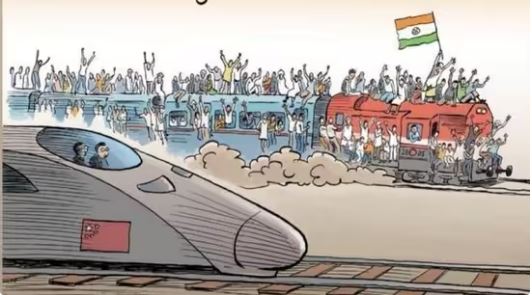
NYT Mangalyaan Cartoon October 2014

The hypocrisy and double standards in peddling news is staggering. A few months back, an unarmed 17-year-old man of North African descent was killed by the police in a Paris suburb, sparking off weeks of violence in the city and across the country. Cut to BBC reporting on the banlieue (suburbs) where the migrant populace stays, “Is the violence the result of poverty and discrimination?” Not quite. “It’s a law and order problem. Gangs and petty criminals use anger over a tragic death to sow mayhem. Their problems have long been recognized by the authorities. But it will not be resolved anyway soon.” BBC Verify also talked about false posts and images about the French riots spreading online. Remember that Brexit happened with a 52%-48% leave vote majorly influenced by images of a wave of immigrants from Africa, the Middle East, and Asia swamping the country. These images were dropped by Putin’s army of social media manipulators sitting in St. Petersburg. Rest assured that the handlers from ISPR (Inter-Services Public Relations Unit of the Pakistani ISI) will be extremely active in fear-mongering and spreading toxic disinformation in India in the run-up to the 2024 election. Insidious versions of Chinese whispers will also pass around.

Sticking to Britain, the extradition of fugitives Nirav Modi & Vijay Mallya will be drummed up by our Opposition bloc as a major election issue. Status – Nirav Modi – his case is said to be ‘statute barred,’ indicating further pending litigation. This after he lost his final appeal in November 2022. The latest about the ‘King of Good Times’ is that he cannot be extradited till a ‘confidential legal issue’ concerning him is resolved. When our MEA tells us that the entire extradition process is tortuous, it is exactly right. No wonder that London is the haven for financial fraudsters and oligarchs.

Recently, liberal France banned the wearing of the Islamic Abaya dress in schools. Check out the reaction from the Western media. Zilch!! Why then the uproar when the erstwhile Karnataka Government talked about standard school uniforms for all. Think about the profound disrespect shown against a Great Religion in Sweden and Denmark in recent months. Shrugged off by the Western media and channels like Fox News as mere ‘freedom of expression.’

Let’s move to Canada. Justin Trudeau openly supported the farmers’ agitation in India, which was confined to 2 States and went on for months in a heavily politicized manner. His vote bank politics led him to interfere in another sovereign country’s internal affairs. The funding for the agitation came from Khalistanis and allies in Canada, the UK, the US, and Australia. Fast Forward. How did the Canadian PM respond to the country-wide transporters’ strike in his nation relating to some Covid regulations? He went missing and underground for a week. He emerged to declare a national emergency (Fact Check – which was the party in power in India when the Khalistan crises came to a boil?).

It is an undeniable fact that the Union and State Governments in India handled the prolonged COVID-19 pandemic challenges more effectively than any advanced nation. Yet papers in the US and Europe showed photos of dead bodies at the Varanasi ghats as Covid deaths, which were being suppressed by the Indian authorities. India supplying vaccines to more than 100 countries also did not receive the media attention it deserved.

Selective Outrage. Remember that the World Health Organisation (WHO) and reputed Western virologists and bio-scientists played PR for Beijing after the Wuhan leak. China is the second-largest funder of WHO, and The Gain of Function Research which resulted in the leak has been a financial bonanza for the scientific community. Likewise, the persecution of over a million Uyghur Muslims in Xinjiang province of China does not raise protests from even Islamic countries. It’s not surprising that our human-rights Comrade activists are quiet.

In the 60’s & 70’s, the KGB infiltrated the top rungs of the Indian government, public service, media, university campuses, and even the Hindi film industry (The Mitrokhin Papers). If not Ideology, Vodka, Money, or a Honey Trap did the trick. Now it is Chinese money that is funding leftist media outlets, some political parties, NGOs, and social influencers. It’s distressing to hear the complete silence from the Opposition parties and this eco-system when China recently released a map claiming Arunachal Pradesh as its territory. All political parties in the Philippines joined together to lambast China’s claims to their part of the South China Sea. A joint US-Philippines naval exercise followed. It is high time that our political parties, irrespective of ideology or political compulsions, do not undermine serious matters of National Security. Remember that ahead of the 2019 election a national political leader after meeting the Chinese Ambassador claimed that the PLA (People’s Liberation Army) had occupied 2400 sq km of Indian territory. Mocking the Indian Army just to take some political potshots.

China’s remarkable growth over the last 3 decades has been propelled by the Communist Party’s absolute dictatorship and State Controlled Capitalism. No dissent is allowed. India as the world’s largest democracy has made a more gradual but definite progress. With the additional internal challenge that some elements in the political domain and media have actively worked to undermine the national interest. Today the bottom line is that India’s growing geo-political clout and economic rise do not sit well with 2 neighbors, some Western countries, and their special interest NGOs and agenda-driven Think Tanks. It is interesting to note that Harvard has received $1 billion from China over the last decade, mainly as gifts. Show me the money. Be prepared for a lot of negative flak from Ivy League intellectuals over the next 10 months.

Cartoon from German Magazine Der Spiegel

In April 2023, a cartoon in the German magazine Der Spiegel depicted an overcrowded Indian train passing a modern Chinese bullet train on a parallel track with only 2 drivers inside. The many passengers on top of the Indian train are holding the tricolor.

‘Everyone is entitled to their own opinion. But they are not entitled to their own facts.’ Daniel P. Moynihan-US Senator and Ambassador to India. The stakes and criticality of the 2024 Lok Sabha election cannot be overstated. Please fact-check. Please don’t get misled. Please see through the clutter and noise. Then please cast your valuable vote. Once the dust has settled and the debris removed we will have our new Government per the mandate and will of the people.

India Positive

Photo by Naveed Ahmed on Unsplash

Rainbow Nation was a phrase coined by Archbishop Desmond Tutu to describe post-apartheid South Africa after the 1994 elections as the country peacefully and remarkably transitioned into a democracy.  This was to bolster the blending of diverse cultures and traditions to create a colorful and vibrant society. India with its huge geography and 140 crores + population defies any such paradigm. Just consider this. 122 languages adding up to 234 including dialects. Hindi is said to be spoken by a major segment of the populace. If you count dialects like Awadhi and Bhojpuri… and even the tapori slang of the Mumbaikars and the Hyderabadi lingo’s twist and flavor. 6 recognized religions (Christianity, Islam) & including 4 great faiths born in India- Hinduism, Sikhism, Buddhism, and Jainism. Add the small Parsee community of Zoroastrian tradition and Jews who sought refuge in India from persecution elsewhere. An ancient civilization that dates back to 6000-7500 years ( historian Tim Dyson).

Today’s India has truly started to churn as a melting pot. This cultural acceptance is being fostered by the job opportunities and economic interdependence of ordinary Indians which has led to mass relocations, which in turn is driving the wheels of commerce. Travel and tourism have led to millions of Indians discovering new sub-cultures and traditions and even taking a liking to their food and apparel habits. INDIA POSITIVE- a story not following the script of the divisive politicians and their acolyte media influencers.     

Food for Thought. Whether the sweet delicacy Rasgulla originated in Puri as an offering to Lord Jagannath or in the State of Bengal does not really matter; as also whether the original recipe of Sambhar can be traced to the royal kitchens of Maratha ruler Sambhaji Maharaj or is a Southern India concoction as considered today. Whether the famous Idli dish originated in Tamil Nadu or Karnataka or as Kedli by the cooks of the Indonesian Hindu kings more than 1000 years ago also does not matter. Today be it Punjabis, Gujaratis and Bengalis are drooling over some delicious variants of the Idli & Sambhar or the Dosa, Uthappam, or Appam. The Rasgulla is a must at large corporate events and weddings as a preferred dessert. The Lucknawi or Hyderabadi servings of the biryani or kebab are hot-sellers across the country. The Chola Bhatura, Aloo Paratha, and Rajma Chawal from up North are the stuff of thousands of Swiggy orders every day down South. The Bengali Doi Maach, Goan, and Kerala fish curries are culinary bestsellers. The very thought of farsan items like the Dhokla Khaman virtually transports us to Gujarat as does Daal-Baati-Churma to Rajasthan.  The delicious Momo –a staple in Leh-Ladakh, Sikkim, and Arunachal Pradesh – has spread its food-print all over.  A visit to Indore is not complete if you do not sample the fare at Chhapan Bhog (the 56 eateries’ food lane) or taste the night offerings at the Sarafa bazaar.

During a recent visit to Chennai, I was struck by the number of Tea Shop chains across the city- Chai Kings, Chai Waala, and Chai Galli. Although the aroma of filter coffee still fills the metropolis the young Chennai crowd is having their sips of the other beverage also. A young woman from Chattisgarh was attending the order desk and language was hardly a barrier in handling local customers and the delivery boys. At one such crowded joint, I noticed the ubiquitous Mumbai fast food Vada Pav selling like hot cakes.

During a 2-day hotel stay in Chennai, I learned that the Supervisor and the entire Housekeeping staff were from Tripura. Disciplined, polite, and making an honest living a long way away from home. At a reputed South Indian restaurant chain, the entire waiter service staff was from Bihar and spoke the Maithili dialect. One of them told me that he had been working for them for the last 5 years and that he and his buddies were decently looked after.  Other than the specialities the restaurant is known for they had expanded the Menu items to Naan, Paneer Kulcha, and Rajma Chawal. For me, Chennai is the Bellwether of cultural shift and change.

More than 13 million domestic tourists have visited the Kashmir valley this year with 3 months of the season still to go. The hotels and guest houses are full as are the cabs, buses, and Shikaras.  Some of my friends who have returned after a memorable vacation are not just full of the beautiful scenery but also about the warm hospitality from the locals. Travel is good education. It changes perspectives and dismisses prejudices. The North East is now firmly on the Indian traveler’s map and as I have been there multiple times it is an experience to cherish. The backwaters of Kerala, the coffee hills of Coorg, the beaches of Goa and Puducherry, the wildlife sanctuaries, and the tranquil spots of Himachal and Uttarakhand are already attracting hordes. The less visited spots of the tribal hills of Araku (Andhra Pradesh) or the lush forests, icy lakes, and monasteries of Sikkim will soon turn into attractive tourist destinations. Odisha will not remain “ India’s best-kept secret’ for long and with the Governments of Rajasthan, Madhya Pradesh, and Gujarat putting their weight behind scaling up the tourism economy good times are ahead for the tent stay in the Rann of Kutch, the Jaisalmer desert festival and the Kanha Tiger Reserve Park. The younger generation is on the move and they are seeing and finding the Real India. Their passion for long trips by car or bike and for trekking and adventure sports is a good omen.

When one does the ‘Matha Tekna’ at the Golden Temple in Amritsar one is bowing down to show respect to the message of the Gurbani. Then there is the heart-warming concept of the Langar. In Sikhism, the Langar is the community kitchen of the Gurudwara which serves free meals to all irrespective of caste, creed, gender, or economic status. During the Covid lockdown, the Langar was God sent for lakhs of migrant workers and the jobless and the destitute. Putting a Chadar at the Ajmer Sharif Dargah is on the wish list of millions of Indians cutting across faiths.  The Sufi saint and philosopher Moinuddin Chisti is celebrated in the A R Rahman song,’ Khwaja Mere Khwaja’ in the 2008 film ‘ Jodha Akbar’.  The Sai Baba temple at Shirdi attracts millions of devotees every year and is second only to the multitudes that pay respects at the Lord Balaji temple at Tirupati. Just imagine the seismic effects when the Ayodhya temple of Shri Ram is opened to the public. Crores of faithful will line up for darshan. But it will also do wonders for the local and neighborhood economy and will serve the Greater Good. The Buddhist and Jain circuits in Bihar are testimony to India’s rich spiritual heritage. A look at the beautiful paintings at the Jain temple in Mount Abu or the pristine sculpture work at the Meenakshi temple in Madurai gives us a glimpse of who we are as a people. The St Thomas Church in Palayoor Kerala is believed to have been established by the Saint himself as far back as 52AD. The celebration of Merry Christmas in India is not confined to the lighted-up and decorated churches and the Midnight Mass. That Santa Claus caps and little glittering Christmas trees are sold at the city traffic lights a week before the Big Day speaks of the festive spirit which has taken over.

The Soft Power of Indian films, music, and dance has reverberated across Asia, Africa, the Middle East, South America, and Europe and is now making waves in North America. Dangal has been a huge blockbuster in China. The ‘Naatu Naatu’ dance sequence from RRR has captivated the world. But now in India Bollywood no longer rules the roost. Bahubali 1 & Bahubali 2 did huge business in the original Telugu and other South Indian languages but the Hindi dubbed versions broke all box-office records. Paving the way for the big success of Pushpa & RRR (Telugu) & KGF & Kantara (Kannada) in the Hindi heartlands.  Southern stars like Yash, Prabhas & Vijay Deverakonda are now well accepted and applauded by Hindi film audiences. So much so that many Bollywood biggies do not release their films when a mega South film is about to hit the cinema theatres. The Covid lockdown and the streaming channels also have played a big role in the breakdown of these regional film barriers. Audience tastes are now conditioned to the quality content and performances from Malayalam, Tamil, Bengali, and Marathi films.  Tumbbad is a stellar example of a classic Marathi movie. Vijay Sethupathi (Tamil) and Fahadh Faasil (Malayalam) have developed a fan following of their own beyond South India. I was not surprised when on a trip to Kochi I saw a corporate gathering at a hotel grooving to the beats of ‘Zingaat’ (Sairat, a Marathi blockbuster). Nor was I surprised when I saw baraatis at a traditional Maharashtrian wedding in Pune doing the rousing Bhangra. People are now opening up to other cultural influences.

 Rabindra Sangeet strikes a popular chord much beyond Bengal with its distinctive rendition whilst singing. But the music is a fusion of Bengali folk music, Carnatic music, Hindustani classical music, and the occasional Western note. Gurudev Rabindranath Tagore created a pan India scores much before Independence. More than 100 years later we are still understanding the notes.

For the last 2 decades, many of India’s top cricketers have come from India’s smaller towns. Dhoni (Ranchi), Jadeja (Jamnagar), Shami (Saharpur-UP), and Bhuvaneshwar Kumar (Meerut) to name a few. India’s most popular sport is no longer about the metros. And for the fervent fan of the Men in Blue, it does not matter if the winning runs are scored by Kohli, Gill, or Sanju Samson or if Mohd Siraj or Ashwin wins the match with the ball. That a man from Jharkhand is anointed as Thala (Leader) by the Chennai Super Kings fans and is embraced as one of their own is a potent, emotional story. Mr. Naveen Patnaik’s Odisha government sponsoring and supporting both the men’s and women’s hockey teams has resonated well with sports buffs across India.  These impactful undercurrents are not restricted to big sports. A Pro Kabbadi League (an indigenous sport with the scent of our desi soil) was launched in 2014 and attracts full stadiums and a good viewership on Star Sports. It has brought into prominence Indian stars like Maninder Singh from Dasuya, Punjab; Nitin Tomar from Malakpur in UP; Kashiling Adake from Sangli, Maharashtra. Plus professionals from countries like Iran & South Korea. Times are changing.

The gender barrier is falling on all fronts. Sticking to the sports narrative we have medal-winning woman wrestlers from conservative Haryana. Mary Kom (Boxer- Manipur) & Deepika Kumari (Archer from Jharkhand) who both have tribal backgrounds are now pan-India sporting ICONS. Mary Kom has had a successful Bollywood film made about her life and achievements. PV Sindhu & Saina Nehwal (Badminton) and Sania Mirza (Tennis) are household names and brand ambassadors for many products and services. Earlier this year the lucrative and glamorous Indian Premier League for women’s cricket was launched and the first season had good audiences and good TV ratings. Some of the Indian women cricketers are already celebrities on social media.  Top women corporate and business leaders are no longer outliers; many successful start-ups are being driven by women entrepreneurs. It’s still a work in progress but with the tipping point in the not-too-distant future.

In a sense, this can be seen as the quiet confluence of India’s mighty rivers, criss-crossing across our vast land. The Brahmaputra, the Ganga, the Indus, the Narmada, the Godavari, the Tapti, the Krishna, and the Cauvery and their tributaries flow into and merge into the other with the mythical and hidden Saraswati beneath the surface. A myriad of sub-cultures reach out to understand, appreciate, and live with each other. This is not wishful thinking, being naïve, or misplaced idealism. The story of India Positive-around the Idea of India-is not making any headlines but has started happening. It is gradually enriching and reinforcing the national ethos. Just let people be.

The Inspiring Story of Rashid Khan

Rashid Khan celebrating a wicket in his signature ‘airplane’ celebration

Afghanistan and Cricket!!  1935. Abdul Aziz Durani catches the eye of the Jamsaheb of Nawanagar with his wicket-keeping skills. He offers him a job as a sub-inspector and the Afghan family moves to Jamnagar with their one-year-old son born near the Khyber Pass in Afghanistan.  Salim Durani grows up to be the flamboyant Indian Test cricketer known for his big sixes.  He was born before his time. He would have taken to T20 cricket and the IPL like a duck to water. Sadly the great all-rounder passed away this April and the tributes and obituaries all highlighted his Afghan lineage.

In the 2019 ICC World Cup, the Afghanistan cricket team went winless in all 9 matches. But such is the soft power of sports and cricket that there were no bomb blasts or attacks on the day of the matches in the troubled nation.

Today the 24-year-old Rashid Khan is Afghanistan’s first global sporting superstar and cricketing icon. Born in eastern Afghanistan his family fled to Peshawar during some turbulent years of the Afghan war and even lived in the refugee camps. This is where the young boy picked up the game of cricket. After their return to their homeland, he continued to play the game but mostly with his 6 brothers. It was not till 2014 that Rashid who fancied himself as an opening batsman converted into a spin bowler. He taught himself through endless hours bowling on the concrete passageways, and then fields, and in the nets, in a country that had just become an affiliate member of the ICC when he was born. Today- the Afghan hero, IPL millionaire, and T20 smash hit- the Rashid Khan story is celebrated and savored by all cricket lovers.

Just 17, he made his debut for Afghanistan on the Zimbabwe cricket tour in October 2015. Just 2 years later he was picked up by SunRisers Hyderabad for $600,000 at the IPL auction. He then picked up franchise deals with the Guyana Amazon Warriors and helped the Adelaide Strikers to win their first BBL (Big Bash) title in 2018. He then also played in the PSL for the Quetta Gladiators and the Lahore Qalandars. Rashid Khan, without exaggeration, is the busiest cricketer in the world and a globe-trotter. He is invariably amongst the top wish-list of teams in big cricket leagues around the world. In 370 T20 matches, he has taken 500 wickets with an economy rate of 6.33, and sustaining these numbers across years, various leagues and oppositions, and playing conditions have been a remarkable achievement.  Many cricket pundits rate him as the best T20 bowler of all time.

 5 seasons with the Sunrisers in the IPL had led to a wicket haul of 93 wickets with an economy rate of 6.3. With the Gujarat Titans in 2022- 19 wickets and the IPL trophy. In 2023, 27 wickets and a loss in the finals to CSK. Listen to another great spinner Harbhajan Singh on Sports Today, “Rashid Khan is a great player from a different league.  He is picking up wickets in heaps, he is scoring runs, he is a gifted fielder, and he led GT whenever Captain Hardik was not available. He has done everything and excelled. GT is exceptionally lucky to have a player like Rashid Khan in their ranks.”

What is it that makes him such a great bowler? L Sivaramakrishnan has this to say, “He is an unorthodox leg-spinner. His arm action is so quick that he has to release the ball at the right moment. He is very accurate. His grip doesn’t change much for leg spin and googly. Because his grip is more like an off-spinner with a big gap between the index finger and middle finger, it allows him to bowl a better googly.”

Rashid himself said in an interview that he usually bowls between 90-91 kmph. That extra 5-6 kmph above the normal spinners is what harries the batter. ‘’Opposition batsman may know what is coming- they are just not sure what to do” (Wisden Cricket Monthly).  Ravi Bopana has acutely observed, “You can’t pick him from the hand. If you pick him from the pitch by the time you have worked out which way it’s going to turn it is too late for playing the big shot. You nudge him around. Finally, you try to take him down in the last over. That’s when he bags a couple of more wickets.”

Like most other world-class spinners more than half of his deliveries are on the good length and most of the remainder are just short of a good length. The batters don’t reach the pitch of the ball and the speed ensures that they don’t have time for the cut or the pull. His speed through the air is modeled on his idol Shahid Afridi while maintaining a stump-to-stump line.  Rashid’s biggest weapon and mind-game ploy is the lethally accurate googly and he has multiple variations in his arsenal. In the T20 format, the most effective method of dismissals is to control the runs and force the batter to take more risks. Rashid Khan knows how to keep the pressure lid on.

This self-taught genius has picked up some bowling tips from watching his idols Afridi and Anil Kumble on TV and video. But take a peek into the sheer dedication of the man- “I place bottle tops at different spots on the pitch and I bowl until I hit each one. It doesn’t matter how long it takes-1hr, 2hrs, 3 hrs, or only 5-6 balls. I have to hit every one of the bottle tops.” Is it surprising that he has airbrushed many a middling total to a match-winning one for his team?

Plus his ingrained discipline. In the 2017 IPL, he was given to eating unhealthy foods like biryani, bread, and sweets. He quickly made the switch to barbecues or grilled food with lots of salad. This has given him the fitness and strength to take on his punishing cricketing schedule. It has given him that extra energy to consistently bowl at 90+kmph and even touch 99-100 kmph at times. He has sheepishly confessed that he cheats for one meal a month; also that he is unable to eat if he does not do his regular workout.

In 2017, ICC declared him as the T20 Associated Player of the Year. His 96 T20 wickets in 2018 inspired the headline-‘Prodigy to Superstar’ (Wisden Cricket Almanac). Then, Rashid Khan was lauded as the ICC T20 player of the decade. Just before the ICC  T20 World Cup cricket legends like Ricky Ponting, Mark Waugh, and Mahela Jayawardene picked him amongst their top 5 players across teams. Yet, the young Afghan yearns to be the MVP (Most Valuable Player) in an IPL season.

There is more to him than just being a champion spinner. With the bat, he is capable of clearing the ropes in the slog overs. Over the years he has evolved into an extravagant, destructive lower-order batsman.  In his early teens, he had dreamt of being an opening batsman like his idol Sachin Tendulkar. As a fielder also he has been agile and focused, giving his all for the team.

In the history of IPL in India the most popular foreign players have been AB de Villiers and Chris Gayle. Rashid Khan has now been embraced by Indian cricket fans as one of their own.  What adds to the aura of this young cricketer is his grounded approach; his close-knit family life with his 10 siblings and their families; the regular requests from his nephews and nieces that he shows them his ‘airplane celebration’ after taking a wicket; how his parents have taught him how to handle success and fame. As he himself puts it, “Money doesn’t give you good fame, good personality, good image. The only thing that gives you that is being humble. Being kind to everyone. Also if a fan asks for a photo and I ignore it, I don’t think I will be able to sleep. I never want to hurt someone’s feelings.” Small wonder that the spin maestro is so warmly welcomed by fans around the world.

Rashid Khan gives a lot of credit to his SunRisers Hyderabad mentor VVS Laxman and Captain Kane Williamson for keeping him calm, positive, and focused. Referring to the latter he has said that he put his arms around my shoulder, “You just need to enjoy and keep smiling. That’s the only thing I want from you.  Doesn’t matter whatever the result at the end but I want you to be smiling on the ground.”

His former national team captain Asghar Afghan has this to say, “The one special thing about Rashid is that whenever Afghanistan wins any match, the dinner is on him. Everyone gathers in his room and all expenses are borne by him. He really has a very big heart. Irrespective of whether he has performed or not if we win he takes the initiative for treating us to dinner. Even the 12th man of our team prays that we win so that Rashid can treat us to dinner.”

The cricketing superstar is just 24 years old. His full name is Rashid Khan Arman. Arman is the male Persian name for ‘Wish’ and ‘Hope.’ In Turkish and Armenian it also means ‘God’s Man’.

Own Goals which have cost India dearly

Over the last 75 years, India’s standing and development have been heavily compromised by statecraft blunders, misplaced ideology, prejudices and biases and lack of vision from our top political netas and a compliant babudom.  They have shown a flair for scoring own goals in the fields of geopolitics and national security. They have also undermined national welfare and governance in the single-minded pursuit of power at any cost. Some of our most esteemed leaders have let the nation down through short-sighted policies and actions and even more so through sheer inaction.

Let’s put the Kashmir problem in context. In 1946 Sheikh Abdullah raised the call of ‘Quit Kashmir’  to get rid of the Dogra rulers. Mr Nehru rushed to support his friend and Raja Hari Singh stopped him at the border. The Nehruvian ego cost India dearly as subsequent events proved. In July and Sept 1947, Raja Hari Singh approached the Indian leadership for accession to the Dominion of India. Nehruji declined. He wanted Sheikh Abdullah to first take charge of a provisional government and accession would come later. National interest, logic and common sense dictated that he accept Kashmir’s accession to the Indian Union, forever shut the door on any Pakistani plans and then go for the change in administration. His intransigent position still haunts us after more than 7 decades. Pakistan took advantage and invaded Kashmir occupying a large portion of it and the State became a disputed territory. The Instrument of Accession was finally signed on the 27th Oct 1947. All the tragic events which have panned out since have been a corollary to this original sin.

Worse was to come. On the 2nd Nov 1947 PM Nehru announced that the fate of Kashmir would ultimately be decided by the people through a referendum held under the auspices of the United Nations. So the Kashmir problem was internationalised by our own Prime Minister. To aggravate matters further Article 370 came into force in 1954 with the Agreement of the State Constituent Assembly- basically granting local authority to the State of J&K. Article 370 was a temporary provision with its applicability to last until the formulation of the State Constitution.  However, the State Constitution dissolved itself without recommending the abrogation or amendment of Article 370. The huge benefits of this special provision and the Union Government’s generous funding accrued to Nehruji’s dost Sheikh Abdullah’s family and the family of Mufti Mohammad Sayeed. Shockingly, some terrorists and separatist leaders sponsored by Pakistan enjoyed a luxurious lifestyle in the Valley with security also provided by the Indian government. Finally, on the 5th Aug 2019, the pernicious Article 370 was abrogated.

In the 1950’s, PM Nehru rejected Nepal King Tribhuvan Bir Bikram Shah’s offer that the Himalayan kingdom become part of the Union of India (The Presidential Years- Pranab Mukherjee). The same is also detailed on the Shodhganga website. Nehruji rejected the offer on the grounds that Nepal was a free country and should remain so. The late President has commented in his book that ‘had Indira Gandhi been in Nehru’s place she would probably have seized the opportunity as she did with Sikkim.’

On the 5th of May 2018 (Karl Marx’s birthday)Mr Sitaram Yechury celebrated the merger of the Communist Party of Nepal (Marxist-Leninist) and the Communist Party of Nepal (Maoist) as a transition from a once-Hindu kingdom to a Republic.  Since 2006 the Indian Comrade had become a mentor to this nation’s tryst with Communism. Cut to 2023. India faces an imperialistic China with humungous influence in Nepal. At times it does seem that our Comrade General Secretaries sit in Delhi. Their Chairman sits in Beijing.

Then there is the curious case of India being offered a permanent seat in the UN Security Council in the 1950s. In 2023, it remains one of the country’s top diplomatic objectives considering the chaotic geopolitical situation. A seat at the table should be reserved for the world’s largest democracy, the 5th biggest economy, an established nuclear and military power plus a Soft Power in its own right.  The Great Wall of China is the barrier. Even left-wing media in India have acknowledged that in August 1950 as the Cold War gained momentum, America dangled the bait for a permanent seat at the UNSC. There was more to come. Servapalli Gopal’s biography of Nehru (1979) specifically mentions that ‘he (Nehru) rejected the Soviet offer in 1954 to propose India as the sixth permanent member of the Security Council and insisted that priority be given to China’s admission to the august group.’ Please note that the historian was the son of President Radhakrishnan, a close friend of the Prime Minister. Further, a detailed exchange between Nikolai Bulganin and Nehruji on this subject is part of another Nehruvian scholar’s book- AG Noorani’s ‘Selected Works of Jawaharlal Nehru’ (2002).  Some Congress leaders and intellectuals have dismissed this as baseless rumours and a conspiracy theory of the BJP. The Hindi-Chini bhai-bhai bonhomie was rudely jolted by the Chinese invasion in October 1962 resulting in the loss of Aksai Chin territory in Eastern Ladakh. This humiliating loss is detailed in Brig John Dalvi’s ‘Himalayan Blunder’. The helplessness and shock displayed by the PM and his close acolyte, Defence Minister Krishna Menon. The outdated rifles of the Indian army and even the lack of warm clothing. Today, China has its eyes on Arunachal Pradesh.

In 2017, 2018, and 2019 the PM in waiting Rahul Gandhi met the Chinese Ambassador multiple times. He publicly announced that India had lost hundreds of square km to the Chinese without a fight.  Shameful!!. A disparaging remark by a national party leader for the Indian Army just to score some political points. But flashback to 1962. His grandfather had done exactly that. Foreign intelligence agencies reported that in a few clashes in recent years, the PLA had retreated with a bruised nose. The latest is that the Chinese are reinforcing their border forces with Han-Tibetan soldiers.

The Vodka Biryani brigade, which drives the ‘Aman ki Aasha’ narrative should get a reality check done. China and Pakistan are hostile neighbours. Period.  Check out what happened after the PM Atalji Vajpayee- PM Nawaz Sharif Lahore peace declaration in early 1999. KARGIL!!.

In the late 1970s, Mrs Indira Gandhi’s Congress attempted to co-opt Bhindranwale in a bid to split the Sikh votes and weaken the Akali Dal- its chief rival in Punjab. For starters, Congress supported his candidates in the 1978 SGPC election. Mr Sanjay Gandhi and Giani Zail Singh are credited with transforming an obscure preacher into a Frankenstein monster. The rest is history leading to Operation Blue Star.  Followed by the shocking assassination of PM Mrs Indira Gandhi. Then the genocide of thousands of innocent Sikhs with Congress leaders inciting the mobs and goons. Even 40 years later justice has not been done. Connect the dots to the well-orchestrated Khalistan rallies in Canada, the UK, the USA and Australia. Follow the money to the funders of the farmers’ agitation.

The implementation of the Uniform Civil Code (UCC) is a hotly debated topic today amidst the Amrut Mahotsav of Azaadi. Countries with large Muslim populations like Indonesia and Bangladesh have adopted the same. UCC has been practised for decades in Goa and Puducherry. Dr Ambedkar tried to reform Indian society by recommending the UCC.  It just ended up as an article of the Directive Principles stipulating that ‘the State shall endeavour to secure for the citizen a uniform civil code throughout the territory of India.’ The recommendation remained a dead letter because Muslims took a hard line on their personal law. There was also a pushback from traditional Hindus who were opposed to reforms of Hindu practices like inheritance, marriage and divorce and adoption. But the next few decades did see codification and reforms of the Hindu code as also the practices of Sikhs, Jains and Buddhists.

In 1985 the Shah Bano case became the litmus test for the progressive Rajiv Gandhi government. A 73-year-old woman was divorced through Triple Talaq and denied regular maintenance under Muslim Personal Law. The Supreme Court ruled in favour of Shah Bano (Section 125 of All India Criminal Code) pertaining to the maintenance of wives, children and parents irrespective of religion.  The Congress Government with 400+ Lok Sabha seats capitulated to vote bank politics and appeasement. In 1986 the Muslim Women (Protection of Rights of Divorce) Act was passed making Section 125 inapplicable to Muslim women and verily overturning the Supreme Court decree. Alimony or maintenance was deemed payable only for 90 days after divorce.

In October 1993, the Vohra Committee submitted its 100-page report which has never seen the light of the day. The Home Ministry now claims that it has been misplaced. It is said to have explosive revelations of the cosy relationship between senior Maharashtra ministers and politicians, Mumbai crime branch officials and primarily the D Company of Dawood Ibrahim and some other underworld figures. The Netflix serial ‘Scoop’ tangentially refers to this in a 2011 time frame. If only the Vohra Committee report had been discussed responsibly in the public and national interest.  The needle moves to 25 years later and the sordid saga of the MVA government in Maharashtra with its Home Minister in jail, an absconding Commissioner of Police and a reinstated sub-inspector- who had easy access to both- running an extortion racket targeting bars, dance clubs and restaurants. Truth be told, the Congress playbook with its winnability formula for elections- money, muscle, caste and creed have wholly been embraced across the political spectrum including by the BJP. So we have 233 elected MPs in the current Lok Sabha with criminal charges; 65% of sitting Kerala MLAs with criminal records with 21% in ‘the serious category’; and the BJP leading with 37% criminally tainted representatives in the UP Vidhan Sabha.

It is said that a fish rots from the head down. Independent India’s first official scam was the Jeep scam. In 1948, Krishna Menon, High Commissioner to the UK bypassed protocols and ordered 2000 refurbished jeeps for military use from an unknown foreign company. A substantial amount then of Rs 80 lakhs was paid upfront.  155 jeeps were delivered but did not pass the Defence Ministry tests. PM Nehru’s patronage ensured that even judicial enquiries were dropped in 1955. In Jan 1956 Menon was inducted into the Council of Ministers and continued till he met an inglorious end as Defence Minister in the disastrous Indo-China war of 1962. Those were supposed to be idealistic and patriotic times with memories of the freedom struggle still fresh. The Scourge of corruption was unleashed and has now become synonymous with India; gnawing like termites at the vitals of the nation and hurting the poor and needy and the middle class the most.

Jaichand and Mir Jafar are not confined to our history books. In 2008, India Today presented the Youth Icon Award to the mass killer and Kashmiri terrorist Yasin Malik.  He was cheered on by the Vodka Biryani brigade in full strength. The trophy was handed over by a well-known Harvard-educated industrialist. In 2002, Malik had laughingly admitted to the killings of a Judge, some unarmed IAF personnel and some innocent bystanders in a BBC Hard Talk interview. Not surprising, what?! Consider which self-respecting government would have done absolutely nothing after the persecution and forced exodus of half a million Kashmiri Pandits from 1990 onwards. Just 2 years after 26/11 we had Digvijay Singh, Mahesh Bhatt and Zakir Naik on the stage for the release of the book- ‘26/11 an RSS conspiracy. Disgusting!!!  Several Congress and Opposition leaders were in denial after the Balakot surgical strike against Pakistan. Can’t blame them, what? It’s totally beyond their comprehension. But more seriously, this is the reason India is seen as this soft, fractious and easy to lecture to and meddle with country. Even national security matters have become political football.

The majority governments of PM Nehru, Smt Indira Gandhi and Mr Rajiv Gandhi faltered and messed up in vital areas and the side-effects are still being felt. PM Modiji in his second term and with a majority in both the Houses also does not seem to be focused on urgent structural reforms. Possibly his own BJP Parliamentarians, Legislators and Corporators are the nay-sayers who defend the toxic status quo. The Supreme Court in 2006 in a landmark judgement had directed the Centre and State Governments to bring in urgently needed police reforms on a PIL filed by a retired senior police officer. Road maps on the way forward were already in place. Zilch!! (meaning nothing.)The 33% reservation of seats for women in the Lok Sabha and State Assemblies was first proposed in 1996 and was also part of the BJP election manifesto. The Sound of Silence!!! A well-thought-through election finance bill on the lines of the French model to curb black money has never been on the table.  To borrow some lines from Bob Dylan’s famous protest song- ‘The answer my friend… Blowin’ in the Wind.’

 So it seems that in 2047, 100 years since independence, India will remain a work in progress. The country may make huge strides as a major economy, in technology and defence innovation and in global geopolitics. However, in key areas which directly influence governance and the greater good we may still languish behind as a developing nation. Courtesy of the reluctance of our tall political leaders to go the whole hog in cleaning up, revamping and reinforcing the entire edifice of the country’s public institutions and support systems.

Over the last 2 decades, a galaxy of stars of Indian spirit and origin has sparkled brightly in the space of business, technology, culture and entertainment. Is this destined to be India’s century- with India leading the comity of nations?!