
Notes & Records of some Iconic Hindi Film Songs

The Golden Age of Hindi Film Music is considered to be the period from the 1950s to the 1970s. Song and dance were always considered to be a part of Indian Nautanki and drama and became an integral part of the narrative structure of popular Indian cinema. By the 1970s, Hindi film songs had reached out to a humongous audience across India but were also resonating in Asia, Africa, Russia, and Eastern Europe. This amazing era was defined by the exceptional creativity, talent, passion, and innovation of not only the Musical Trinity of Iconic Singers, Composers, and Lyricists; song and music also flourished because it was exquisitely imagined and projected by visionary filmmakers and directors.

Flashback to ‘Shree 420’ (1955). ‘Ramaiya Vastavaiya’ sung by Lata Mangeshkar, Mohammad Rafi and the voice of Showman Raj Kapoor- Mukesh. RK’s music team – Shankar Jaikishan, Hasrat Jaipuri, and Shailendra frequented Khandala to compose music for his films. They used to stop at a roadside hotel run by a Telugu guy Ramaiah for tea and snacks. Shankar, who was conversant in Telugu, placed the orders. One time around there was a delay in service and Shankar started humming  ‘Ramaiya Vastavaiya’ – calling Ramaiah to come quickly. His partner Jaikishan started drumming on the table. Shailendra piped in with ‘Maine dil tujko diya’ – indicating that all 4 were waiting for Ramaiah. As they hummed the lines they felt that this could be a song. Raj Kapoor liked the idea and created a street situation for the song and the lyrics were written keeping these lines intact. The original Telugu words were retained even though the Hindi audience could not understand its meaning. The song became a chartbuster.

Lata Mangeshkar sang the ‘Pyar Kiya to Darna Kya’ song for recording at 3 different locations. Mughal-e-Azam was released in 1960 and had been a few years in the making. “There was no technology to create’ the echo effect’,” writes Srishti Magan in an article for the magazine Bollywood probably alluding to a grand palace setting. “The only way out was to record the song at different places and overlap the recording. ” This was achieved to splendid effect by music-director Naushad and Lata Mangeshkar.

OP Nayyar (OP) is lauded as ‘The Rhythm King’.  His music had a robustness and rhythm; his songs were bewitching and easy on the ears. He brought the folk and modern together in perfect harmony. But the OP name is associated with the melodious use of Western instruments like the guitar, accordion, claret, cello, and piano. Author Ajay Mankotia reveals surprising facts through his meetings with and articles on this maverick composer. He changed the rules of Hindi film music. Please listen to ‘Yeh Kya Kar Dale Tune’ from ‘Howrah Bridge’ (1958) and ‘Ankhaon hi ankhon mein ishaara ho gaya’ from ‘CID’ (1958). He brought the Sarangi out of its limited role- either in kothas or as a mournful accompaniment to melancholic songs. He transformed it into an upbeat musical instrument. He gave it a feel-good melody and a fast pace. “The poor Sarangi was joyfully released from typecasting.”

Take the Santoor. The beat allotted to it by music directors was gentle. OP Nayyar used it as a fast-flowing brook- soft but more insistent in the prelude to ‘Jayenge Aap Kahan Jayenge’ from ‘Mere Sanam’ (1965). Never had been the santoor used like this. Shades of fusion music in the 1990s brought forth by the upbeat rhythm of traditional Indian musical instruments. Take ‘Yeh Haseen dard de do’ from ‘Humsaya’ (1968). For the song an accomplished tabla player would provide a beat pattern that would be simple and linear. OP’s beat patterns are complex yet riveting. The beat patterns certainly shook up the music aficionados of the time.

In an episode of KBC, Big B revealed that the exuberant yell “Yahoo!” in the song ‘Chahe Mujhe Junglee Kahe’  from ‘Junglee’ (1961) was recorded by writer Prayag Raj who happened to be in the studio and not by the singer Rafisaab. Later in Amitabh Bachchan’s own ‘Coolie’ (1983) Prayag Raj provided vocalization by shouting “Allah Rakha” in a song. The ‘Yahoo’ song picturized on the ‘Rebel Star’ Shammi Kapoor is considered a turning point in Hindi cinema. It solidified his image as an untamed screen presence, an unshackled freedom-seeking soul. Much akin to contemporaries Elvis Presley and James Dean. The singer in a later interview commented that he sang this exuberant song on a high scale whilst visualising the persona of the rocking Shammi Kapoor. In his foreword to the biography ‘Mohammad Rafi- Golden Voice of the Silver Screen’ by Sujata Dev, Dilip Kumar writes, “With Rafisaab it was a mystical bonding.  As if he was part of me when he sang for me without being told how I would perform the song during the filming of the sequence.” Think also of Kishore Kumar. His years as an actor helped him to project his voice to captivatingly express the emotions of other actors.

A musical giant Salil Chowdury or Salilda, enriched us with his music over 5 decades. From Bengali to Hindi films, Malayalam, Tamil, Telugu, Gujarati, Marathi, Assamese and Odia films. Agnivo Niyogi when writing for the Telegraph mentions quite a few Bengali masterpieces introduced to Hindi audiences. We check out some of these compositions of Salilda which are memorable both in Hindi and Bengali. “The wistful melody ‘Na Jaane Kyun’ from ‘Chhoti Si Baat’ (1976) set to Yogesh’s words and brought to life by Lata Mangeshkar was a recreation of his Bengali song  ‘Pagol Hawa’ which Jaitleshwar Mukhopadhyay sang with great finesse. ‘O Sajana Barkha Bahaar Aayee’  from Bimal Roy’s 1960 classic ‘Parakh’ is another gem from the composer-singer duo of Salilda and Lata Mangeshkar. The latter also sang the Bengali version, ‘Na Jeo Na’. ‘Kahin Door Jab Din Dhal Jaye’ from ‘Anand’ (1971) captures the melancholy of a terminally ill cancer patient who is watching his life slip by. Penned by Yogesh the heartfelt lyrics as rendered by Mukesh touches our hearts. The original Bengali version ‘Amay Proshna Kore Neel Dhrubo Tara’ in Hemant Kumar’s deep, rich voice has etched its place in the annals of Bengali music.”

‘Ek Chatur Naar’ one of the most loved songs from the1968 laugh-riot ‘Padosan’ was actually made up of 3 different songs. A puzzle perfected by bits and pieces brought in by the versatile Kishore Kumar. As composed by RD Burman it was a combination of Carnatic and Hindustani classical music. Manna Dey, a trained classical singer rendered the Carnatic part whilst self-taught Kishore da sang the Hindustani counterpart.  The Alaap ‘Ek Chatur Naar Karke Shringar’ was taken from Ashok Kumar’s original version in ‘Jhoole’ (1941). The tune used in ‘Sant Tulsidas’ (1939) song  ‘Ban Chale Ram Raghuram’ was adapted as ‘Are Dekhi Teri Chaturai.’ The tune used in ‘Chanda Re Jaa Re Jaa Re’ sung by Lata Mangeshkar  ‘ Ziddi’ (1948) was the final piece of the puzzle, ‘Kaale Re Jaa Re Jaa Re Are Nale Mein Jake Tu Munh Dhoke Aa.’  The famous reel battle remains as humorous and entertaining as it was 55 years ago. Rajendra Krishan’s lyrical fluidity, RD Burman’s creative mastery, the class of Manna Dey, and the genius of Kishore Kumar all contributed to the timeless track we have today. The humorous on-screen presentation by Sunil Dutt, Mehmood, and Kishore da himself remains till today as a favorite repeat watch for movie buffs, Manna Dey in his interviews has mentioned his fond memories of the making of this crazy, rollicking duet. The rehearsal over 8 days and good food at each other’s house. The final recording in 2 phases. Manna Dey in his interviews admiringly speaks about the mad-cap genius of Kishore and his improvisations which made the song into a cult classic.

Indian Railways is a recurring character in countless Hindi songs of that era. Shakti Samanta’s 1969 romantic drama ‘Aradhana’  gave Hindi cinema an evergreen romantic song in ‘Mere Sapnon Ki Rani’.  The filmmaker’s son Ashim Samanta recounts what went into the making of the iconic song. The number was to introduce the lead pair of Rajesh Khanna and Sharmila Tagore. The song was visualized with the hero driving a jeep through a scenic hill station whilst the heroine is sitting in a slow-moving passing train. The Bagdogra to Darjeeling toy train route was selected for the song. But just a few days before the actual shoot, Sharmila Tagore informed the director that she had already allotted the dates for a Satyajit Ray film. The filmmaker was livid but she convinced him to go ahead with the scheduled shoot without her. As the hero proposes to her in the song the heroine is seen sitting in the train trying to read a novel and sneaking glances at the Romeo. Whilst watching the film it seems that it was all shot at the same Darjeeling location. In reality, it had to be re-shot on a set at Nataraj Studios, Bombay. Art Director Shanti Das recreated a set to match the toy train compartment. The scenes were edited and interspersed so seamlessly to seem one with the outdoor location shoot. Another important reveal is that all the songs were supposed to be sung by Mohammad Rafi. As he was on a 3-month world tour, Sachin Dev Burman and Shakti Samanta brought in Kishore Kumar. The rest is history.

‘Khaike Paan Banarasiwala’ became the USP for the 1978 hit film ‘Don.’ The lyrics were written by Anjaan for a Dev Anand film ‘Banarasi Babu’ (1973). Kalyanji-Anandji (KA) were the music directors for both the films. However, the star disliked it as it did not go with his urbane, debonair image and hence it went into the KA song bank. After the completion of the rushes, ‘Don’s’ director Chandra Barot screened the film for his mentor Manoj Kumar. He was advised that the film script was going too fast and that a song be introduced post-interval to give the audience a breather. Hence, the famous song picturized on Amitabh Bachchan, where he was inspired by some of Bhagwan Dada’s dance moves a la ‘Albela’. Kishore Kumar agreed to sing the song after much persuasion by the music director duo but insisted that he would only give one take. He asked for a paan at the studio, and chewed the paan, and also spat it during the recording. Please check out the song again to get the real feel and flavor of it again. These incidents were recounted in the radio show Suhana Safar with Annu Kapoor’.

In a Facebook video, Asha Bhosle recalls the recording of the song ‘Inteha Ho gayi Intezar Ki’ when Kishore Kumar sang the song whilst lying on a table. This superhit song featured in Prakash Mehra’s film ‘Sharabi’ (1984) with the camera panning on Big B and another top heroine from the South, Jaya Prada. Anjaan captured the mood of the song in his lyrics which was composed by Kishoreda’s nephew, Bappi Lahiri. The singer decided that he would sing the song lying down as a fallen drunkard. A teetotaller, the artist in him decided to reach the high by lying down flat.

During her last concert tour to Britain in 2016, Asha Bhosle spoke with the Hindustan Times about how she immersed herself into the role of a Lucknow courtesan to prepare herself for the rendering of the mellifluous ghazals from the 1981 film ‘Umrao Jaan’. The soulful lyrics were penned by Shahryar and the music of the film was composed by Khayyam. She mentioned that normally her focus is on 2 things- who is singing the song on the screen and what the screen persona of the actress is. For ‘Dil Cheez Kya hai’ the gestures and expressions of Rekha came to her mind. Then she read an Urdu novel ‘Umrao Jaan Ada’ (1905) to understand the character and situation. “After imbibing all that I became Umrao Jaan myself. I could translate her feelings into my rendition of the song.” We have all heard of Method Acting- the technique for an actor to get into the skin, mind, and even soul of a character. How about, ‘Method Singing?’

Eminent lyricist and filmmaker Gulzar is full of anecdotes about Pancham. 116 of his songs were set to music by R D Burman. “He used to be at his wit’s end about my lyrics. Ek to bechare ki Hindi weak thi aur oopar se meri poetry,” says Gulzar- The poor man’s Hindi was weak and to top it he had to grapple with my poetry. “When I gave him ‘Mera Kuch Saaman ‘ (Ijazat-1987) he threw away the sheet saying that next time you will give me a headline from the Times of India and tell me to tune it.”

Such iconic songs are known for their timeless melodies and poetic lyrics which resonate with people across generations. They have stood the test of time. They take us back in time to a period when music-directors Laxmikant-Pyarelal (LP) flawlessly conducted an 80-piece orchestra and when music arrangers played a vital role. The lyrics were meaningful and had universal themes and appeal. These classic melodies touched millions of hearts and spread cheer and goodwill. Tapping into the entire spectrum of human mood and emotions- uplifting, philosophical, sad, reflective, wistful, upbeat, naughty, and seductive. During a recent episode of a reality show, Sanjay Dutt shared that his father Sunil Dutt had told him to listen to 4-5 select inspiring and motivational songs when he felt down and desolate. One of the booster-dose numbers, ‘Ruk Jaana Nahin Tu Kabhi Haar Ke’- Do not stop after a defeat from the film ‘Imtihaan’ (1974). Another stirring song by Kishore Kumar,  curated by the LP- Majrooh Sultanpuri team and featuring an idealistic and resolute teacher Vinod Khanna who triumphs over the travails and challenges that life has in store for him. The Golden Oldies numbers have this subtle power to relax and refresh, revive and reinforce.

The Method of Dilip Kumar

Portrait of Dilip Kumar in 1946 from Wikimedia Commons

Amitabh Bachchan has famously said that, “the history of Indian cinema shall always be reckoned as before Dilip Sahab and after Dilip Sahab because of his impeccable presence.” Dilip Kumar (Yousuf Khan) made his screen debut in the mid 40’s and became an actor and star to reckon with by the end of that decade. The audience of that era had grown up on high voltage melodrama, high pitched dialogues accompanied by lots of gesticulations. Motilal and Ashok Kumar and (later Balraj Sahani ) had begun the process towards a more natural form of acting. However, it was Dilip Kumar who carried the torch and made it the norm.

Satyajit Ray called him the ‘Ultimate Method Actor.’ Javed Akhtar went a step further and called him the first method actor in the world even before the Hollywood great Marlon Brando burst on the stage and screen. The Indian screen icon has publicly spoken of his admiration for the craft of Brando and Paul Muni.

In lay terms, in order for actors to create natural performances they needed to tap into personal experiences in order to imagine how their characters are feeling. They would use their own memories and relate these emotions to the portrayal of a character. This is the essence of Method Acting although there are many more dimensions to it. In his autobiography ‘Dilip Kumar- the Substance and The Shadow’ the thespian reveals to the narrator Udayatara Nayar, “that the epithet was used to describe me before Brando. I am an actor who evolved a method which stood me in good stead. I learned the importance of studying the scripts and characters deeply and building upon my own gut observations about my own and other characters. It was always meaningful for me to study even those characters that would be close to me or opposed to me.” Thus began a legend’s life- long obsession with immersing in the character and inhabiting the role.

In doing so he changed the very concept and grammar of acting. He redefined the meaning of acting. If the dialogues were potent the acting had to be understated. It was not necessary to shout to be heard. A nuanced body language and even silence conveyed more through the camera lens than a plethora of theatrical gestures. Indeed, this actor had the gumption to enact critical scenes with his back to the camera letting his voice envelope the audience. Remember ‘Ram aur Shyam’ where the quivering voice of the nervous, timid Ram resonates through the halls – of how he has been bullied and beaten into submission by Gajendra babu (his screen brother in law- Pran). He played out the entire gamut of emotions brilliantly from the heartbreak and sorrow of ‘Jogan’ and ‘Devdas’ to the lively fun characters of ‘Kohinoor’ and ‘Ram aur Shyam’. It was no longer taboo for the hero to do comic sequences. Dilip Kumar gave a polish and finesse to acting which till then had been largely confined to self-conscious histrionics.

But a career of almost 5 decades, embellished with many memorable performances, did not just happen. Dilip Sahab imbibed quickly that the art and quality of film-making depended heavily on team-work. He understood the importance of not only the director, co-actors and cinematographer but even the value of a lightman and every member of the set crew, His commitment was not only to his role but to the film itself. Listen to Yash Chopra, third assistant to his brother BR Chopra during the making of ‘Naya Daur,’ “Dilip Sahab spent an entire month with Akhtar Mirza, the writer, and Chopra-saab at his Juhu shack. He would take up each scene with the dialogues and enact it with the drama, pathos, sentiment, humour and deep emotion and render us speechless. He would show us variations in the enactment and enthral us. He not only dwelt upon the moulding of his character but also the character played by Ajit. He made sure that Ajit’s part (a critical character) was equally strong and sensitively written. And the climax of the film was a challenge for Akhtar Mirza. How could a horse-driven tonga beat a motor vehicle in a race. It was Dilip Kumar who gave the writer the idea of the tonga taking a short-cut- something that was logical and convincing.” [Excerpt from ‘Dilip Kumar- the Substance and The Shadow’]

The immersive performance in ‘Devdas’, a man driven by unrequited love to become a complete drunkard. Recall that his eyes are hazy and glazed throughout the film, the spoken word is oft slurred and the silences are melancholic. Film-lore had it that Dilip Kumar got so much into the skin of the character that he had to seek the help of a Harley Street psychiatrist to come out of the depression. And per his advises went on to do some light-hearted roles in ‘Azaad’ and ‘Kohinoor.’

‘Ganga Jamuna’ is considered to be his greatest performance. The ‘Method Actor’ in him made him run all around the studio premises to the point of exhaustion in order to get the right look and feel for the death scene in the film. The rustic dance with a folk flavour to the song ‘Nain Lad Jayi Hai’; a sublime collaborative effort with choreographer Hiralal and team brought out and captured the simple, cheery spirit of that moment. In his movies, songs were in-built into the story and drove the narrative forward. And, speaking the Purbi/Avadhi dialect impeccably after learning from the dialect coach Kumud Tripathi. Actors like Amitabh Bachchan and Naseeruddin Shah who hail from the State of UP have been bowled over.

Dilip Sahab’s voice modulations enhanced his performances. His considered pauses added weight to the delivery. He did not rely only on the spoken word to act. His mere presence in a frame made the scene come alive. And he brought in the subtle art of listening. Listening to what the other character was saying brought realism and involvement to the scene. Then reacting with a mere glance, a half-smile or furrowed eyebrows. Amazing! The audience was sucked into that moment itself.

His dedication was legendary. His quest for perfection was clear. He learnt to play the sitar for months from Ustad Abdul Halim Jaffer Khan .  All for a song ‘Madhuban me Radhika’ in the film ‘Kohinoor.’ He could have faked it as many of his contemporaries did. But his desire to get the positioning of the instrument and his hand movements right added credibility to the performance.

The under-stated role of Prince Salim in ‘Mughal-e-Azam’. A lesser actor would probably have gone toe-to-toe with Pruthviraj Kapoor’s grandiose Emperor Akbar. The high-pitched dramatic acting, deep throated dialogues and flamboyant style. Dilip Kumar chose to strike a contrasting note. Emoting with his eyes and saying the graceful words in a soft, refined voice. His smile, his walk and the overall demeanour added to the aura of a romantic prince. The ‘Master at Work’ image is further highlighted by a sequence where as an actor he had nothing to do and nothing to say. The interest and emotion he evokes in the viewer as Prince Salim as his lover Anarkali performed the provocative ‘Jab Pyar Kiya to Darna Kya’ number. The prince had to maintain his royal composure even as the Emperor was about to lose his through a series of eruptions. It is very difficult for an actor to make an impact by doing nothing but Dilip Kumar pulled it off.

Let’s move to the heart-rending late -night scene in ‘Mashaal’. Where he is the helpless, elderly man begging for help from nearby residents and passing motorists to take his dying wife to a hospital. Where he is callously pushed by a passing vehicle on to the rain-drenched street. As he screams for help his voice becomes more desperate and hoarse and plaintive and cracks. The scene is numbing and gives us goose-bumps. The consummate actor drew from sad memories of his brother’s death and the anguish on his father’s face in the emotional scenes in ‘Mashaal’ and earlier in ‘Shakti.’

In a career spanning almost 50 years, Dilip Sahab acted in less than 60 films. It must have taken tremendous guts and self-belief to do so. He has himself said in interviews that he had avoided over-exposing himself to the audience. Plus the decision to only work on one film at a time underlined his confidence in the content of these films and his complete dedication to them.  He showed courage in the choice of scripts and roles that were varied and different. He moved from being ‘the Tragedy King’ to swashbuckling action to fun and comedy with flair and success. He imbued some characters with gravitas. He took conscious risks with his screen image breaking all the unwritten rules for stars of his era. In ‘Aadmi’ his character is mostly confined to the wheel-chair, a jealous, possessive man with a murderous streak. Much earlier he had played the blind young man in ‘Deedar’, playing the character with his eyes open. And a small aside. Be it the dapper suited gentleman in ‘Andaaz’ or Prince Salim in Mughal regal finery (Mughal-e-Azam) or the dhoti-kurta wearing villager in ‘Ganga Jamuna’, Dilip Kumar donned the role and stepped into the character.

No surprise that he is regarded as the gold-standard of film acting across India. His recent demise has brought heartfelt and glowing tributes from the likes of Amitabh Bachchan, Kamal Haasan, Manmooty, Chiranjeevi and many many others. He was the first leading man of cinema to build the bridge across talent-acting-stardom. He had total grasp of the medium of cinema and that it worked only as a collaborative effort. Kamal Haasan has remarked that, “Only after watching his classics he understood the meaning of subtlety; the eloquence of cinema where a mere look or sheer silence can convey so much, so powerfully.” [Excerpt from ‘Dilip Kumar- the Substance and The Shadow’]

The ability to understand a character and react to and from its innate nature was what set Dilip Sahab apart. Let’s have the last take from the legend himself, “Attempts should always be to make films with good stories, sound conflicts, characters that make it real and entertaining. I do not like films with a lot of lectures.” Dilip Kumar has left his indelible imprint on Indian cinema and on a vast global audience. His stellar performances will continue to inspire generations of actors and film-makers to raise the bar for their art, craft and work.

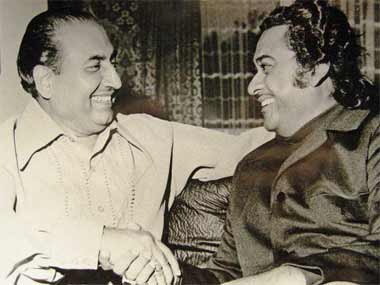
Rafi Saab and Kishore Da

A picture taken when Kishore Kumar visited Rafi at his son’s Khalid’s place in London. Image courtesy: Yasmin Rafi.

In a village near Amritsar, the young Mohammad Rafi would fly kites with his friends. He would look up and say, “meenu aasman di udai leni hai” (I want to fly in the sky- in Punjabi as told in his biography by Sujata Dev). A few years later the family moved to Lahore to join his father. Here the boy came under the singing spell of a fakir (religious ascetic) who he would follow down the streets of his neighbourhood. Then destiny smiled. In 1943, the programme executive of All India Radio (AIR) Lahore heard him sing as he worked at his brother’s saloon. He became a radio singer, performed at mehfils and even recorded for a Punjabi film. For a short period, he learnt the basics of classical singing from the maestro himself, Chote Ghulam Ali Khan. Then it was Bombay calling. In 1946, Naushad saab gave him his first big break in Anmol Ghadi. The music-composer remained his mentor and guide till the very end.

His homage to Gandhiji in 1948, ‘Suno Suno O Duniyawalon, Bapu Ki Amar Kahani’ brought Nehruji to tears. The young Rafi received a silver medal from the Prime Minister to commemorate India’s first Independence Day.

He became the rage in the 50’s and 60’s. His range was awesome and the masses loved his mellifluous voice. The patriotic song from Shaheed, ‘Aye Watan Aye Watan’ still gives us the goosebumps. ‘Hum Bekhudi Me Tumko Pukare’ the ghazal from Kaala Paani still weaves its elegant magic. Rafi saab sang many soulful bhajans. ‘O Duniya Ke Rakhwale’ from Baiju Bawra carries divine stirrings. The qawali ‘Pardah Hai Pardah’ from Amar Akbar Anthony in the late 70’s had the fans clapping in accompaniment. ‘Main Zindagi Kaa Saath Nibhata Chala Gaya’ (Hum Dono) remains evergreen and a spirit booster to this day.

Dilip Kumar in the foreword to the cited biography (Mohammad Rafi- Golden Voice of the Silver Screen by Sujata Dev) says that, “With Rafi saab it was a mystical bonding as if he was a part of me when he sang for me without being told how I would perform the song during the filming of the sequence.” Tune into the melancholic Devdas, the peppy numbers of Naya Daur or the unforgettable Bhojpuri rendition in Ganga Jamuna.  Shammi Kapoor broke the mould of the lead star with his exuberance and it was Rafi who heralded it with the Junglee song. Even the career graph of comedian Johnny Walker is embellished with famous songs like ‘Sar Jo Tera Chakraye’ in Pyaasa to ‘Yeh Hai Bombay Meri Jaan’ from CID.

Film songs and music were critical to the Box office of Hindi films till the late 70’s. Mohammad Rafi played a seminal role in the stardom of Rajendra Kumar, Pradeep Kumar, Bharat Bhushan, Biswajit , the young Jeetendra, and Shashi Kapoor and many others. His songs added to the aura of Dilip Kumar, Shammi Kapoor and Guru Dutt.

Despite all this, he won only 6 Filmfare awards and 1 National Award in his 24 year career (the Filmfare Awards had prestige then). This was largely because the first singer awards were instituted in 1959 and the Best Male and Female categories were opened up only in 1968. But if you tune in to the Golden Oldies Rafi nominations which missed the cut you will shake your head in disbelief. The National Award was for ‘Kya  Hua Tera Wada’ in 1978 for Hum Kissi Se Kum Nahin. Add to that a Padma Shri in 1967. This glaring wrong can certainly be righted posthumously.

This legendary artiste was considered a Farishta (Angel) in the film world. He was totally immersed in his music and songs. Even in his heydays he never missed out on a morning riyaaz (practice). Otherwise, it was all time with family and close friends. He remained a Punjabi foodie, enjoyed kite-flying and spent good time on the badminton courts. He was also amongst the first from the film world to entertain our jawans at the border.

The only major controversy was the feud with Lata Mangeshkar, the superstar female singer. They did not sing a duet together between 1963 and 67. The fall-out was related to getting a share of the royalty payments. Music directors were entitled to a 5% royalty from the sale of records. Lata and some other singers fought for 50% of these proceeds. Rafi’s personal opinion was that he was being paid fees upfront. Possibly, he was too creative a person to be much involved with the commercial aspects of his talent.

On 31st July 1980, just 55, Rafi saab passed away at Bombay Hospital with his family in attendance. At this critical time in his last voyage, who should step forward to help out- Uttam Singh (Sikh), Bhupinder Singh (Hindu), Kersi Lord (Parsee) and Leslie Coutinho (Christian – a drummer), all musicians and singers. The Universe bowing down to this epitome of Insaniyat (humanity).

Kishore Kumar’s maverick journey seems to have started young. His brother Ashok Kumar has stated that he had a shrill voice. At the age of 10, he injured his foot badly in a kitchen accident. He cried and sobbed for a month and his voice changed. Later in Khandwa (MP) his father, a successful lawyer, used to give him 2 annas for entertaining guests and visitors with a KL Saigal song. The rate was halved for his star sibling when he came over from Bombay.

Towards the mid 40’s Kishore moved to Bombay to stay with Ashok dada, a leading star. In 1948 he got his first solo break in Ziddi. Big brother nudged him towards acting and thus started a career of more than 80 films. His purple patch only came in the late 50’s with films like New Delhi, Aasha, Chalti Kaa Naam Gaadi and later Half Ticket and Padosan. As a singer a turning point was his meeting with SD Burman. The composer rebuked him for imitating Saigal and asked him to ‘find his own voice’. Burman da remained a mentor and guide for over 25 years. But the playback opportunities remained limited to singing some songs for Dev Anand (a big star) and for his own screen forays. The versatile genius dabbled in everything- production, direction, writing, music director. ‘Door Gagan Ki Chaon Mein’ stands out as a testimony to his creativity as a director and for composing memorable tunes.

In 1969, it was Dada Burman again. The film Aradhana and the lead man- Rajesh Khanna who stoked a nationwide hysteria. Kishore with ‘Mere Sapnon Ki Rani’ and ‘Roop Tera Mastana’ exploded on the charts. Then came a time where every leading star wanted Kishore in his playback corner. The old guard of Dilip Kumar and Shammi Kapoor were coming to the end of their lead-man days. Rajesh Khanna, Amitabh Bachchan, Vinod Khanna, Rishi Kapoor and others stepped up to take the baton forward with songs from the inimitable Kishore Kumar.

His years as an actor helped him to project his voice for the other actors. He captured the charm of Rajesh Khanna and the debonair gestures of Dev Anand on screen with effortless elan. For an untrained singer to carry off the semi-classical numbers from Amar Prem, Kudrat and Mehbooba was a triumph. The folk-songs like ‘O Majhi Re’ were a legacy from the Burman days. The poignant ‘Zindagi Ka Safar’ (Safar) retains its recall value as a classic as does the playful ‘Khaike Paan Banaraswala’ from Don. And when needed he simply switched on the rich deep tone for a Big B song.

Dev Anand said that Kishore had the voice of ‘a hero’. Their bonding went back to Ziddi in 1948. The great Manna Dey had fond memories of their crazy, rollicking duet , ‘Ek Chatur Naar’ in Padosan. The rehearsals over 8 days and good food at each other’s houses. The final recording in 2 phases. Manna da spoke admiringly about the mad-cap genius of Kishore, his improvisations which made the song a cult-classic. Javed Akhtar, the well-known lyricist, in his TV program ‘Classic Legends’ goes so far as to say that in any duet, Kishore’s voice held its own distinctive appeal. When 2 versions of the same song were there in the film, it is his rendition that stays with you. Check out Kudrat and Pyaar ka Mausam.

Hindi film aficionados know all about his yodelling skills inspired by the American country singer Jimmie Rodgers and the New Zealand born vaudeville star Tex Horton. Lesser known is that he and Burman Dada introduced falsetto singing in the Hindi film world. Singing notes higher than their normal range or as the composer put it, ‘gala tod ke gaana.’ ‘Chala Jaata Hoon’ from Mere Jeevan Saathi effectively captures this musical nuance.

Some will remember that his songs were banned on AIR and Doordarshan for many months during the Emergency years. He had the gumption to say No! to Sanjay Gandhi’s orders to perform at a Congress meet at Bombay. He had also turned down instructions to sing some songs to hype up the party’s 20 point program. Dev Anand, Manoj Kumar and Shatrughan Sinha also stood up during these dark months and had to pay a price. Although, Kishore da bagged 8 Filmfare awards, his Padma award and National award shelf remained empty.??!!

Stories of his eccentricities are legion. Like the framed message near the front door ‘I want the Money’ directed at the producers. Like locking up a producer in a cupboard for getting him into trouble with the Income Tax people. Like walking around his garden with a journalist and talking to the trees on personal terms. He had been called at times a sad and lonely man. Possibly the roller-coaster years with many of his films not doing well and a limited acceptance as a singer took their toll.

Unlike the serene Rafi saab, his life was a tumultuous journey. Four marriages including the one to the beautiful Madhubala.  His fellow-artistes have variously described him as moody and whimsical and  warm, funny and a live-wire at the recording studios. His packed concert tours saw an invariably energetic and entertaining performer.

Little is said about his helping hand to friends and relatives. His financial support helped Bipin Gupta to complete the movie ‘Dal Mein Kaala’ in 1964. After the untimely demise of a friend and fellow-actor Arun Mukherjee, his consistent help was critical for the family. He sang the Tagore song in Ray’s ‘Charulata’ for free as he admired them both. Earlier he had helped out Satyajit Ray with Rs 5000 to complete his path breaking film ‘Pather Panchali’.

He passed away on the 13th Oct 1987, his brother Ashok Kumar’s birthday. His body was taken to Khandwa for the last rites. Kishore da had been actively thinking of a retired life in his beloved hometown.

Rafi saab and Kishore da sang 33 duets together.  At every concert, Kishore would sing a few Rafi numbers with the respectful disclaimer’ I do not possess the vocal talent of Rafi saab but I would like to present some of his melodies.’ On another occasion when he learnt that Mohammad Rafi had been paid less than him for a duet he quietly corrected the situation with the producer. On his part, the senior singer treated him with affection like a younger brother. He took only a rupee as token compensation for the 2 songs he sang in ‘Chalti Kaa Naam Zindagi.’ The industry lore has it that whenever a Kishore song touched him, the younger compatriot would be invited for a feast, possibly a biryani spread. ‘Dukhi Man Mere’ from Funtoosh, ‘Koi Hamdam Na Raha’ from Jhumroo and ‘Tum Bin Jaoon Kahan’ from Pyar Kaa Mausam were such daawat occasions. Remember, that Rafi had done the playback of the last song for the hero Shashi Kapoor.

Rafi saab and Kishore Da. Both legends. Poles apart as personalities. Respect and Camaraderie. Rivals yet friends. Their unique jugalbandi story – Inspirational and Heart warming.

The Bollywood Bazaar

Image by dan123ny from Pixabay

Behind the glamour and glitz of Bollywood is the Hindi film industry. It churns out 350-400 films a year. Most go unnoticed and do not recover their costs. Some quality movies get very limited releases but then hopefully a fresh lease of life on the streaming OTT platforms. A few do well in the C & D centres. A significant data point is that there are only 6,700 single screens + around 2,400 multiplex screens in India for 1,600+ films a year, compared to the 40,000 in the US and 55,000 in China.

With the Mumbai film world also in a lockdown, let’s look at how the real business works. Brush aside the myths and make-believe narrative about the mega-stars and the celebrity film makers. After all, these are tales spun by PR agents, TV anchors, critics and trade people on their pay-roll. Social media facilitators take the hype and hero-worship to another level.

Glorify, hype, manipulate, seduce, deflect, misinform are all tricks of the trade. Add snuff- out competition.

The big production houses, superstars, media outlets and the social media apparatus have together created powerful cabals which dominate B-Town.

Let’s look at some real numbers. Sushant Singh Rajput’s Chhichhore grossed ₹ 200+ crore last year on a budget of ₹ 45 crore. It managed to get a 1200 screen release in September last year and the audience lapped up the content. Uri-the Surgical Strike, with Vicky (who??) Kaushal in the lead, garnered ₹ 245 crore in domestic collections alone, on a budget of ₹ 25 crore only.  Again a 1200 screen opening. A smash hit, wouldn’t you say. The chatter media has largely kept quiet, even played it down.

Salman bhai’s magnum opus Bharat, has a 2,000 plus screen grand release. Just touches ₹ 200 crore with inflated ticket prices at the multiplexes. Production costs are touted at ₹ 80 crore. But it is the time to go ga-ga. This is the tried and tested formula for Mr BO. His films come out on a major festival which along with week-end gives it a 7 day free run with no competition to speak off. His die-hard fans plus the holiday mood kicks in. All the moolah is raked in over the first week. Then it is all down-hill.  The average cine-goer forgets the movie as soon as he/she steps out of the theatre. Tubelight and Dabangg 3 have flickered briefly and flopped. No industry insider dares to say so. The Sultan continues to walk with a swag.

Take the case of King Khan. A disappointing run for the last 6-7 years but his stardom has not dimmed. A few average movies and some big duds. Remember Zero. Fades in comparison to Kamal Hassan’s Appu Raja and AB’s Paa. A critic for a leading paper panned it with a 1 star rating. But couldn’t resist saying that it was not worthy of the SRK talent. I naively thought that he had the clout to command scripts, choose directors and co-stars… In fact the works. Mainstream actors like Matt Damon and Tom Hanks use their stardom to get better projects and quality content. Jab Harry met Sejal was a disaster. The critic in another leading English paper drooled, “SRK is like old wine. The more he matures, the better he romances.” Are these guys made of Teflon? Nothing sticks to them. Is it too much to hope for a Swades again!!!

You can now see why we wallow in such mediocrity. The eco-system pampers the stars and the so-called show-men. There is no reality check. The camp culture keeps them in a comfort zone. They have become lazy and repetitive and are taking all of us for granted.

Only politicians and movie stars get away with such trash in India. A 2 time world cup winning captain like Dhoni is asked if he is past his shelf life. Take another analogy. Will investors be gung-ho about a corporate which has given average or negative results over the last 12 quarters.

Let’s move on to the accomplices- like celebrity critics Rajeev Masand & Anupama Chopra, whose bias and fandom is there for all to see. Fortunately, independent You Tube reviewers and Netizens are pushing back and calling a spade a spade. Both these big names refused to review a significant film, The Tashkent Files presumably as the filmmaker is a BJP supporter.  Based on a validated expose of how from the late 50’s the KGB had infiltrated and possibly compromised people at the highest levels of the Indian government, academia, media and even the film fraternity. It was this stuff which was difficult for their ideological gut to digest. And the mystery of Shastriji’s death was too much to handle.

The A-list filmmaker, husband of one of these reviewers released Shikara on the streaming platform, billed as ‘the Untold Story of Kashmiri Pandits’. Sadly the story remains untold. The film makes little mention of the genocide, violence and rape which led to the exodus of half a million of this community from their centuries old homes. If anything, more screen time is given to justifying the cause of the militants- funded and armed by our ever friendly neighbour State.

A few more examples- Tanhaji (₹ 200 crore club) was treated by these intellectuals with some disdain. A Maratha warrior taking on the Emperor Aurangzeb. Really? Research and history be damned. Ajay Devgns third film on unsung Indian heroes may calm their nerves. It celebrates the great football coach- Syed Abdul Rahim- and the golden period of Indian football from 1952-62. I look forward to this homage to a sporting icon.

Akshay Kumar’s terrific run at the box-office is shrugged away as hyper-nationalism.  Mission Mangal, Kesari and Airlift are inspiring, true stories and make for good cinema. I recall that their take on Uri was punctuated with the word ‘Jingoism’.

Bollywood is loath to admit the superior quality of films from other regions, esp. the South and Maharashtra in recent times. More movie buffs are discovering the same on Netflix or Prime. Consider Kumbalangi Nights and Virus (Malyalam), Super-Deluxe (Tamil) or  Tumbbad (Marathi). They ooze with creativity and story-telling.

The Hindi films award shows are a farce.  Gully Boy getting ten! LOL!  An engaging film. Not an all-time classic. Think of the opportunity missed in hailing some real actors and technicians. It must be great to belong to this close-knit clique.

Their inflated egoes will never acknowledge the biggest box-office bonanzas which have been helmed at other centres. Bahubali 2 tops the India box office with a staggering ₹ 1400 crore collection. Surprise, Surprise-its Hindi version topped ₹ 570 crore. Rajnikanth’s 2.0 follows with ₹ 564 crore (multiple language release). Then Dangal with ₹ 538 crore and Bahubali – the Beginning at ₹ 516 crore. KGF (Kannada) scored a BO century on home turf itself. Sairat (Marathi) made at a modest ₹ 6-7 crore breached the historic ₹ 100 crore mark. It was immediately remade in Hindi with star kids.

Global BO numbers of Hindi films are largely driven by the Indian diaspora. Very few have made the cross-over and resonated with foreign audiences. Dangal has smashed records in China pulling in over ₹ 1,000 crore. Earlier 3 Idiots had really connected with audiences in South Korea, China, Japan & South East Asia.  Secret Superstar (made for ₹ 15 crore) had an India score of ₹ 75 crore and a China tally of ₹ 750 crore.  Andhadhun also hit the ₹ 300 crore jackpot in China. But this also is not trumpeted in the media domain.

The Bollywood kitty of the world box-office revenue of $40 billion is just under 5%.

Some earlier films to make the breakthrough were Awara & Shree 420 ( Soviet Union & China), Mughal-e-Azam,  Naya Daur,  Anand, Sholay, Deewar, Trishul, DDLJ, Lagaan, My Name is Khan…..Disco-Dancer had Russians and East Europeans dancing to its tunes. Rajni’s Muthu touched the hearts of the Japanese. Satyajit Ray’s films created a loyal, niche audience especially in Europe.

Let’s turn the clock back for another interesting take. How much would the blockbusters of yesteryears taken at the ticket counters today. An eye-opener for today’s movie nut clued into the ₹100/200/300 crore clubs instituted by the trade people. Adjusted for inflation, Sholay and Mughal-e-Azam would probably rub shoulders with Bahubali and Dangal in the ₹ 2,000 crore stratosphere. Mother India would have set the cash registers ringing for say ₹1,300 crore. Awara would be in the ₹ 1,000 crore club. Mass entertainers like Johnny Mera Naam, Amar Akbar Anthony & Disco Dancer would have crossed the ₹ 700 crore mark. To be fair, DDLJ and Hum Aapke Hain Kaun would also have pole vaulted into the ₹ 1,000 crore collection zone in today’s times. But the perspective to take here is that Raj Kapoor, Dilip Kumar and Amitabh Bachchan would have featured in the top grosser list many times over. (These are estimate numbers sourced from articles on the internet by cinephiles, journalists and pundits.)

Those were also times when this abject sycophancy did not exist. Raj Kapoor’s Mera Naam Joker was called out as a flop. In contrast SRK’s ambitious Ra-One was quietly laid to rest. In the mid-70’s itself Rajesh Khanna was being discussed as a super-star in decline. I recall reading in a popular magazine that his mannerisms had become stale. Indeed, trade papers and critics had dismissed the multi-starrer Sholay as a dud in its first week itself. They had to eat their words for the next 5 years and more.

Till the end of the seventees it was not all about the stars. Technicians were given their due. DOP’s like Dwarka Divecha and Fali Mistry were feted and lauded. Musicians and lyricists had their names on hoardings and posters. The legendary singers-Mohd Rafi & Kishore Kumar, Lata Mangeshkar & Asha Bhonsle…. could pack concert halls on their own. Today they piggyback on a star tour. Everybody had their place in the sun- the directors, character actors, editors, choreographers, production designers.

The raw business truth is that today it is the distributor and exhibitor who are taking the real risk. The star packaged product is sold out to all the 11 territories by the big production house. Plus they rake in the big bucks from the overseas markets, the music rights and deals made with other media and streaming outlets.

Finally, it is upto the audience to demand better value for money. The success of Andhadhun, Chhichhore, Uri, and Article 15 shows that there is a large and growing market for good content films. The distributors and exhibitors should wake up to the fact that this involves lesser risks and higher margins and ROI. More screens and shows is the only way for good talent to show what they are capable of.  The creative juices will then really flow in the Mumbai film world. A good story, well told, will carry the day.

The show must go on. But it is high time that we as consumers call for a more fulfilling experience.