
In a village near Amritsar, the young Mohammad Rafi would fly kites with his friends. He would look up and say, “meenu aasman di udai leni hai” (I want to fly in the sky- in Punjabi as told in his biography by Sujata Dev). A few years later the family moved to Lahore to join his father. Here the boy came under the singing spell of a fakir (religious ascetic) who he would follow down the streets of his neighbourhood. Then destiny smiled. In 1943, the programme executive of All India Radio (AIR) Lahore heard him sing as he worked at his brother’s saloon. He became a radio singer, performed at mehfils and even recorded for a Punjabi film. For a short period, he learnt the basics of classical singing from the maestro himself, Chote Ghulam Ali Khan. Then it was Bombay calling. In 1946, Naushad saab gave him his first big break in Anmol Ghadi. The music-composer remained his mentor and guide till the very end.
His homage to Gandhiji in 1948, ‘Suno Suno O Duniyawalon, Bapu Ki Amar Kahani’ brought Nehruji to tears. The young Rafi received a silver medal from the Prime Minister to commemorate India’s first Independence Day.
He became the rage in the 50’s and 60’s. His range was awesome and the masses loved his mellifluous voice. The patriotic song from Shaheed, ‘Aye Watan Aye Watan’ still gives us the goosebumps. ‘Hum Bekhudi Me Tumko Pukare’ the ghazal from Kaala Paani still weaves its elegant magic. Rafi saab sang many soulful bhajans. ‘O Duniya Ke Rakhwale’ from Baiju Bawra carries divine stirrings. The qawali ‘Pardah Hai Pardah’ from Amar Akbar Anthony in the late 70’s had the fans clapping in accompaniment. ‘Main Zindagi Kaa Saath Nibhata Chala Gaya’ (Hum Dono) remains evergreen and a spirit booster to this day.
Dilip Kumar in the foreword to the cited biography (Mohammad Rafi- Golden Voice of the Silver Screen by Sujata Dev) says that, “With Rafi saab it was a mystical bonding as if he was a part of me when he sang for me without being told how I would perform the song during the filming of the sequence.” Tune into the melancholic Devdas, the peppy numbers of Naya Daur or the unforgettable Bhojpuri rendition in Ganga Jamuna. Shammi Kapoor broke the mould of the lead star with his exuberance and it was Rafi who heralded it with the Junglee song. Even the career graph of comedian Johnny Walker is embellished with famous songs like ‘Sar Jo Tera Chakraye’ in Pyaasa to ‘Yeh Hai Bombay Meri Jaan’ from CID.
Film songs and music were critical to the Box office of Hindi films till the late 70’s. Mohammad Rafi played a seminal role in the stardom of Rajendra Kumar, Pradeep Kumar, Bharat Bhushan, Biswajit , the young Jeetendra, and Shashi Kapoor and many others. His songs added to the aura of Dilip Kumar, Shammi Kapoor and Guru Dutt.
Despite all this, he won only 6 Filmfare awards and 1 National Award in his 24 year career (the Filmfare Awards had prestige then). This was largely because the first singer awards were instituted in 1959 and the Best Male and Female categories were opened up only in 1968. But if you tune in to the Golden Oldies Rafi nominations which missed the cut you will shake your head in disbelief. The National Award was for ‘Kya Hua Tera Wada’ in 1978 for Hum Kissi Se Kum Nahin. Add to that a Padma Shri in 1967. This glaring wrong can certainly be righted posthumously.
This legendary artiste was considered a Farishta (Angel) in the film world. He was totally immersed in his music and songs. Even in his heydays he never missed out on a morning riyaaz (practice). Otherwise, it was all time with family and close friends. He remained a Punjabi foodie, enjoyed kite-flying and spent good time on the badminton courts. He was also amongst the first from the film world to entertain our jawans at the border.
The only major controversy was the feud with Lata Mangeshkar, the superstar female singer. They did not sing a duet together between 1963 and 67. The fall-out was related to getting a share of the royalty payments. Music directors were entitled to a 5% royalty from the sale of records. Lata and some other singers fought for 50% of these proceeds. Rafi’s personal opinion was that he was being paid fees upfront. Possibly, he was too creative a person to be much involved with the commercial aspects of his talent.
On 31st July 1980, just 55, Rafi saab passed away at Bombay Hospital with his family in attendance. At this critical time in his last voyage, who should step forward to help out- Uttam Singh (Sikh), Bhupinder Singh (Hindu), Kersi Lord (Parsee) and Leslie Coutinho (Christian – a drummer), all musicians and singers. The Universe bowing down to this epitome of Insaniyat (humanity).
Kishore Kumar’s maverick journey seems to have started young. His brother Ashok Kumar has stated that he had a shrill voice. At the age of 10, he injured his foot badly in a kitchen accident. He cried and sobbed for a month and his voice changed. Later in Khandwa (MP) his father, a successful lawyer, used to give him 2 annas for entertaining guests and visitors with a KL Saigal song. The rate was halved for his star sibling when he came over from Bombay.
Towards the mid 40’s Kishore moved to Bombay to stay with Ashok dada, a leading star. In 1948 he got his first solo break in Ziddi. Big brother nudged him towards acting and thus started a career of more than 80 films. His purple patch only came in the late 50’s with films like New Delhi, Aasha, Chalti Kaa Naam Gaadi and later Half Ticket and Padosan. As a singer a turning point was his meeting with SD Burman. The composer rebuked him for imitating Saigal and asked him to ‘find his own voice’. Burman da remained a mentor and guide for over 25 years. But the playback opportunities remained limited to singing some songs for Dev Anand (a big star) and for his own screen forays. The versatile genius dabbled in everything- production, direction, writing, music director. ‘Door Gagan Ki Chaon Mein’ stands out as a testimony to his creativity as a director and for composing memorable tunes.
In 1969, it was Dada Burman again. The film Aradhana and the lead man- Rajesh Khanna who stoked a nationwide hysteria. Kishore with ‘Mere Sapnon Ki Rani’ and ‘Roop Tera Mastana’ exploded on the charts. Then came a time where every leading star wanted Kishore in his playback corner. The old guard of Dilip Kumar and Shammi Kapoor were coming to the end of their lead-man days. Rajesh Khanna, Amitabh Bachchan, Vinod Khanna, Rishi Kapoor and others stepped up to take the baton forward with songs from the inimitable Kishore Kumar.
His years as an actor helped him to project his voice for the other actors. He captured the charm of Rajesh Khanna and the debonair gestures of Dev Anand on screen with effortless elan. For an untrained singer to carry off the semi-classical numbers from Amar Prem, Kudrat and Mehbooba was a triumph. The folk-songs like ‘O Majhi Re’ were a legacy from the Burman days. The poignant ‘Zindagi Ka Safar’ (Safar) retains its recall value as a classic as does the playful ‘Khaike Paan Banaraswala’ from Don. And when needed he simply switched on the rich deep tone for a Big B song.
Dev Anand said that Kishore had the voice of ‘a hero’. Their bonding went back to Ziddi in 1948. The great Manna Dey had fond memories of their crazy, rollicking duet , ‘Ek Chatur Naar’ in Padosan. The rehearsals over 8 days and good food at each other’s houses. The final recording in 2 phases. Manna da spoke admiringly about the mad-cap genius of Kishore, his improvisations which made the song a cult-classic. Javed Akhtar, the well-known lyricist, in his TV program ‘Classic Legends’ goes so far as to say that in any duet, Kishore’s voice held its own distinctive appeal. When 2 versions of the same song were there in the film, it is his rendition that stays with you. Check out Kudrat and Pyaar ka Mausam.
Hindi film aficionados know all about his yodelling skills inspired by the American country singer Jimmie Rodgers and the New Zealand born vaudeville star Tex Horton. Lesser known is that he and Burman Dada introduced falsetto singing in the Hindi film world. Singing notes higher than their normal range or as the composer put it, ‘gala tod ke gaana.’ ‘Chala Jaata Hoon’ from Mere Jeevan Saathi effectively captures this musical nuance.
Some will remember that his songs were banned on AIR and Doordarshan for many months during the Emergency years. He had the gumption to say No! to Sanjay Gandhi’s orders to perform at a Congress meet at Bombay. He had also turned down instructions to sing some songs to hype up the party’s 20 point program. Dev Anand, Manoj Kumar and Shatrughan Sinha also stood up during these dark months and had to pay a price. Although, Kishore da bagged 8 Filmfare awards, his Padma award and National award shelf remained empty.??!!
Stories of his eccentricities are legion. Like the framed message near the front door ‘I want the Money’ directed at the producers. Like locking up a producer in a cupboard for getting him into trouble with the Income Tax people. Like walking around his garden with a journalist and talking to the trees on personal terms. He had been called at times a sad and lonely man. Possibly the roller-coaster years with many of his films not doing well and a limited acceptance as a singer took their toll.
Unlike the serene Rafi saab, his life was a tumultuous journey. Four marriages including the one to the beautiful Madhubala. His fellow-artistes have variously described him as moody and whimsical and warm, funny and a live-wire at the recording studios. His packed concert tours saw an invariably energetic and entertaining performer.
Little is said about his helping hand to friends and relatives. His financial support helped Bipin Gupta to complete the movie ‘Dal Mein Kaala’ in 1964. After the untimely demise of a friend and fellow-actor Arun Mukherjee, his consistent help was critical for the family. He sang the Tagore song in Ray’s ‘Charulata’ for free as he admired them both. Earlier he had helped out Satyajit Ray with Rs 5000 to complete his path breaking film ‘Pather Panchali’.
He passed away on the 13th Oct 1987, his brother Ashok Kumar’s birthday. His body was taken to Khandwa for the last rites. Kishore da had been actively thinking of a retired life in his beloved hometown.
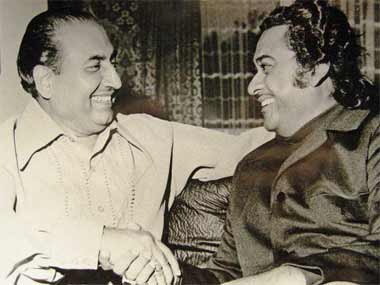
Rafi saab and Kishore da sang 33 duets together. At every concert, Kishore would sing a few Rafi numbers with the respectful disclaimer’ I do not possess the vocal talent of Rafi saab but I would like to present some of his melodies.’ On another occasion when he learnt that Mohammad Rafi had been paid less than him for a duet he quietly corrected the situation with the producer. On his part, the senior singer treated him with affection like a younger brother. He took only a rupee as token compensation for the 2 songs he sang in ‘Chalti Kaa Naam Zindagi.’ The industry lore has it that whenever a Kishore song touched him, the younger compatriot would be invited for a feast, possibly a biryani spread. ‘Dukhi Man Mere’ from Funtoosh, ‘Koi Hamdam Na Raha’ from Jhumroo and ‘Tum Bin Jaoon Kahan’ from Pyar Kaa Mausam were such daawat occasions. Remember, that Rafi had done the playback of the last song for the hero Shashi Kapoor.
Rafi saab and Kishore Da. Both legends. Poles apart as personalities. Respect and Camaraderie. Rivals yet friends. Their unique jugalbandi story – Inspirational and Heart warming.
 A Fistful of Salt