
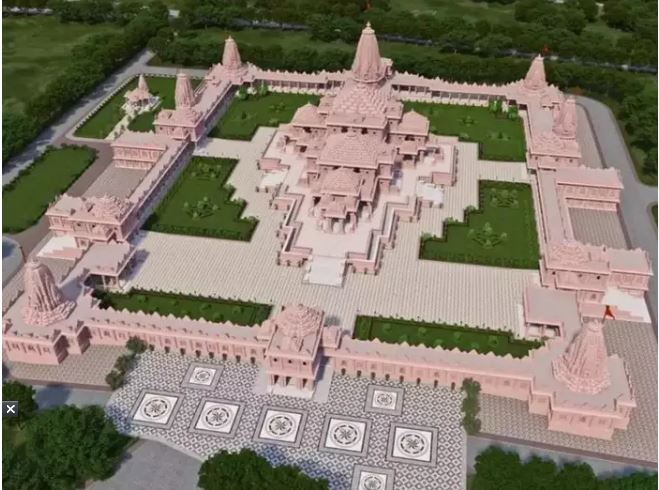
On the 22nd of January 2024, Ayodhya will resonate with the euphoric chants of ‘Jai Shree Ram.’ The Pran Pratishtha ceremony leading up to the installation of the Ram Lalla idol, followed by the first Aarti will be performed by the Prime Minister-guided by Hindu Pandits- with 7000 special guests invited by the Temple Trust in attendance. The Consecration ceremony will illuminate and reverberate not only across our vast nation but also with millions of devotees across the world
Flashback. In 1885, Mahant Raghubir Das filed the first suit to build a temple on the land adjacent to the mosque. Denied permission by the District Magistrate, Faizabad. In December 1949 a Ram idol was found in the mosque and the faithful started offering prayers. The Indian Government declared the site ‘a contested area’ and locked the gates. The following year permission was granted by the Faizabad Court to conduct pooja for Sri Ram Lalla but only in the minor courtyard with the main gates remaining closed. In 1961, the UP Sunni Wakf Board filed a suit seeking possession of the Babri Masjid and demanding the removal of the Hindu idols.
It was in 1984 that the Vishwa Hindu Parishad (VHP) started the Ramjanmabhoomi movement as we know it now. BJP leader Mr LK Advani took the reins of the campaign. In 1986, the Babri Masjid Action Committee (BMAC) was formed as the opposing party. In the meantime, the Shah Bano case made headlines with the Supreme Court (SC) ruling in favour of the elderly, divorced Muslim woman- that she gets monthly maintenance from her re-married husband. This was contrary to Muslim Personal Law and to appease the conservative elements in the community, the Mr Rajiv Gandhi government with 400+ MPs in the Lok Sabha overturned the SC judgement by amending the law itself. In this balancing act political drama, the Government in 1986 allowed the Hindus to do Pooja and have darshan after opening the gates. A tipping point of sorts happened in November 1989 when the VHP was permitted to perform Shilanyas (lay foundation stone) near the Masjid.
On to the Rath Yatra led by Mr Advani in September 1990 from Somnath (Gujarat) to Ayodhya ( Uttar Pradesh). The movement mobilised huge public support leading to the 6th of December 1992 – when Hindu karsevaks demolished the Babri Masjid and left behind a makeshift temple. More than 50 of this violent mob were killed in police firings. Communal riots broke out in many parts of the country. More than 900 died in the Mumbai riots of December 1992 and January 1993. Culminating in the deadly Mumbai serial blasts of March 1993, orchestrated by Dawood Ibrahim from Dubai. To control a volatile situation the Congress-led government passed an ordinance to acquire the ‘contested land.’
All the suits related to the Ayodhya land title dispute had been transferred to the Allahabad High Court in 1989. The needle moves to 2003. The Court authorises the Archaeological Survey of India (ASI) to excavate the land and give its findings with evidence. The 574-page report was submitted in August 2003. The only public takeaway was that ‘of a very large structure that considerably pre-dated the Babri Masjid’. In September 2010, the Lucknow bench of the Allahabad High Court split the land 3 ways- Ram Lalla Virajman, UP Sunni Wakf Board and Nirmohi Akhara (a Hindu order of warrior saints who managed many temples in the region).
Finally on the 9th September 2019, when a full bench of the Supreme Court of India ordered the Government of India to create a Trust to build the Ram Mandir and to form a Board of Trustees within 3 months. The entire 2.77 acres of disputed land was passed to the custody of the Trust. 5 acres of land was allotted to the UP Sunni Wakf Board at a suitable place within Ayodhya to construct a mosque.
The commonly accepted narrative is that the first Mughal Emperor Babur ordered the demolition of the Ayodhya temple in 1528 and got the Masjid built on its ground,( hence the Babri Masjid). During the arguments in the SC a reference to Babur’s visit to Ayodhya (as mentioned in Baburnama- a book by Babur) was brought up. However, the Advocate for the opposing side clarified that 2 pages of the Baburnama were missing (whether about the Ayodhya temple remains unclear). Kishore Kunal, former IPS officer, in his book ‘Ayodhya Revisited’, is of the firm opinion that the temple was not destroyed in 1528 but in 1660 by Fidayi Khan, a governor appointed by Emperor Aurangzeb. This timeline seems to be in sync with the accounts of English travellers William Finch (1608-11) an English merchant with the East India Company (EIC) and Captain William Hawkins (EIC Ambassador) who both landed in Surat in August 1608 and spent more than 2 years at Emperor Jahangir’s court. Finch visited the fort in Ayodhya where Hindus believed Lord Ram was born and mentions it in his accounts. Hawkins also refers to the sacred town of Ayodhya in his travelogues (William Foster’s book “ Early Travels in India’- accounts of 7 English travellers in India).
Perhaps, most significantly, Austrian Jesuit missionary Joseph Tiefenthaler suggests in his works that the Ram temple was demolished by Aurangzeb. This European geographer came to India in 1743 and visited Ayodhya in the 1760s.’ He refers to a particularly famous spot called Sita Rasoi- or table of Sita- the revered wife of Shri Ram. He states that Aurangzeb demolished the fortress and erected a mosque in its place to prevent heathens from practising their ceremonies. However, they have continued to practice their religious ceremonies knowing that they have been to the birthplace of Ram by going around it 3 times and prostrating on the ground. On the left is a square box called Bistar palana (cradle) where Ram (Vishnu) and his 3 brothers were born. In the month of Chaitra, a large number of people gather together to celebrate the birthday of Ram, extremely popular throughout India.’
The Ayodhya Kanda Recitation was recorded in writing by Mr Robert Montgomery after the 1857 Uprising or Mutiny as he calls it. He was the Chief Commissioner of Oudh or Avadh in 1858-59.
In 1975-76 Mr B B Lal, Director General ASI and his team started excavating the Archaeology of Ramayana- Ayodhya, Bharadwaj Ashram, Nandigram, Chitrakoot, Shringverapur In his 2008 book, ‘Rama- His Histrocity, Mandir and Setu’ he states that ‘attached to the piers of the Babri Masjid there were 12 stone pillars which carried not only typical Hindu motifs and mouldings but also figurines of Hindu deities. It was self-evident that the pillars were not an integral part of the Masjid but were foreign to it.’ Another eminent archaeologist Mr K K Muhammed who was part of the team reveals in his book, “An Indian I Am” that he found the remains of the temple on the western side of the mosque. The 12 pillars were constructed with Hindu symbolism including Ashtamangala signs (8 auspicious objects as per Hindu practice and astrology.) They also found terracotta figurines of humans-men and women- and animals.’ Mr Muhammed clearly states that ‘his findings were suppressed by Marxist historians like Prof Irfan Habib who was very powerful and influential with the Indian Council of Historical Research and with many leading newspapers’. Irfan Habib and his powerful supporters even spread the lie that Mr KK Muhammed had not been a part of the ASI excavation team at Ayodhya. This coterie also went all-out to tarnish the image of the ASI after they submitted their 2003 report to the Allahabad High Court. In the early 1980s also the ASI was under tremendous pressure to play down and not to reveal the excavation findings. Recommend that you read Mr Muhammed’s book as a tribute to his passion, courage and integrity as a professional and to learn about his other interesting digs and excavations.
The Jawaharlal Nehru University (JNU) clan led by Irfan Habib had 25 influential intellectuals including Dr Romila Thapar. They hyped up the narrative that the legendary Ayodhya of the Ramayana was a purely mythical city and was not the same as present-day Ayodhya. However, they fumbled with the name Saket which historically is one and the same as Ayodhya. Their overwhelming influence with the powers that be and the Sunni Wakf Board ensured that there could not be any out-of-court compromise solution as some moderate Muslim leaders recommended. Former Aligarh Muslim University (AMU) Chancellor Lt General (Retd) Zameeruddin Shaikh said that the Muslims should take the initiative of handing over the land to the Hindus and facilitate a harmonious out-of-court settlement. In November 2019, before the Supreme Court judgement the then AMU Chancellor and Professor Tariq Mansoor cautioned the students against false propaganda. They should accept the decision of the highest court with maturity, respect and restraint.
The Nay-Sayers and Obstructionists were in for a shock when during the demolition of the Masjid in 1992, 3 inscriptions on large stones were found. The most important was the Vishnu-Hari inscription of 20 lines in the Nagari script on a 1.10m by 0.56m stone. Shri Ajay Shastri, Chairman of the Epigraphical Society of India examined the inscriptions and observed, ‘Line 15 clearly tells us that a beautiful temple of Vishnu-Hari built with heaps of stones and beautified by golden spires, unparalleled by any other temple built by earlier kings was constructed. This wonderful temple was built in the temple city of Ayodhya situated in the Saketmandala ( Saket district). Line 19 describes God Vishnu as destroying Bali and the 10-headed personage.’ Prof Meenakshi Jain again exposes Irfan Habib who first dismissed the inscription as from a private collection and then alleged that it was stolen from the Lucknow museum and surreptitiously placed at the site. In fact, the Lucknow museum inscription was the ‘Tretha ka Thakur’ one –another Ayodhya temple demolished at Aurangzeb’s orders. The Director of the Lucknow Museum refuted the canard spread by Habib and displayed the inscription in the custody of the museum.
After the Supreme Court judgement, it was decided by the Sunni Wakf Board and the Management Committee that the mosque would be constructed on a 5-acre land at Dhannipur, around 25 km from the temple. It will be named after the Holy Prophet of Islam- Mohammed Bin Abdullah Masjid. Top clerics from several countries would be invited including the Honourable Imam, who leads the prayers at the Grand Mosque of Mecca. It will be the largest mosque in India and will have the world’s biggest Quran- measuring 21ft high and 36ft wide.
It is imperative to see the Ram Janmabhoomi saga in the global context. In 2020, the Erdogan-led government in Turkiye converted the famous UNESCO-declared heritage site and cultural museum, Hagia Sophia, into a mosque. It had earlier been a Christian Orthodox Church and Mosque and a Museum since 1934. The Icons of the Virgin Mary and the Infant Christ were covered by fabric curtains. Since 2017, the authoritarian Chinese Communist Party has destroyed or closed down hundreds of mosques in Xinjiang province (North-West) and Ningxia and Gansu provinces in the North – where the majority of the Muslim populace live. Total silence from our Comrade intellectuals. Going back to 1490- the Spanish Crown ordered all the Muslims to convert to Christianity. Over the next 100 years 3 million Muslims fled from Spain to North Africa. The last of the Moors adhering to Islam were expelled in 1610. The Iconic Cathedral of Cordoba, dedicated to Santa Maria, had been a mosque till the 13th century. Unfortunately, world history is replete with such events. Hark back to the cautionary words attributed to Spanish-American philosopher George Santayana,’ those who don’t learn from history are doomed to repeat it.’ Discussion, Reconciliation and even some Compromise may be the only way out through difficult, divisive situations.
So on the 22nd of January, Ayodhyanagari will rejoice to the traditional sound of the conches and bells; the melodious bhajans and kirtans; the overwhelming fragrance of fresh flowers and incense. At night time, there will be thousands of lamps on the banks of the river Sarayu. In the months after the temple inauguration, around 1 lakh pilgrims each day are expected at Ayodhya. Hotels, Hostels and homestays will be full to capacity and beyond. Buses and cabs will be on demand 24/7. Restaurants will have stand-and-eat tables and nukkad chai shops will struggle to keep pace with the relentless sipping of the beverage. Flower sellers and general merchants will be constantly stocking up their wares. The ancient town of Ayodhya, whilst retaining its spiritual core, will transform into a bustling city with a classic airport and railway station and with all the amenities.
The economic boom will be humongous for lakhs of local people in the city and the neighbourhood- transcending religion and communities.
 A Fistful of Salt