
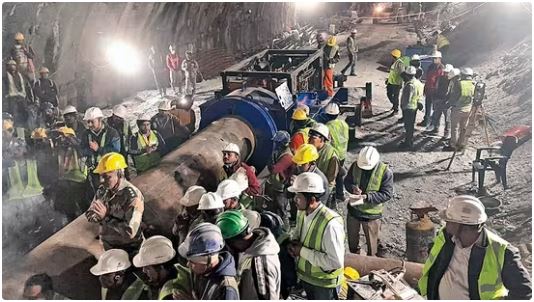
In the early hours of the 12th of November 2023, the under-construction Silkyara tunnel in the Uttarkashi region of Uttarakhand collapsed. For the next 17 days, the nation was transfixed by the humongous rescue efforts to bring out the 41 trapped workers alive and safe. Non-stop coverage on TV channels and on social media brought this intense story into every home. What made the entire experience so riveting and inspiring was the human heart-beat which throbbed right through. Plus the back-stories of the heroes who put their own lives at risk, and the experts and professionals who worked day and night at the site without rest or sleep.
Rat-hole mining was banned by the National Green Tribunal in India in 2014. It was the process of digging employed in Meghalaya and North East India to extract coal. It was a procedure that involved digging manually wherein the workers had to crawl and burrow in and out of a narrow passage or tunnel. The ban was due to the very high-risk working conditions and for causing damage to the environment. The technical and rescue teams at the disaster site were out of their depth as the state-of-the-art Auger horizontal dry drilling machine broke down more than 10 meters short of the 60-odd meter passage to the trapped workmen. The list of the heroic rat miners who cleared the final stretch to reach the workers reads as Munna Qureshi, Devendra, Monu Kumar, Feroze Qureshi, Wakeel Hasan, Nasir Khan, Rashid Ansari, Irshan Ansari, Ankur, Surya Mohan… Our heroes worked with Companies involved in contractual jobs with the Public Works Department and Municipal Corporations primarily in Delhi. They cleaned nallahs before monsoons, kept the sewer lines operational, and dug narrow tunnels and underground ditches for utility pipelines. Earning Rs 300/ to Rs 600/ per day for 12-hour shifts. Surya Mohan had this to say to a news channel, “We can squeeze ourselves and stay in that position longer than any normal and flexible person. We can work in holes with foul smells for 2-3 hours at a stretch. We can operate in conditions where oxygen levels are low. This is not an expertise but skills gained through practice since childhood.” Devendra Kumar, who was the first to reach the trapped workers and embrace them elaborates, “We can squat on our haunches and rest our body weight on our toes for 3 hours at a stretch. We can work like this in as little space as 2 feet and that is what we did as we sat in the pipe at Silkyara tunnel to clear the blocked portion. We held the drill machine right in front of us vertical to our chest with the heavier part where the motor is fitted touching the ride side of our chest.” Leaving the final word to Feroze Qureshi, “We expect nothing. We were so happy to save and help 41 fellow workers.” Real Heroes!!! Whilst hopefully some worthy financial rewards and honors will come their way it is refreshing to see that these saviors are being feted and applauded on prime TV shows like ‘Indian Idol.’
‘Rat miners surprised the world with their unique capability to bore around 13 meters and to fix and weld steel pipes- all this after cutting and extracting broken Auger parts.’ Lt General (Retd) Syed Ata Hasnain cited in his articles later. Local media and social influencers hailed it as a win for Indian Jugaad.
In an interview with the Free Press Journal, tunnel foreman Gabbar Singh Negi talked about how the 41 workers survived the 17 harrowing days without sinking into depression or hopelessness. Many workers later spoke about how he had kept them calm by practicing yoga and meditation and leading them on a morning walk of the 2000-meter stretch available. Negi, a local of Uttarakhand, rose to be a true leader for his team from Bihar, Odisha, West Bengal, Uttar Pradesh, Jharkhand, Assam, and Himachal Pradesh by motivating them to regroup as a unit for those long nerve-wracking days.
Australian Professor Arnold Dix became a national hero after all the workers were rescued unscathed. A geologist, engineer, and lawyer, he answered the SOS from the Indian Government and reached the site on the 20th of November. He inspected the collapsed tunnel, co-ordinated with all the Agencies on the ground, and suggested technical solutions to overcome challenges through the rubble. He was always on the forefront whether advising the rat mining operations or the final rescue mission by the NDRF (National Disaster Response Force). In a conversation with Business Today he talked about, “How keeping them warm and connected, providing proper food, and having all the emergency services around helped a great deal.” Prof Dix was also seen praying for the safe evacuation of the 41 workers and even performing Pooja at a small temple in the vicinity. He remains the most loved Aussie in India after the Australian cricket team broke a billion hearts by beating India in the WC ODI cricket final on the 19th of November.
Lt General Syed Ata Hasnain (Retd) as a Member of the NDMA (National Disaster Management Agency) stands out as another hero in this multi-agency, multi-approach, multi-options rescue mission. In his articles in the Indian Express and First Post, he lauds the Government of India’s dictum that “Every life is precious including those engaged in the rescue efforts. On a virtual war footing, no expense or effort was spared to save all the 41 lives at stake. A unique and outstanding example of how teamwork facilitated from the highest to the lowest levels. Bureaucratic hurdles were thrown aside. Perfect coordination between the Centre, the Uttarakhand Government, and other States left nothing to chance.”
The Uttarakhand State Disaster Management Authority (SDMA) and State Disaster Response Force (SDRF) reached the disaster location immediately and quickly estimated that the end-to-end distance of debris to reach the workers at approx. 58-60 meters. The NDRF quickly deployed 2 teams to the tunnel site. They conducted contingency drills to take out the workers in improvised stretchers with wheels using ropes. An 80-metre long, 900 mm wide steel pipe was used for the mock drill. Alongside, the Madras Sappers (Army Engineers) prepared for a side drift technology option and did all the fabrications on the spot.
In the initial days, a 4-inch compressed pipeline became the lifeline for the trapped workmen. Survival rations like almonds, dry fruits, chickpeas, and medicines were pushed through by compressed air. Around the 8th day, a 6-inch pipeline facilitated the supply of water, oxygen, cooked food, fruits, and communication lines. The conditions of entrapment revealed that the power cables had not snapped and there was some light inside the tunnel. BSNL set up a landline facility and with walkie-talkies, the workers could speak with their close family and friends. And perhaps for the first time in India, psycho-social advice was given to each worker in their own language by qualified professionals who were flown to the site. After the rescue many workers expressed their heartfelt thanks to the Chief Minister of Uttarakhand Shri Pushkar Singh Dhami, General VK Singh (Retd) Minister of State of Road Transport and Highways, and the Principal Secretary of the PMO (Prime Minister’s office) for their concern and for regularly boosting up their morale.
The scale of the operation can be gauged by the fact that the Indian Government reached out to Norway’s Norwegian Geotechnical Institute (NGI) and the Thailand cave rescue team. Micro-tunneling expert Mr Chris Cooper, already a consultant on the Rishikesh –Karnaprayag rail project was specially flown in on the 18th of November. A nationwide hunt for large drilling equipment led to Odisha, MP, and Gujarat. Gigantic machines were dismantled and loaded onto IAF C-17 transport aircraft, flat-bed railway rolling stocks, and huge trucks. Green corridors were provided for surface transport. State authorities in Odisha, Chhattisgarh, Madhya Pradesh, Gujarat, Rajasthan, and Uttar Pradesh effectively coordinated with the National Disaster Management Agency ( NDMA) and the nodal IAS officer of the Uttarakhand Government. The huge Auger machine was air-lifted from Delhi using two Hercules 130 planes, brought to the spot in 3 parts, and assembled without any delay at all.
A ward with 41 oxygen-supported beds was ready at the Chinyalisaur Community Health Centre -30 km from the collapsed tunnel. Medical personnel and psychiatrists and a fleet of ambulances were on the alert. Arrangements had been made to airlift workers to advanced hospitals if required.
However, this is also a wake-up call. A 2021 research project by the Wadia Institute of Himalayan Geology revealed that half of Uttarakhand including Uttarkashi fell into the high to very high landslide-prone zone. There is talk that a landslide triggered the collapse. Another cause may be water seepage through loose patches of rock. The NHAI (National Highway Authority of India) preliminary report refers to geological faults and fractures – Shear zones. There are different types of rocks in the region some hard and some soft contributing to an inherently unstable region. The Himalayan mountain region is considered relatively young and growing and evolving. Mr RK Goel (former Chief Scientist at the Central Institute of Mining and Fuel Research) talks about terrain-specific technical solutions. Small shear zones can be addressed by fore poles and rock anchors. Already known shear zones be incorporated into the designs. If not known through survey, advance protection terrain-specific measures should be used. He also adds that tunnel-building technology, if correctly applied, poses minimum damage to the environment.
However, the challenge of construction on the Himalayan landscape will remain despite conducting a thorough assessment, seismic and geotechnical studies, and putting extensive safety measures in place. Please note that a leading German-Austrian engineering and consulting firm Bernard Gruppe has been on board the Silkyara tunnel project since 2018. The NHAI has now ordered a safety audit for all the 29 under-construction tunnels in the country.
The 4.5 km tunnel when completed and operational will save the general public, the Armed Forces, and the 4 Dham pilgrims -26 km of treacherous roads.
Till then, let us celebrate the heart-warming and courageous tale of what the Union Government and State Governments, various National Institutions and agencies, and the Aam Heroes are capable of in a national emergency or crisis. If only we could somehow tap into this huge potential and harness the immense positive synergy in normal times.
 A Fistful of Salt