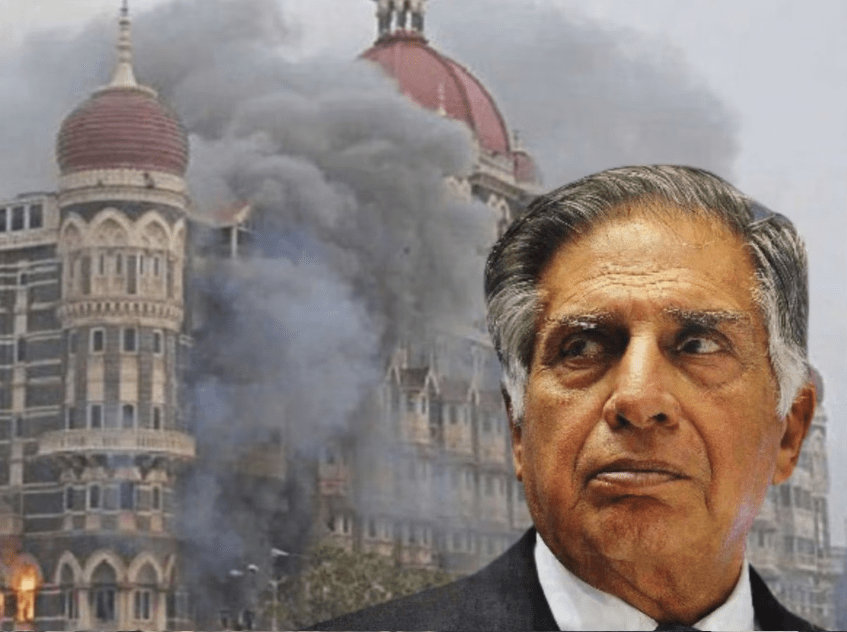
Ratan Tata & the 26/11 terror attack on the Taj

Ratan Tata passed away in the late hours of the 9th of October, 2024. The heartfelt sense of public grief and the profound sense of loss across the country was unprecedented. Social and print media, TV anchors, corporate honchos, political leaders and especially the common people bowed their heads in tribute. A social phenomenon unlike any other, akin to the emotional reactions after the sudden demise of Dr Abdul Kalam on the 27th of July 2015. Eminent scientist, author, teacher and the most distinguished President India has ever had.

On the late evening of the 26th of November 2008, 10 terrorists landed on the Mumbai shores via the Arabian Sea. They belonged to the terror group- Lashkar-e-Taiba-sponsored, supported and trained by the Pakistani Army and ISI. Other than The Taj, the targets were the Chhatrapati Shivaji Terminus, Oberoi Hotel, Cama Hospital, Leopold Café, Chabad House, and Nariman Lighthouse, for which recce had already been done. The terrorists split up to wreak havoc and terror. 2 entered the Taj, and two more joined later. Out of 1700 people at the hotel, over 1600 escaped safely; 34 died, including 17 staff members.

At around 10.45 pm, Ratan Tata reached the Taj after getting a call from RK Krishna Kumar, Director of Tata Group. For him, the hotel resembled a venerable old lady. Built in 1903 by Jamshedji Tata in defiance of the British for barring Indians from their hotels. In an interview with Fareed Zakaria (CNN), he admitted that he was truly emotionally overcome by the sight of the rather beautiful building going up in flames. He could hear the sounds of gunshots and exploding grenades from inside the hotel and felt ‘tremendously helpless.’ The fact that there were hundreds of people trapped in a life-or-death situation caused him extreme anxiety. But as Thomas Mathew writes in his book ‘Ratan Tata- A Life’ ‘for him, it was not just an attack on a hotel belonging to his group but on the nation.’ For 3 days the Chairman of the Tata Group (then 70 years old) stood at the Colaba end of the hotel. When it was all over, he was found at the back of the hotel feeding street dogs, which were distressed.

On the 21st of December 2008, the Taj reopened its doors. As the corporate doyen remarked, ‘We can be hurt, but we cannot be knocked down.’ Religious leaders of all faiths said prayers and performed healing ceremonies. The names of all 1700 Taj employees were read out to highlight their dedication to the Group philosophy. 540 employees who were on duty on the fateful days and could attend the function walked proudly through the lobby on a red carpet. Exactly one year after the horrific event, Ratan Tata unveiled a 12 ft high memorial with the heading- ‘for now and forever you will inspire us’- and there were etched the names of those who were killed in the terror attack. Just 21 months after 26/11, the Taj was restored to its former iconic glory.

Within hours, five outreach centres were set up by the Tata team to provide food, water and first aid to all affected across Mumbai city. In the days after, Ratan Tata & Senior managers visited all the injured at the hospitals to inquire about their well-being and pledge support. The Corporate Icon attended funerals and offered deep condolences and full support to the bereaved families. The families of the martyred employees were flown or driven to Mumbai and put up at the Taj President for 3 weeks at Company cost. He met 80 family members personally to share their grief and show his support. When his team came up with the rehabilitation package for each family, he kept saying, “This is not enough.” The Taj Public Services Welfare Trust (TPSWT) was set up. Ratan Tata broke all limits of empathy and generosity. Spouses or parents of Taj employees who lost their lives were awarded a compensation package of Rs 36 lakhs to Rs 85 lakhs. The spouses became eligible for full salary for their lifetime. The Company paid full educational fees for the children of the deceased and extended full medical facilities for the whole family for the rest of their lives. All loans and advances taken by the deceased were waived. The children who had lost a bread-winning parent were given an open offer of employment at any of the Taj Group of Companies of their choice. Plus, a counsellor was appointed for each bereaved family and for the Staff who survived the ordeal for any post-trauma stress disorder.

Listen to the story of Sunu Verghese (widow of Taj hero Thomas Varghese) meeting Ratan Tata, Krishna Kumar & Raymond Bickson, MD of India Hotels; when she cried and told Ratan Tata, “I have lost everything and we will go home now (to Kerala).” And Ratan Tata’s response, “We lost one of our golden employees in Thomas, and till you die, The Taj will take care of you.” In an interview with author Thomas Mathew, she tearfully said, “I have not seen God. But that day, I saw God in him. God was in front of me.” She was a housewife earlier but now works for the TPSWT. The Institution extended generous support and help to all those who were affected by the terror attack in Mumbai. Beneficiaries included police personnel, commandoes, railway employees, firefighters, pedestrians, and street vendors. TPSWT identified the 168 people who died and their families became beneficiaries of the Tata generosity. Even street hawkers who had lost their wares in the commotion were given brand-new handcarts. Amazing!!

Shaunak Chemburkar, a bell captain at Oberoi Trident, lost his life. TPSWT reached out to his widow, Anjali, and sponsored her beautician course. The whole family, including the paralyzed father and the Alzheimer-stricken mother, received medical and financial support. The Tata Trust stood steadfast with Karuna, a janitor at GT Hospital, and her 3 children. On 26/11, her 29-year-old husband Waghela was having dinner in their tiny house when a gun-wielding Ajmal Kasab knocked on the door. After 2 glasses of water, he sprayed the host with AK 47 bullets. Shyam Sunder Chowdhury, a pedestrian, was paralysed when a taxi full of RDX exploded as he crossed the road in Ville Parle. The Company where he worked did not offer any relief. TPSWT sends a monthly pension to Shyam and sponsors his children’s education. The Trust gave his wife and sister Skills training, and they are now working and earning for the family.

Whilst we salute the many brave-hearts amongst the Mumbai Police, Anti-Terror Squad and the Commandos who made the ultimate sacrifice for the Megapolis and the Nation, let’s highlight some of The Taj’s heroes.  The General Manager, Karambir Singh Kang, remained in the hotel and took charge of the rescue operations during the 3-day siege. His wife and 2 children were in a 6th-floor suite, but he did not walk away from his duty calls to take them to safety. Tragically, his family perished due to asphyxiation as fire engulfed the floor. He had promised his father, an Indian Army Officer, that if the ship goes down, I will be the last man there. Kang calls Ratan Tata ‘a corporate saint’ but adds that he ‘is at his strongest when cornered.’

Mallika Jagad, a 24-year-old banquet manager, was managing the dinner conference hosted by Uni Lever. As soon as she heard the gunshots, she locked the doors and switched off the lights. She and her team told the 60 guests to move away from the doors and windows and quietly hide under the tables. They were asked not to use their mobile phones. The staff moved the food trollies to block the doors but continued to serve food and water to the terrified guests. Leena Iyer, the HR Head at Uni Lever in a Survivors- TV Interview marvelled at the young manager’s admirable presence of mind and the calm composure in the nerve-wracking situation right up to their rescue by fire brigade officials and commandoes. Mallika had only this to say, ‘I may have been the youngest in the room, but it was my responsibility.’

Incredibly, even staff who had been evacuated came back to their station later, such as the all-women’s team of The Taj’s telephone operations. They stayed back the whole night, guiding the guests on how to stay safe and escape. They softly advised the guests in the rooms to stay quietly, switch off the TV and power, and even remove the entry pass card to delete the ‘Occupied’ sign.

Thomas Varghese, a 48-year-old senior waiter, acted instinctively when alerted to the terror attack. He herded the 50-odd guests from the Japanese restaurant down to the kitchen area. When he got the all-clear, he got his juniors to take the guests down the stairs in batches of 5. An active trade union activist, he chose to be at the tail end to ensure that his team would lead the guests to safety. Sadly, the terrorists shot down and killed the final batch of guests and Thomas Varghese. A butler, Sudharshan Thevar, also demonstrated extraordinary courage in rescuing a Swiss couple in their 70s from the 6th floor. He remained in their room and barricaded the door with the bar cabinet and luggage items. As acrid smoke started coming in, he broke the glass windows and took the couple to the ledge. However, as the fire brigade was not able to reach up, he rushed the couple down the stairs just clear of the engulfing flames and finally got them out by crawling out of an AC duct near the ground floor. He later, in a choked voice, recalled meeting Ratan Tata at a function at Taj Chambers where the British Consulate officials had come to thank the Taj Staff. As he walked up to shake hands, all he heard the Chairman of the Tata House say other than a sincere thanks was, ‘May God give me the strength. I wish to do more.’

The most intriguing aspect of the 26/11 attack on The Taj was that all the 600 employees at the hotel remained at their duty stations. Many were young, and many were the sole breadwinners. The natural human instinct would have been to escape, and they were all aware of all the backways and exits. They all stayed back with the single goal of taking all the guests to safety. Why?! It has been the subject of much discussion in academic circles, newsrooms, and multiple TED Talk shows. As Ratan Tata himself had said,’ there were no manuals, no instructions as to what to do in such a situation. These were civilians from the hospitality industry, not Armed Forces or para-military personnel.

How did they defy the psychological stereotype? Prof Rohit Deshpande from Harvard University, who has done extensive research on The Taj attack, came up with 3 theories. ‘Athithi Devo Bhava’ or ‘The Guest is God’ is an enduring theme of Indian culture. In those desperate times, the Staff did not hide or flee but chose to become protectors of the guests and lead them to safety. Plausible. A more reverberating explanation was that because of their humane culture, the Tata Companies evoked a deep sense of loyalty and responsibility from their employees. But the most revealing insights came when the Professor sought to understand the staff’s behaviour through the lens of The Taj’s recruitment process, training and rewards & recognition program. The Taj recruited employees from Tier 2/3 cities and towns where the old-world values still prevailed. Respect for Parents, Elders, Teachers, and Guests. The Tata team recruited for ‘character’ and not high grades. They looked for Integrity, Respect, Empathy & Responsibility. In the customer-centric hospitality industry, they want to delight customers with kindness and attention. The training system at the Taj was to create leadership and ownership from below. The front-line employees were ambassadors of the Guests, the voice of the Customer. Also significantly, even though The Taj was at par with other big name hotel chains on monetary compensation and incentives, they were far ahead on the appreciation and recognition quotient. Within 48 hours of a complimentary remark or comment from a happy customer, the said employee would be applauded not only by her/his department but by the entire hotel management & staff.  (Sourced from Thomas Mathew’s book and Prof Rohit Deshpande’s Ted Talk)

Ratan Tata’s steely resolve, indomitable spirit, and his extraordinarily compassionate response to the victims of the 26/11 terror attacks on Mumbai and The Taj has no parallels in the history of India or of any country in the world. Leaving the last words to the biographer, ‘In having responded the way he did to the crisis, he may have left behind a parable for the ages.’


Teflon Trump 2.0 & Its Implications for India

Reuters reported that ‘a convicted felon is elected as the 47th President of the USA.’ Yes, convicted on 34 felony counts. The only US President with 2 Impeachment trials against him. Acquitted for abuse of power and obstruction and later for the incitement of the 6th of January Insurrection and attack on the Capitol. A corrupt, venal person, a bankrupt billionaire and 78, the oldest person to stand for the Presidential elections. A true democracy would have barred him from contesting for the highest office in the land. He has brushed aside everything for a second term at the White House. Truly remarkable. Nothing sticks to him. Teflon Trump.

What has shocked the left-liberal elite is that Trump has rallied against the odds and won the mandate emphatically in a democratic way. He has won the popular vote against VP Kamala Harris by almost 5 million votes. His electoral college votes stack up to 312 vs 226 for Harris. 46% of women voters have supported him despite his anti-abortion stance and misogynist comments; Latino votes surged to 45%; young blacks signed up for him, and Evangelicals thronged up in large numbers. Many of the latter viewed the failed assassination attempts as a Divine Call of Destiny.

The Liberal/Woke meltdown is a seminal lesson for those living in a bubble; it’s also a wake-up call for genuine liberals as their potent ideology has been diluted and contaminated by an influential coterie of self-serving people.  Elite Hysteria- we have been betrayed by the people. The educated elite cannot believe that everyone doesn’t share their beliefs and views. They have created a partisan and ideological echo chamber – an environment where they encounter only opinions and thoughts that coincide with their own, and alternative ideas are simply shrugged away. Their take on Identity Politics is that minorities and ethnic groups will only vote their way; their condescending attitude referring to Latinos as Latin X; the gender quotient with women voters inevitably lining up for Kamala Harris; that nationalism and patriotic politics are past tense. That it remained a potent force manifested in the fear of unchecked immigration. Legacy media houses have shown their total disconnect from ground realities. One cannot find a more liberal person than Senator Bernie Sanders who lashed out at the Democrats after the defeat saying that ‘they abandoned the working class which led to the working class abandoning them.’ He acidly pointed out that 60 % of the American workforce lived from paycheck to paycheck and that 20 million workers did not get even a livable minimum wage. It all boils down to the quote: “It’s the economy, stupid.’  Trump said that He would Fix It. A big takeaway for the Indian Government also. Focus on Development & the Greater Good. In the visceral hatred that was shown to Trump by the mainstream media, it was conveniently ignored that in the first term of the Trump Presidency, the USA was not involved in or did not instigate any wars. Strange for the military-industrial complex that is the USA; strange that the leftist, liberal Dems have been pro-war when it suits their agenda; strange that a liberal, woke party has abandoned the working class. Selective Agenda. Selective Narrative. Selective Outrage. We also see this being played out in India. With our Left, Liberal brigade and their colonial and ideological hangovers- for whom the BBC remains the Voice of Truth, the New York Times as the Words of Truth.

The USA has been revealed as a polarised and flawed democracy. Indian democracy and institutions come off better in comparison. Please watch the National Geographic documentary- The Great Indian Election, to appreciate the sheer magnitude and scale of the democratic exercise and how effectively it is conducted by The Election Commission of India. The Electronic Voting Machines (EVM) work effectively with Opposition protests only when they lose the election. Another pillar, the Supreme Court of India, shines when compared to SCOTUS, a rigged, corrupt institution where appointees have lifetime tenures. Kamala Harris could not become the first US women President; India already had 2 women Presidents and a strong Prime Minister in the late Mrs. Indira Gandhi, who held office for almost 16 years. It’s high time for us to shed our mongrel attitude-constantly deriding and undermining ourselves as Indians.

Millions of Indians are rejoicing at Trump’s phenomenal come-back. CAUTION. One cannot project one’s preferred outcomes on such an unpredictable personality. Trump 2.0 will disrupt the Global Order. His protectionist economic policies with higher tariffs will adversely impact Indian exports. Hopefully, things will turn out well for Indian-born green card aspirants. It is highly likely that Indian students will continue to be welcomed at US colleges, and so will be skilled Indian professionals. Trump is also expected to pull back on global commitments, and we don’t know how this will play out. However, a Trump Administration can ease things for India regarding national security, national interests, and strategic autonomy. Also, India and its companies may not be sanctioned for buying oil or armaments from Russia or doing business with them.

The Trump win may pay other dividends for India on the geopolitics and national security front against covert, subvert warfare by foreign parties. George Soros, a hedge fund manager, played a major role in triggering the 1997 Asian Financial Crisis. He bet against the Malaysian currency and ruined the economy and also made huge profits by betting against the Thai Baht. The South Korean Won and Indonesian Rupiah were also targeted with dire results; this led to currency devaluation, large outflow of capital and years of political instability. Earlier in 1992, he became famous as the man who broke the Bank of England by betting against the British pound and making a billion dollars for himself in the process. Cut to 2023 when Hindenburg Research, a forward trading investor, made allegations about questionable financial dealings through offshore entities connected with Adani. Some months later, The Organized Crime and Corruption Reporting Project (OCCRP), funded by the Soros Open Society Foundation, alleged that Adani had engaged in stock manipulation and accounting fraud and channelized large funds to fronted offshore accounts. Old habits die hard. Adani shares tanked, and about a dozen unknown entities profited from the spoils. The Soros plan was to kill two birds with one stone. Sure enough, Rahul Gandhi and the Congress started screaming about Crony Capitalism and Corruption. Name-calling and allegations of corruption are the norm -whether it is the USA or India. The 2024 elections were around the corner. It’s the insidious, clandestine foreign meddling which is deeply disturbing. The Opposition did not join the chorus as expected and for a simple reason. Adani already had a gas-line project in the DMK-led Tamil Nadu; the Communist Government in Kerala had awarded the business house the contract to manage, operate and maintain a large port; Adani had built a major port in Naveen Patnaik’s Odisha; even the Congress-led Rajasthan Government had awarded the largest hybrid power project to the Corporate.

The Hungarian American billionaire Soros has been the largest donor to the Democratic Party for many years. Suggest to please read the book ‘Shadow Party’ by David Horowitz and Richard Poe- about how the Clintons and Soros and the 60’s radicals took over control of the Democratic Party. A NYT article eulogized him as a protector of democracy, an anti-communist, an anti-nationalist, global liberal. Soros’s clandestine influence extends to liberal media, Ivy League colleges, and established Think Tanks & NGOs, which enables him to manipulate societies and even destabilise governments. Alternate media in the US have talked about his dark side- controlling society without interfering with legislation but by controlling how laws are enforced. Thus, creating chaos and undermining the power of lawful authority.

With a Trump White House, Soros and his influential minions will be on the back foot. Especially with a powerful Elon Musk to contend with. Hopefully, it will provide India with respite from malevolent foreign interference—some examples. In 2018, Soros Open Society backed NGO -Sherpa Association filed a corruption complaint with the National Financial Prosecutor in France against the 36 Rafale aircraft deal. Connect the dots. Rahul Gandhi, Congress and the Opposition screamed ‘Scam’, and this was amplified by our Left, Liberal media in the run-up to the 2019 General elections. Frustrated that his plans had not worked out, at the 2020 Davos Conference Soros openly slammed the PM Modi Government ‘as the biggest and most frightening setback for the survival of Open Societies’ specifically mentioning CAA & Kashmir. Move to the prolonged farmer’s agitation (mainly from Punjab and in part from Haryana) in 2020-21, funded by Soros and Canadian Khalistan outfits. Please recall celebrities like Rihanna and Greta Thunberg (environmental activist) and some from Bollywood butting in.

The shadowy power of Soros. Reuters Alessandra Galloni, whose quote started this blog, is on the Committee to Protect Journalists, funded by Soros—likewise, NBC’s Lester Holt & Associated Press’s Julia Pace. CNN’s Christiane Amanpour is on the Board of Centre for Public Integrity, another Open Society venture. On a prime-time TV show she spoke of PM Modi in the same breath as Xi Jinping, Putin and the Dear Leader from North Korea. Really!! The glowing tribute of a book, ‘The Philanthropy of George Soros’ is written by Chuck Sudetic, a NYT columnist who now works for the Open Society Foundation. Economist Sanjeev Sanyal hits the bulls-eye when he says that there is so much anti-India stuff around that if AI or Chat GPT had to submit an India report, our democracy , human rights record, and governance would be shown in a starkly negative light. So, to Rahul Gandhi’s Cambridge University visit a few years back. He waved a copy of ‘The Guardian’ with the headlines, ‘Indian democracy in danger.’ It’s amusing to note that after Trump’s election, The Guardian offered counselling & therapy services to its staff and reporters.

Let’s talk about the recent events in Bangladesh. Sheikh Hasina and the Awami League are overthrown in a well-orchestrated coup by so-called student leaders—an Islamist, extremist+ the Soros signature – an anarchist movement. The Chief Advisor to the interim government is none other than Muhammad Yunus- the esteemed ‘Banker to the Poor’ through the micro-finance Grameen Bank. He is also a Nobel Laureate, winning the Peace Prize in 2006. With humungous support from former President Bill Clinton, Hillary Clinton and who else… George Soros. The Anti-Corruption Commission acquitted him of the graft charges of misappropriating $ 2 million from the Grameen Telecom Workers and Employees Welfare Fund. The Soros heir, Alex Soros, visited him in Dhaka on the 2nd of October to reinforce his support. In 2016, Yunus contributed generously to Hillary Clinton’s Presidential campaign fund. Trump’s upset win left him ‘shattered and barely able to speak or breathe.’ He dismissed it as a ‘solar eclipse’. Trump’s return to the White House has left him writing a long, rambling congratulatory message. This was surely not anticipated by ‘the Deep State.’  It is a relief of sorts for India with another hostile neighbour appearing on our borders. A point to ponder. Candidate Trump before the Election date condemned the attacks on Hindu places of worship in Dhaka and Chittagong. The Nobel Peace Prize winner has remained silent.

Although India and China have already entered into a border cease-fire agreement, the US election results will help in dousing the dragon fire to an extent. With economic problems and the threat of high tariffs for Made in China products, Emperor Xi Jinping and the CCP will have to reset their priorities. If nothing else, the uncertainties unleashed by Trump will keep them guessing. But you never know with Trump. The Saudi Prince made him dance with a sword and followed up by bailing out his son-in-law Jared Kushner from a financial crisis. If China confers him with the Ancient Order of the Dragon or invites him to grace a throne on the Great Wall, one never knows. It’s certainly bad news for Pakistan. They badly need bailouts from the IMF and the World Bank which are controlled by the USA. Also, Trump’s acknowledgement of India as a major power and the apparent Trump-Modi bonhomie will alarm the Pak Army-ISI Establishment.

Justin Trudeau will be unnerved by The Donald’s comeback. Trump had called him ‘two-faced’. The USA is Canada’s big brother, and 75% of the nation’s exports go there. He has called Khalistan Canadians celebrating the assassination of PM Indira Gandhi as ‘just exercising freedom of speech’. I sometimes wonder why the grandson and daughter-in-law are not up in arms as they should be. The unsubstantiated allegations against the Indian Government of killing Nijjar have taken a heavy toll on diplomatic relations. The attacks on Hindu temples and devotees have further undermined his hollow narrative and exposed his hypocrisy. It’s all vote-bank politics to secure his political future. Thus far, the Biden-Harris administration has played along, claiming that there was an imminent threat to another guy called Pannun. Knowing that his cosy days in the US are over, Pannun has moved to Canada and threatened to attack Hindu temples this month, including the Shree Ram Temple at Ayodhya on the 16th/17th of November. Justin Trudeau represents the white, woke icon who has self-destructed over the last few years. As regards the Sikhs, they are a hugely respected community in India for their contributions to society and the country. (Trivia- the convicted assassin of Sheikh Mujibur Rahman – Captain Noor Mohammad- has been enjoying the good life in Canada for the last 3 decades and more. Just so that you get the big picture.)

Liberal philosophy is, in its essence, a progressive philosophy. But anything good, if taken to the extreme, becomes counterproductive. Unfortunately, this humane ideology, which was primarily meant to uplift the disadvantaged and focused on human welfare, rights, freedoms and values, has been hijacked to suit the personal ambitions and agendas of some powerful people. Disconnected from the problems of the common folk and from ground realities. Many, many others have been misled, lured and trapped in this Elitist bubble. India is on track as the world’s largest, functioning democracy. However, it is a work in progress with issues of criminals in politics, corruption, unemployment, long-pending structural reforms of the judiciary and police, tax reforms and societal fractures around caste, creed and community yet to be addressed effectively. The Trump re-election will put on hold the subversive warfare launched against India to halt its progress and growing global structure. It also has many lessons for our Government and political leaders- to listen to all sections of society & to focus on innovative, inclusive development for The Greater Good.

Movienomics

The trending news from Bollywood is that Reliance Jio Studios is in the final phase of discussions for buying the major stake in Karan Johar’s Dharma Productions. Earlier talks with Mr Sanjiv Goenka’s Saregama Group fell through because of valuation issues. Founded in 1976 by Mr Yash Johar with a resounding hit ‘Dostana’, the Company has produced 63 Hindi films with 3 on the floors. So why is this such a big deal.?! Karan Johar represents the centre of the elite and entitled Bollywood club; an omnipresent mover and shaker; other than his films, there is the much-watched, controversial TV show, fashion walks and his celebrity Emcee avatar at all the glittering film awards functions. His considered decision to offload much of his stake (90.7%) and his mother’s stake (9.3%) starkly reveals the tumultuous state of the Hindi film industry.

Listen to his comments also. How has the Mumbai film industry run itself to the ground? First, the stars demand high fees, but the films open poorly, creating unstable economics for producers. The budget structure is skewed so heavily in favour of stars (50%) that there is little left for the technical crew. Simply put, if A-listers cannot generate hits, how do they justify their high fees?! Saif Ali Khan has responded that movie stars should not charge exorbitant fees but…shrug…. shrug, this is a part of the economics of the industry. (Read- Dharma Productions itself is complicit in creating this unbalanced structure.)

The Bollywood mogul has also ranted about the high-ticket costs and F&B charges which have driven audiences away from cinemas. His take is that the average cost for a family of 4 works out to Rs 10,000/. Visits to the cinema have plummeted from 8-10 a year to just one or two. The Multiplex Association of India (MAI) has responded that cinema prices are dynamic and flexible depending on location, day of the week, seat zone, film format and star hype. Higher ticket prices also prevail in the first week, weekends and holidays and even night-shows. MAI has said that the average ticket price at PVR-INOX (1700 multiplex screen leader) is Rs 258/. Plus Rs 132/ as average cost for food and drinks- total expenses of Rs 1560/- for a family of 4. Methinks, the IMA has halved the normal expense for a family movie outing at a multiplex. Mr Ajay Bijli of PVR has said that only 14% of the tickets are priced at Rs 350/ with the rest between Rs 180/- and Rs 200/-. Experience suggests otherwise. The ATR for All India Theatres in 2023 was stated at Rs 130/.

Let’s shed some light on Mr. Vashu Bhagnani’s plight. He became Producer No 1 in the 90s with his rollicking David Dhawan- Govinda movies. His recent release, ‘Bade Miyan Chote Miyan’ made on a whopping budget of Rs 350 crores sputtered to a lifetime collection of Rs 64 crs at the BO. Mr Bhagnani had made tall claims of Rs 1000 crs collections at pre-release events. Alas, the film disaster has reduced him from Bade Miyan to Chote Miyan. With Rs 200 crores of debt he is selling his Juhu Office to, he says, redevelop the building into a luxury residential tower. The film’s director, Ali Abbas Zafar, has sued the producer for non-payment of Rs7.3 crs; accusations of unpaid wages to crew members are also doing the rounds. So, what about the 2 lead male stars, Akshay Kumar and Tiger Shroff? With reported paychecks of Rs 80 crs and Rs 40 crs they are laughing all the way to the bank.

Let’s delve into the Indian cinema ecosystem. We produce the largest number of films in the world- 1500 to 2000 every year- in 20 languages. Our huge country has only 9742 screens as compared to 65,500 in China & 35,280 in the USA. Hindi, Telugu and Tamil are the leading film industries, with Malayalam, Kannada and Marathi cinema also punching above their weight. In 2023, South Indian cinema surged ahead of Bollywood with 47% BO market share against 44%. South India also houses 47% of the cinema theatres. According to researcher Mr Hemant Chaturvedi, the number of single screens in India has declined from 25000 in 1990 to less than 6000, with many of them not operational. End of an Era. With the rising cost of real estate, many have been converted into malls and commercial complexes. Even a smaller theatre costs Rs 5 lakhs for monthly upkeep and maintenance plus the pressure of keeping the projection room, sound system and screen in the best condition. The GST on cinema tickets is 18%, but most States levy an additional entertainment tax of 20% to 30%, the highest tax ratio for any sector in India. Business uncertainties add to the gloom.

The Hindi film industry traditionally had 6 territories, which are now defined as 11 circuits. The profit-sharing ratio generally for a single screen owner/ distributor is 25:75; sometimes, it is 20:80 or even 30:70. The Multiplex owners have all the heft and clout—Week 1 is 50:50, Week 2 is 60:40, and Week 3 is 70:30.

For the Producer, the cost of the film is Budget + Promotion and Advertising expenses. They also sell OTT rights to streaming platforms like Netflix, Amazon Prime, Hotstar, Sony Liv… to help recoup their investment. Earlier OTT contracts were pre-sold, and even if a film performed poorly in its theatrical run, the contract was adhered to. This proved to be the lifesaver for the Kartik Aryan film, ‘Shehzada’ which mustered only Rs 32 crores at the cinema counters against a budget of Rs 70 crs. Reportedly, Netflix had paid Rs 40 crs for the streaming rights. Trade analyst Karan Taurani says that now there are clauses in the streaming deals regarding the theatrical performance of the film-where streamers say that only when a film reaches a certain threshold in theatres will the overflow or agreed additional amount be given.

It’s the distributor who takes significant risks when they purchase the rights to distribute a film. They hedge their bets by acquiring the satellite and music rights for the movie. T Series bought the audio rights for Pushpa 2-The Rule for a staggering Rs 65 crs. SRK’s Jawan’s rights had earlier been bought by T series for a record-breaking Rs 36 crs. Tamil-Nadu, Telangana and Andhra Pradesh have a large and passionate fan base for film music. Film songs become chartbusters and are played on a loop on FM stations and streaming platforms like YouTube, Spotify & Rasso. Flashback to the Iconic film ‘Sholay’. In 1975, its dialogues album sold 500,000 copies. By 1979, the platinum 1 million mark was crossed. The film exceeded its Rs 1 crore budget 3X. It grossed Rs 35 crs worldwide and brought in another Rs 35 crores in re-releases. Adjusted for inflation the box-office figures exceed Rs 3000 crores.

The ‘Adipurush’ disaster saga is a cautionary tale for distributors. People Media Factory bought and backed this Rs 550 crs budget film confident of a pan-India hit because of the Prabhas factor; the director Om Raut had delivered a hit with ‘Tanhaji’; plus the fact that it was inspired by the Epic Ramayan meant nothing could go wrong. Superficial performances, shallow storyline, poor VFX and cringeworthy dialogues scripted a mega-disaster. The character, ostensibly inspired by Lord Hanuman, was spouting tapori-style dialogues. Social media was outraged, and the distributors were looking at Himalayan losses of over Rs 150 crores.

The financial challenges for the Indian film industry have been cited as a big drop in audience footfalls, rising cost of production and the growing popularity of OTT platforms offering many options. The Covid lockdown has opened the eyes and sensibilities of audiences to better and more engaging cinema from all parts of India and worldwide. Reliance Jio Studios already holds stakes in Balaji Films and Viacom 18. The phenomenal success of the horror-comedy film Stree 2, which they co-produced with Maddock Films, must have propelled them on. The biggest Hindi film hit of all time with net collections of Rs 600 crores plus and riding on a budget of just Rs 40 crores. The lead actors Rajkumar Rao & Shraddha Kapoor don’t fall into the celebrity guest profile for’ The Koffee with Karan Show.’

Content has become the King. The Vijay Sethupathi-helmed film ‘Maharaja’ is a stellar example. Made on a budget of Rs 20 crores it closed its theatrical run at Rs 107 crores. This masterpiece is jointly produced by The Route, Think Studios, and Passion Studios. Many large and mid-budget films are now following this joint production template. This highly emotional action thriller is a case study in moviemaking. Impactful performances, master-class direction, great screenplay and editing with jaw-dropping twists and turns, real dialogues and photography that make the visual experience so intimate. Since being released on Netflix in July 2024 and with an IMDb rating of 8.5, it has become the most-watched Indian film of 2024. Content is King. Whether it is the true, relatable and inspirational story of ‘12th Fail’ or the real survival and rescue thriller Manjummel Boys. It is the biggest Malayalam hit film ever without marquee names like Mohanlal or Mammootty. The Marathi classic ‘Tumbad’ became a cult film on OTT and is drawing large audiences on its theatrical re-release.

The assembly line productions of Akshay Kumar films- wrapped up in 40 days- no longer work at the BO. One of the greatest duds from the house of YashRaj Films is ‘Pruthviraj Chauhan’ where this star is said to have charged a whopping Rs 60 crores. Many shows were cancelled due to zero attendance. The film fans went hoping to see a glimpse of Samrat Pruthviraj; all they got was Akshay Kumar in every frame. The audience has become unforgiving; social media can influence the fate of a movie on the first weekend itself.

The Soft Power of Indian Cinema is immense. But again, it’s all about the quality of content and the entertainment quotient. Stories with human appeal and emotional connect, catchy music or well mounted large screen spectacles. RRR rode high at the Japanese Box office on all counts. In China, Aamir Khan’s ‘Dangal’ and ‘Secret Superstar’ minted Rs 1400 crores and Rs 810 crores—mind-boggling numbers. Strong storylines created social, cultural & emotional phenomena.

It’s time for Bollywood (and the Indian film industry) to acknowledge their self-inflicted problems. It’s time for them to recognize that good films are created out of collaborative teamwork – where writers, editors, cinematographers, music directors, production designers, and VFX specialists – all play a significant role. They must be recognized and rewarded for their creative contributions. It’s also time to acknowledge that audiences today will flock to the cinema halls in large numbers only if they feel that both their money and time is well spent.

Toxic Workplace

The tragic death of a 26-year-old CA employee at the EY office in Pune has sparked a massive outrage on social media, forcing government authorities and the National Council for Women to investigate the matter. Unfortunately, the EY India Head’s immediate response reveals a hard-nosed mindset. ‘There is no doubt that each one has to work hard. EY employs 1,00,000 people. She was allotted work like any other employee. We don’t think that work pressure could have claimed her life.’

This cold, distant, unempathetic, transactional management style of managing human resources (which doesn’t sit well with Indian culture) can be traced back to Jack Welch- the celebrity CEO of the Iconic General Electric. He is the guy who reduced human resources to ‘Cost to Company.’  This much-feted Management guru boasted of massive lay-offs on prime TV. Cost-cutting became the buzzword. Just over two decades after his exit, GE is not the brand it was. Some of his devotees moved to Boeing and have virtually grounded the Company. The demise of the 158-year-old Lehmann Bros in 2008 was due to the extreme hustle culture fostered by the CEO. Numbers, Numbers, Numbers!!!  As I write this blog, the Sick Leaves at the Tesla German plants are at a staggering 17%. Mainly Monday Blues. Cautionary tales.

Two other real-life cases highlight the pervading toxicity at workplaces. A young cyber-security professional I knew with an IT major in Pune was brusquely summoned to the office despite having a high fever. The Boss wanted to meet the team. Nothing of substance was discussed. The same evening, the tests revealed Dengue, and he had to be hospitalized. He continued with the company for another year only because family commitments needed to be addressed. Now, he works as a head of cybersecurity for a global IT company in Seattle, USA. He is also a respected ethical hacker on the US Cyber Authorities panel.

In another scary case told to me by friends in another firm, a middle-aged VP of Marketing got a humiliating dressing down at a virtual meeting called by his boss with many of his team members also linked in. Otherwise, a consistent performer, he and his team missed the half-yearly targets. At night, he developed severe chest pain and was rushed to the hospital by his wife and neighbours: a sudden heart attack and 7 days in the ICU. Months later, when I met him, he had changed jobs but looked like a pale shadow of his former fit, smiling self.

So why do the Jack Welch dogmas enamour so many corporate honchos? The gruelling boot camp culture is designed for and compatible with the Armed and para-military forces. Where hierarchies are clearly defined, orders must be obeyed & followed. In the life-and-death situations of war and combat and terror strikes, such a system makes ample sense.

Through the lens of some in top management, the competitive marketplace is another battlefield. Profits, Market Share, and Brand Value are the holy trinity. The Board breathes down their necks. The corner cabin can become a lonely place and a little bit overwhelming. So, the pressure is downloaded down the line.

Reviews, Analysis, Plans and Targets are the recurrent themes. This is the easy option. There is no time or bandwidth for authentic leadership, effective communication, collaboration, team building and problem-solving. After all, they are employees and are paid well to do the hard work. Period. Even if, at times, employees sadly morph into human targets. Onboarding and orientation sessions are mandatory- but not well-designed, curated or managed. However, the management takeaway is that since the employees have undergone such training, there is no need for actual on-the-job mentorship and hand-holding.

A constant refrain is that team members on the frontline, new entrants or even some in the middle management are not taking Ownership of their roles and responsibilities. It’s also said that the younger generation is not up to the grind- for example, it does not want to take sales roles. But do the senior echelons reach out to them, converse and engage with them and most importantly, mentor them? The youngsters will show what they are capable of and rise to the occasion or fall short of expectations. Some of them are unaware of their work profile or what is expected from them. It’s possible that the younger generation values work-life balance. It’s also likely that some have not worked out their career paths. Yes, sincere, focused work is non-negotiable, and the shirkers & slackers ( Kaam Chor) will be shown the door. Employees will be expected to even punch above their weight. No free lunches! Zero tolerance for inappropriate behaviour and unethical conduct. The lines can be clearly drawn..However, it is imperative that senior school and especially college students be given regular doses of Resilience to help them navigate well in tough situations.

It’s disappointing that the number of hours logged seems to be the main criterion for judging performance or employee loyalty. 11–12-hour workdays and being the last to leave the office are like a badge of honour. Whether these hours have been productive in terms of quality or useful work is anyone’s guess. Responding to work emails and messages at midnight seems to demonstrate the employees’ level of commitment. Simply put, workaholism is a disease. It will take its toll.

Then, there is this growing breed of Quiet Quitters. Fed up with the pressure cooker atmosphere and fearing burn-out, this detached group works quietly under the radar, doing only as much as they have to.

We also have some corporate leaders rejoicing at the prospect of AI, BOTS, Robots, Apps, ChatGPT taking over human jobs and performing them much more efficiently and with no fuss. No frustration, no fatigue of managing the unpredictable Homo Sapiens.

As she/he climbs the corporate ladder, one assumes they will become more leaders and less managerial. But the fetish for micro-management and control continues. In some of the Companies, I am aware that even senior managers don’t have the autonomy to decide & discuss, work and deliver. The mantra for sound, sustainable and consistent business results is simple. A healthy work environment breeds higher productivity and focus. Collaboration fosters team spirit and synergy. For the Boss, the team down the line becomes the Ear to the Ground. Market Intelligence, Opportunities, Challenges, and Solutions are all channelled up to her/him for a considered decision. The happy dressing room culture Rahul Dravid and Rohit Sharma created speaks for itself. The pressure of representing India on the cricket field is immense. However, even after the heartbreak of losing the ODI WC final last year after a 10-match winning streak, the Men in Blue brought home the T20 WC earlier this year. Early days yet, but hopefully the Gambhir-Rohit combine will take The Men in Blue from strength to strength.

All Companies have a Vision and mission statement to encapsulate what they stand for. Typically, it is about protecting and enhancing the shareholder’s interests and profits, providing the best products or services to the customers, and being the preferred place to work for an employee. If quality attention is given to employee wellbeing, it will pay good dividends for both the shareholders and the customers.

The HR Vertical or Human Resources Department is a critical component of any corporation. The primary function of HR is good recruitment practices and fostering employee well-being and bonding. As part of the business strategy, HR can mobilise a trained, committed workforce for the C Suite to leverage and deliver the business results the Board desires. Sadly, in many companies, HR is taking a backseat and presumably does not want to rock the boat.HR becomes visible only through its usual calendar of activities on festivals and events.

I got intriguing feedback from a friend in an established placement firm that even senior professionals and CXOs are scrutinizing potential employers for toxic work cultures and are even turning down lucrative offers if they see red flags. The red flags are familiar but worth elaborating on: the command-and-control structure, lack of work autonomy, frequent changes in role and reporting, excessive office politics, and poor work-life balance.

The rising awareness of mental health issues and the importance of workplace wellbeing should resonate with corporate leaders & in the Boardrooms. The collateral damage is immense. An employee who logs in 10 hours of work daily is probably commuting to and from work for a few hours. A significant part of her/his life plays out at the Office. A frustrated employee is bound to unleash his/her angst at home with the family. Or seek refuge in alcohol, tobacco and even drugs. I remember a poignant moment when I visited the home of a friend whose job did not offer work-life boundaries. Indeed, he was busy on weekends also. His teenage son told me that his father had become a stranger. The Bosses in control should also take a moment to reflect that they, themselves, are also human beings and have other roles and responsibilities. They cannot switch on or off at will. The physical and mental scars will emerge- side effects of the relentless, controlling and even aloof style of leadership opted for.

Let me end on a positive note. His large team dreaded the COO of a corporate client of mine because of his ruthless approach. He was also known for publicly disrespecting even senior team members. He took a month’s break for Vipassana, Yoga and Meditation and returned as a refreshingly changed person.  His direct reports told me he had become more understanding and supportive. When I met him, he smiled and said he had discovered a better version of himself.

Some organisations and several leaders earnestly believe that leadership can be firm but fair- and they consistently perform well. They seem to be outliers, bucking a growing trend. In some large corporates, we find a strange mix of leadership styles, with some respected leaders having employees queuing up to work with them.

Hence, all that is required is for some influential CEOs and CXOs across industries to step up and say enough is enough. Let’s strive for the best possible and realistic balance that creates a Win-Win-Win for all the stakeholders. Leadership will be firm but fair. The pendulum will swing back nearer the middle. Leave the rest to the Ripple Effect phenomenon.

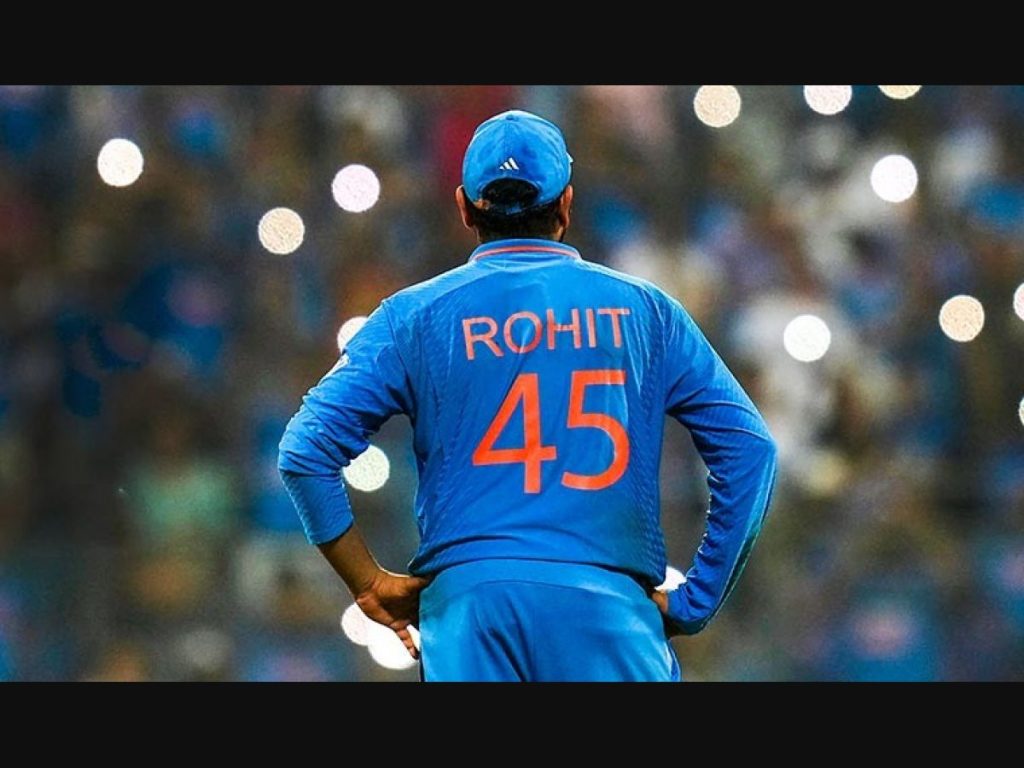
Management Learnings from ‘The Hitman’- Rohit Sharma

Captain Rohit Bhai

I earnestly believe that Team Sports at the highest levels provide a lot of learning for Corporate Management. There is no place to hide. It’s all out there happening in the open in an acutely competitive atmosphere. Goof-ups and crisis management; injuries and replacements; bonding and friction; Ups and downs; temperament and the Never Say Die spirit; leadership and rising up to the occasion; teamwork and collaboration; communication and defining roles; analytics and research; planning and execution. Hence my earlier blogs on ‘Management Lessons from Sports’, ‘The Gift of Captaincy’, and ‘Management Lessons from The Thala- MS Dhoni’- the last posted after CSK won a thrilling IPL final last year.

Rohit Sharma’s so-called laid-back demeanor hides the profound impact he has had both as a captain and batter for India and the IPL franchise. His affable, grounded, pragmatic approach has caught the attention of cricket pundits, cricketing legends, and cricket buffs all over the world. Some of the parallels with MSD are striking and The Thala’s influence is palpable. Rohit Sharma suddenly became the captain of Mumbai Indians in 2013 with Icons and seniors like Sachin Tendulkar, Ricky Ponting, Harbhajan Singh, and Malinga in the squad. Anil Kumble, then associated with MI, remembers that he was completely unfazed and self-assured. Like MSD with the India captaincy, he gave the stalwarts Respect and Space and seamlessly aligned them for the Team’s cause. The Mumbai side picked up its first IPL trophy in 2013. It was also in the same year that Dhoni promoted this middle-order batter to open for India in the Champions Trophy and the rest is history. The Rohit Sharma- Shikhar Dhawan partnership. Dinesh Karthick ( w/k batsman) who was also part of the MI team has observed that the omission from India’s 2011 World Cup team shook him up and he developed the quiet, steely resolve to make every match and tournament count.

‘I have tried to keep it simple. One thing- clear communication to the players. I have tried to make sure that they understand their roles and that’s what it’s all about. Understanding their roles  and going out there and performing their roles.’ Another page out of MSD’s Captaincy manual. Sadly in the corporate sector, there are many employees, especially on the front line who do not understand their roles, contributions, and value to the team, office, or organization as a whole. The positive energy of team synergy and getting the bigger picture is missing. In the vertical or silo systems embraced by many Companies in the Service Sector, the sense of disengagement is even more pronounced and bureaucracy kicks in. Customer Service is the first casualty.

The unique Rohit-bhai takeaway is ‘that there has to be a sense of relaxation as well because it is important to keep the atmosphere light and cheerful’.  But this coin has not dropped with some at the senior levels of corporate hierarchy and even at Board levels. Employee productivity and performance spike if the work atmosphere and culture are congenial- leading to better results and a more robust balance sheet. Virat Kohli calls Rohit ‘the funniest person in the Indian dressing room.’ His tapori language (Mumbai street lingo) and chilled-out behavior are both endearing and calming. The super intense Kohli seems to be enjoying his cricket as never before, laughing and joking with the team.  No overweening egos, no insecurity, no camps. Reaching out and Bonding. The Hitman and The King are Bros for the Indian cricket mission. True, the stump-mic has caught the captain scolding and using cuss words with some team members on the field. But as Rohit Sharma simply puts it, ‘It’s not to hurt anyone. It’s just to make sure they are on the job and are thinking about the team.’ Other funny stump-mic comments have gone viral. In the third T-20 match against Afghanistan he got off the mark with a boundary down the leg-side but umpire Virendra Sharma signalled leg-byes. He approached the umpire with ‘Arrey Viru, thigh-pad diya kya? Bat laga tha. Already mere do zero ho gaya.’ (Did you give it as leg-byes. It hit the bat. In my previous 2 innings I have got ducks.). The Indian commentators in the box doubled up laughing.

Listen in to the Skipper’s report card ( on YouTube -Cricket Boy) on how the Men in Blue performed in their magnificent 4-1 Test win against an England team on a Bazball roll. First, the series-defining partnership by Jurel and Kuldeep Yadav at Ranchi. The emotions around Sarfaraz Khan winning his India cap at the Rajkot Test.  How many years earlier he had played with the father Naushad in the Kanga league. Jaiswal’s dominating double century at Vizag. Bumrah’s 6-wicket spell in the same Test- reverse swinging the ball on a flat track in hot and humid conditions. The best fast-bowling display he has witnessed in India. The ‘legend’ of Ashwin and the brilliant return of the match-winning Kuldeep Yadav. Appreciative mentions of Gill and Jadeja. Special mention of how much he has enjoyed playing with these passionate young cricketers. No mention of his captaincy except to say that he had learned many things during the series. No mention of missing the likes of Kohli, Rahul, Shami, and Pant in the team. When have you last heard of a Corporate Captain being so warm and fulsome in his praise for his team? Teams matter. Corporate heads are representative of their teams. When the team performs well, a generous amount of credit rubs off on the leader.

Rohit-Bhai has been the Big Brother or the ‘Go-to’ man even before he was appointed as captain. You will see his hand over the shoulder of a dejected Kuldeep Yadav who had a bad day at the office. According to Parthiv Patel, ‘Rohit whole-heartedly supports his players even when they are grappling with difficulties demonstrating an unwavering faith in their abilities. There is an unparalleled sense of calmness in the team.’ He then refers to the case of Bumrah brought in by the MI scouts in 2014. By 2015, the management was pondering to send him back after half of the season. But the captain staunchly believed in his abilities and in 2016, the journey of India’s premier fast bowler across formats began. Likewise, Hardik Pandya’s entry in 2015 and after a lack-luster 2016 season many at MI were showing him the exit door. Again, the leader supports the player giving Pandya the chance to become the player he is today. Very ironic, isn’t it? Considering the recent developments at the franchise.

The Captain has to be a good mentor to bring about the best in her/his team. This is a critical attribute to anyone at the Senior or Middle Management levels handling a sizable team. Companies and Institutions unfortunately do not factor in this ‘X’ factor in the KRA’s and Appraisals. It’s all about numbers. So a person with a 15-year innings pops up on the radar as a Cost to Company (CTC). What the team leader is quietly doing daily behind the scenes is overlooked- training and motivating the team, sharing experiences, developing a second line- all fall through the cracks. One of the most critical attributes of an effective Manager- mentoring- is simply shrugged off.

R Ashwin’s exit from Team India after the second day of the Rajkot Test tells a heart-warming story. .The Test match was evenly poised and with the series itself at stake we have Rohit Sharma and Coach Rahul Dravid persuading their main bowler to take the BCCI arranged charter flight to Chennai to attend to his ailing, hospitalised mother. The star spinner then re-joins the Men in Blue on the 4th day of the Test with his recovering mother insisting that her son not let down the national cricket team. Little wonder, that in an emotional video posted on his YouTube channel Ashwin says, ‘I would give my life for him on the field, that’s the kind of captain he is.’ We have an increasing treadmill corporate culture where leave applications for genuine reasons are frowned upon and even family time on weekends is being compromised.

Rohit Sharma has a sharp cricketing brain and reads the game well. Zaheer Khan has this to say, ‘Rohit acts according to the situation, and many times they are different from what may have been planned in the run-up to the game.’ In corporate life also at times long-term planning and rigid structures become constrictive and hold back the Company from changing course pragmatically, especially in dynamic market conditions. Plus the Cool factor he brings to play. Hence no panic buttons after the disappointing loss at Hyderabad from a position of strength. Instead, a determined come-back to dismantle Bazball. Astute handling of bowlers and smart field placements frustrated the English batters and they collapsed like a pack of cards multiple times in the Test series. Another important learning is how the India captain did not hesitate to pick on the brains of key players like Bumrah and Ashwin. A good leader should be open to ideas and suggestions from the core-group and resonating from the ground. The Ivory Tower syndrome has to be avoided at all costs.

Leadership is not bequeathed through job titles or the size of the corner office. Every Corporate leader or Manager worth her/his salt has to earn the respect and trust of the team members by setting the right example and by leading from the front. ‘The Hitman’ ticks all the boxes across all formats of the game. A Test batting average of 45+ over 59 Tests, more than 10,000 runs over 292 ODI, and a Strike Rate of 92; almost 4000 runs in 151 T-20s at a Strike Rate of almost 140 which puts him in the Sehwag league. He has scored hundreds and double hundreds; changed games with his sixes and fours and played many cameo knocks which have made a difference. In the ODI World Cup 2023, he was the second-highest run-getter after Virat Kohli (765 runs in 11 innings) with 597 runs in 11 knocks. Many cricket commentators have lauded his totally unselfish approach of providing a rollicking start to the India innings. The ICC named him as captain of the ICC World Cup team which had 6 Indian players.

The other wonderful dimension he has brought to the game as a batter is the sheer elegance and power he brings to the crease. King Kohli says that ‘he has never seen anyone time the ball like him.’ Kapil Dev captures his Master-Class batting as,’ attractive, effortless and with all the time in the world.’ Sachin Tendulkar has observed to the effect ‘that once Rohit gets into the zone, the poor bowler does not know where to bowl.’ After he made it to ‘The Wisden 5 cricketers of the Year-2022 along with Bumrah) an article in the Almanack celebrated his sublime stroke play and especially highlighted his pull, cover drive, and back-foot punch as perfection.

There is a select group of corporates who have kept their eye on the ball – not losing sight of the fundamentals, the processes, and especially the people. But others focus only on the top-line and bottom-line and pay scant attention to the growing void at the centre.

Back to the Rohit Sharma story. The man who took the Mumbai Indians to 5 IPL titles has been abruptly replaced by Hardik Pandya. The transition could have been handled with more grace and transparency. Instead, it smacks of board-room intrigue, disrespect to the man who has contributed so much to the franchise, and a lack of basic decency and sporting spirit. However, the break from the burdens of leadership can prove to be a blessing in disguise. Fortunately for us, he remains the captain of the Men in Blue for the ICC T 20 World Cup later this year and if he keeps his focus and form we may see the Last Hurrah from Captain Rohit-Bhai at the World Test championship in June next year.

The Magic of Agatha Christie

A hundred years ago Agatha Christie’s first crime novel ‘The Mysterious Affairs at Styles’ hit the book stores. It had been written 4 years earlier on a dare from the author’s sister. After 6 rejections it finally found a publisher. During WW1, she had served as a hospital dispenser and had become familiar with drugs and poisons. It was the latter knowledge which she used to deadly effect in her first novel and then in many others.

The book also introduced Hercule Poirot, a well-known Belgian detective. Agatha Christie first visualised him amongst the stream of refugees from Europe during the first Great War. The foppish little man with a fetish for order and neatness. The egg-shaped head held at a slight tilt and the eyes turning green when excited. The dapper clothes and the patent leather shoes, the taste for tisane and the delicate stomach- all fleshed out the famous persona. The magnificent moustaches added to the flamboyance. But it was his reliance on ‘the little grey cells’ which captured the public imagination. Over the years, he evolved into one of the world’s great fictional characters. Hercule Poirot remains the only fictional character to be honoured by an obituary in the New York Times after ‘Curtain-Poirot’s Last Case’ was released in 1975.

‘The Murder of Roger Ackroyd’ in 1926 was that break-out book which took Christie and Poirot into the rarefied celebrity levels. It is still considered a must read for crime fiction connoisseurs. A classic village murder mystery garnished with intrigue and suspicion. The novel garnered huge acclaim due its unique narrative style and a startling denouement.

Another masterpiece featuring Poirot was the ‘Murder on the Orient Express’ which came out in 1934. The plot was inspired by the kidnapping tragedy of the baby boy of the famed American aviator Charles Lindbergh, two years earlier. Poirot’s flair for deduction makes it a journey to remember. He does not miss out on the physical evidence but it is his order and method approach and uncanny understanding of human nature that uncovers the crime.

In 1930 with ‘Murder in the Vicarage’ arrived a fascinating amateur sleuth, Miss Jane Marple. A little, old spinster from the village of St Mary’s Mead, whose insights into the comings and goings of village life and the universality of human nature facilitates the solutions to gory murders. Unnoticed and considered harmless, the old lady picks up clues and snatches of conversations and nudges the hapless police in the right direction. “Intuition,” says Miss Marple, “is like reading a word without having to spell it out.”

It is surmised that through her character Agatha Christie was taking a sly dig at the spinster stereotype which had become a recurrent theme in the UK between the wars. Women outnumbered men and single ones were seen as lonely, superfluous and sexually frustrated. Hence, the irony of an old, independent- minded spinster sleuth stepping in to right the course of the police investigation.

‘The Moving Finger’ – A flurry of poison pen letters wrecks a peaceful village life and leads on to, what else, murders. The novel has a unique Christie clue that means something different from what is normally assumed. If the reader cracks this, everything falls into place. Miss Marple appears periodically to readjust the focus and to guide the investigation.

She plays the central role in ‘4.50 from Paddington’. The fascinating premise is drawn from the fact that her friend sees a murder being committed in a passing train. “She stared out of the carriage as a man remorselessly tightened his grip on the neck of a young woman.” No body, no other eye-witnesses and no suspects- the authorities do not believe her. However, Miss Marple believes her and takes it upon herself to put together and solve this amazing crime-puzzle.

Poirot appears in 33 novels and 50+ short stories; Miss Marple in 12 books and 20 short stories. Interestingly, the former’s last case (Curtain) was actually written in the early 40’s- prompted by the devastations of war and the desire to give the detective a fitting finale. For three decades this work lay in the vaults. Likewise ‘Sleeping Murder’ with Miss Marple was published posthumously in 1976 but likely penned a couple of decades earlier.

Agatha Christie’s most celebrated book, ‘And Then There Were None’ does not showcase either sleuth. The author called it her most difficult book to conceive. Ten strangers are forced to confront their dark pasts as they are trapped on an isolated island. It becomes clear that everybody is doomed- their fate caught up in the verses of a macabre poem. There is mystery and suspense to increase the heartbeats but what stays with the reader is the sinister atmosphere.

‘The Witness for the Prosecution’ a shocking tale of lust and betrayal remains as popular as ever. This chilling short story has been reimagined for different media- stage/film/TV- starting as a radio play ‘Three Blind Mice’ with its haunting background score. The stage version won the coveted Edgar award in 1955. Released as a major film two years later, directed by Billy Wilder, it hit the BO bulls-eye and was nominated for 6 Academy awards. The film’s poster read- “You’ll talk about it. Please don’t tell the ending.”

Another Christie creation ‘The Mousetrap’ has created history as the longest running play in history. 28000 shows have been staged at London’s West End since 1952. “Nobody is what they seem,” says a character adding to the chills. Everyone is trapped inside a guesthouse in a snowstorm. There is no contact with the outside world. And the murderer is one of them. Today, watching the play has become a part of the London experience for tourists.

So, what is the secret behind the enduring appeal of her books? What makes her the Maestro of the Whodunits? Agatha Christie was a brilliant exponent in the art of misdirection but she never cheated the readers. Yes, there are red-herrings and dead ends; she had the consummate magician’s sleight of hand and adroitly played with the cards. But the reader is provided with all the information needed through deftly placed clues and conversational pointers. In ‘Towards Zero’ we are told that it was dark and raining on the night of the murder. Should it raise the antennae of the readers?!! Or is it just general narration. Readers became arm-chair detectives joining in the quest to solve the crime.

Her books are easy reads. However, her control over the plot was sublime. She completely understood the arc of the set-up, development and payoff. Although unpredictable and original, her plots were linked to a single fascinatingly clever idea. “‘After the Funeral’ does something very clever on the motive front. It offers us a two layer motive of the following sort- X committed the murder for reason Y. And why did X have reason Y as a motivation. Because of reason Z.” said Sophie Hannah-crime writer.

Her unorthodox brilliance shows up again in another class act- where she assembles a cast of characters to be at a certain place at a certain time. ‘Towards Zero’. The book cover succinctly says, “It is all part of a carefully laid plan for murder.”

Some of the cleverly devised conversations have their own undercurrents in the context of the story.  Sample this from ‘Witness for the Prosecution’, “Curious things,habits. People themselves never know they had them.” The author’s observation on human nature was acute and revealing. They added spice and depth to the narrative.

Her simple, succinct ways of stoking curiosity at the end of a chapter made many of her novels a single-sitting experience. Consider Poirot’s unusual remark in ‘The Murder of Roger Ackroyd’, “Three motives. It is almost too much. I am inclined to believe, after all, that Ralph Paton is innocent.”

Her characters were perfectly suited to the genre of books she wrote. Miss Lemon, Poirot’s secretary, with her passion for the perfect filing system, Captain Hastings, Poirot’s very own Watson, and, the good Chief Inspector Japp. Ariadne Oliver, the novelist, a delightful dig at herself as the writer. Dr Shepherd in Roger Ackroyd, the good country doctor, with his dry wit and his coaxing of Poirot out of retirement. The tyrannical Simeon Lee in Hercule Poirot’s Christmas, whose character is at the very centre of the grisly tale of murder and revenge.

But even the super successful have their critics. Agatha Christie books have been dismissed as cozy, ingenious puzzles which lack art. Others have panned her for not developing and detailing her characters as per classic literature works. Her prose has been derided as flat and functional. She was roasted in comparisons with her two contemporary writers and rivals, Margery Allingham and Dorothy Sayers.

Ahem!!! Her book sales have only been surpassed by the Holy Bible and Shakespeare’s works. A billion copies plus in English and a billion and a half in other languages. Amongst her avid readers at that time were Sigmund Freud, TS Eliot, PG Wodehouse, Queen Mary, French philosopher Roland Barthes… and the British POW’s.

Agatha Miller was born in 1890 into an upper class family in Torquay, Devon in south west England.   She was largely home-schooled and got into reading at the late age of 8. She married Colonel Archibald Christie in 1914 and they had a daughter, Rosalind. Her biggest unsolved mystery revolved around herself when she disappeared for 11 days in December 1926. More than 1000 people were involved in a nationwide search which included Arthur Conan Doyle and Dorothy Sayers. She re-appeared at a hotel where she had registered in the name of her husband’s lover. A very private person she later claimed it was amnesia. Many speculated that it was revenge against her philandering spouse whom she divorced in 1928. Some even mentioned that she had contemplated suicide but her Christian beliefs had kept her away from this sin. Does this relate with the anguished and then re-born Angus MacWhirter character in ‘Towards Zero’?

She remarried in 1930, Max Mallowan a well-known archaeologist. Her dry humour again surfaces through her comment, “An archaeologist is the best husband a woman can have. The older she gets, the more interested he is in her.” Every year she spent months with him at his digs in the Middle East getting a first-hand experience of his profession. This was beautifully presented in the ‘Murder in Mesopotamia’.

Agatha Christie became Dame Commander of the British Empire ( DBE) in 1971. Max Mallowan had been knighted in 1968.  Plaudits continued to pour in even posthumously. In 2013, ‘The Murder of Roger Ackroyd’ was voted as the finest crime novel by an association of 600 established crime writers. Two years years later ‘And Then There Were None’ was acclaimed as the World’s favourite Christie.

Sophie Hannah wrote a Christie continuation Poirot novel ‘The Monogram Murders’ in 2014. Translated into 34 languages, it made the best-seller lists in 20 countries. Such is the Agatha Christie legacy.

The 1974 film adaptation of ‘The Murder on the Orient Express’ directed by Sidney Lumet became the biggest British film grosser. ‘The Mirror Crack’d’ , a Miss Marple mystery, had Elizabeth Taylor in the role of the glamorous film star. For the latter, Agatha Christie had again turned to real life for inspiration. Influenced by the tragic story of American star, Gene Tierney, who gave birth to a disabled child after a chance meeting with a fan.

‘And Then There Were None’ had its first motion picture release in 1945. It was successfully adapted as ‘Gumnaam’  in Hindi, in 1965. It made for a sensational TV series in Russia in 1987 and by Asahi TV in Japan in 2017. Some other inspired Indian movies have been ‘Dhund’ in Hindi- ‘The Unexpected Guest’, ‘Shubho Mahurat’ in Bengali- ‘The Mirror Crack’d’  and the Malyalam film ‘GrandMaster’‘ABC Murders’. ‘The Mousetrap’ has long been a favourite play for many Indian theatre groups. And her books continue to sell across Indian languages in packs of 4’s and 6’s.

The major British ITV series ‘Agatha Christie’s Poirot’ screened from 1989 to 2013. 13 blockbuster seasons with 70 episodes. Starring David Suchet in the eponymous role it became a phenomenon. Reigniting fond memories for the oldies and striking a chord with even the millennials.

So what about the constant query- Is she still relevant in this age of gritty realism and bloody gore?!! The answer- her books have never been out of print and continue to sell around 5 million copies a year. The Harper Collins contract with the Agatha Christie Ltd now extends till 2030. The global footprint keeps expanding through plays, movies and TV serials and now the OTP platform. Across peoples, races, generations and borders, Agatha Christie continues to influence, entertain and delight.

A salute to the Queen of Crime!