
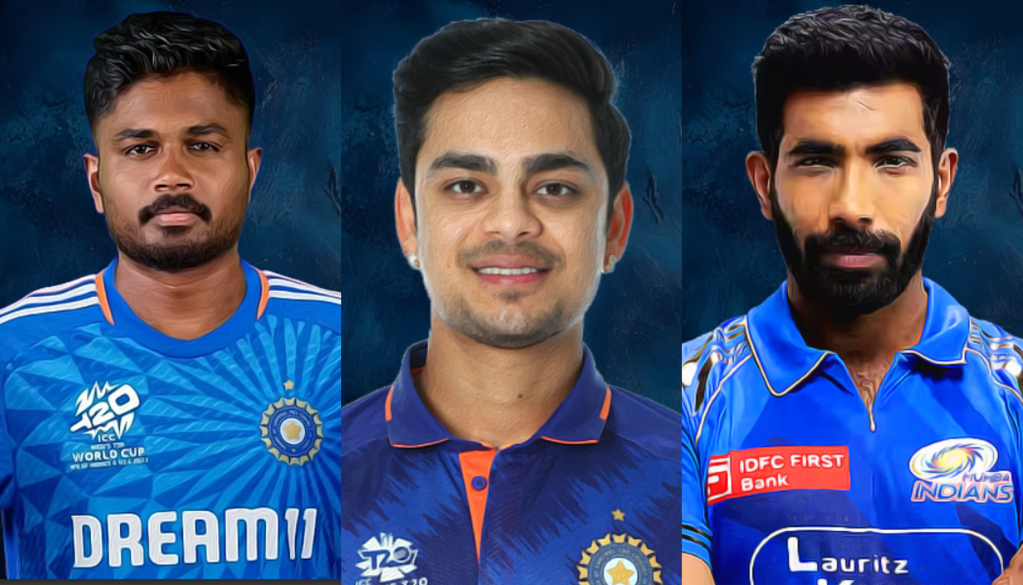
Samson, Kishan & Bumrah

Samson, Kishan & Bumrah

Why has Sanju Samson’s cricket triumph touched the hearts of millions and millions of Indian cricket lovers; from an understated cricketer to India’s T20 World Cup ‘26 HERO. The ‘Darling’ of Kerala Cricket fans, affectionately referred to as ‘Chetta’ (elder brother) by his throngs of supporters.

It’s because nothing has come easy for Samson. He has spent a lifetime preparing for this moment and during his decade long innings he has shown occasionally what he was capable of without being able to get the kind of success he deserved.

He made his IPL debut with Rajasthan Royals at the age of 18 and immediately caught the attention of experts and fans. He donned the Indian colours in 2015 and in his first 23 innings at the top order of the T20 team he scored only 1 fifty. IPL success did not guarantee international runs- so, the quiet and resilient wicket keeper-batter continued to toil in domestic tournaments in front of empty stadiums. Sanju Samson has often spoken about his acute desire to wear the Team India cap and win big trophies for his country; but to make the journey even tougher, along the way with ‘Road Closed’ signs stood the likes of Thala Dhoni, Dinesh Karthik, Rishabh Pant and KL Rahul.

There is an emotional video where he speaks about the inspirational leader and big brother Rohit Sharma’s empathy and support for him. That heartfelt 10-minute talk before the 2024 T20 WC final where the captain acknowledged his contributions and personally explained the tough selection calls on why he was left out- this talk meant a lot to him: ‘Tera bhi time aayega’ (your time will come).

So, to the T20 WC earlier this year. Samson was on the bench in the opening matches. Then he dominated the Super 8’s and beyond- 97 not out against the Windies, a match defining 89 in a close win against England and finishing it off with another 89 vs NZ in the finals. 321 runs at an average of 80.25 with a staggering strike rate of 199.37. The undisputed Player of the Tournament and the Toast of an entire nation.

What happened? Sanju Samson finally found himself in a dressing room where the philosophy and vibes matched his own. The high risk-high reward batting where contributions were measured by impact and not individual milestones. So was born our national hero-who strove always for high impact and this time around carried the blessings of consistency.

Sanju Samson, a devout Catholic, has praised Jesus and made signs of the cross on the cricket field and has drawn inspiration from the Bible verse Philippian 4:13- ‘I can do all things through Christ who strengthens me.’

Another great source of strength has been his father Samson Vishwanath, a former Delhi Police Constable and a retired football player who represented Delhi in the Santosh Trophy. He played a pivotal role by leaving his police job and returning to Kerala when his son was rejected for the Delhi U-13 team. An intensely invested father- his focus was entirely in training Sanju and protecting him from setbacks in his early career. He insisted that his son closely watch icons like Tendulkar and Dravid on TV to develop a strong technique. Mentors matter whether it is on the sports field or off. Here the youngster was blessed- Dravid as his captain and coach at Rajasthan Royals, Rohit Sharma and his personal idol- MS Dhoni. Sanju Samson has spoken about his motivational call with Sachin Tendulkar during the T20 WC itself when he was feeling low and down.

Coming to Ishan Kishan, he played a key role in the T20 WC ‘26. 317 runs in 9 matches with an astounding SR (strike rate) of 193.29. His 77 against Pakistan and a 25-ball 54 in the finals were critical contributions. This was preceded by a stellar domestic season where he led Jharkhand to the T20 title in the Syed Mushtaq Ali tournament.

His has been a roller-coaster ride with controversy in the air. It will be fair to say that he is now astride the Redemption Arc. His talent was never in doubt as showcased by the 210 run rampage against Bangladesh in 2022 or the 103 off just 43 balls against New Zealand on the 31 Jan 2026- a week before the WC began.

His problems started in late 2023 when he pulled out of the on-going South Africa tour citing mental fatigue. He was later seen partying in Dubai and Mumbai. In early 2024 he was dropped from the BCCI Central Contract as he ignored the directives to play Ranji Trophy matches during his break from international cricket. Strong parental support brought him back on track. His father Pranav Pandey and Ishan himself have credited how reading the Bhagavad Gita helped him overcome his career turmoil and negative public scrutiny. His mother insisted that he carry a pocket edition of the scripture in his kit bag and he has often returned to the teachings in times of stress and anxiety.

An older generation is aware of how Indian cricket lost one of its finest talents in the early 90’s- Vinod Kambli to booze and partying with the wrong crowd. A recent example of things going wrong is Prithvi Shaw, hailed as a break-out star in 2018. In July 2019, his contract was suspended by the BCCI for doping violations. Then he totally lost it- a physical altercation with a social media influencer and her friends went viral on social media. Sad to say that as recently as December 2025 whilst representing Maharashtra he had an ugly fight with his former Mumbai teammates and was physically stopped from hitting one of them with a cricket bat. Prithvi Shaw is just 26 years old. Life has given him another chance. Delhi Capitals have recruited him for IPL 2026 for a price of Rs 75 lakhs. The moral of the story- the glamour, money and fame at top levels in Indian cricket and especially the IPL can easily lead youngsters astray.

The other fascinating takeaway from the success of Samson and Kishan is that Indian batters have taken T20 cricket to another level. Their strike rates almost touch 200. If Gill, KL Rahul or Ruturaj Gaekwad ( SR 138-143) aspire to get back into the format they will have to revamp their shots-gear box and move into a higher-level top gear.

Lastly enter Jasprit Bumrah. Picked up by the MI scouts and drafted for the team in IPL 2013. In the T20 WC ’26, he was the joint highest wicket-taker with 14 wickets and the Player of the Match in the finals with 4/15 vs NZ. He is a rare combination of pace (140+ kmph), lethal accuracy and unorthodox action which makes him difficult to read plus an exceptional death-overs bowler. Sadly, the unorthodox action has resulted in multiple injuries and surgeries with even a down-time of a year. Yet, James Anderson has called him ‘an absolute freak’ for his ability to nail lethal yorkers consistently. Damien Fleming is awed by ‘his curve ball slower delivery.’ Ricky Ponting calls him India’s greatest ever fast bowler-across formats- and that ‘his true value lies in making scoring runs very difficult for batters.’ Harsha Bhogle refers to him as ‘The Magician’ whilst accolades like ‘National Treasure’ and ‘Once in a Generation Player’ are floating all around. To add another dimension, Bumrah is also applauded for ‘his tactical genius in analysing pitch quality.’ Lest people forget, he was the Player of the Tournament in the 2024 T20 WC with15 wickets. In ICC ODI rankings he has held the top bowler slot for 730 days. In Test cricket he remains the No.1, with 234 wickets in 52 matches with a remarkable average of 19.79. Please check some fellow legendary bowlers – Marshall (20.94), McGrath (21.64), Akram (23.62), Murali (22.72) and Warne (25.41). Bumrah has played a seminal role in the Men in Blue’s big wins in SENA nations (South Africa-England-New Zealand- Australia).

Jasprit Bumrah lost his father at a very early age and has been brought up by his mother Daljit Kaur- a schoolteacher and Principal- in Ahmedabad. He attributes his success, focus, hard-work, discipline, passion and humility to his Ma’ji. He also embraces devout Sikh values and sacred teachings and has been quietly supporting many charitable causes -especially sponsoring education for under-privileged children.

Harsha Bhogle has revealed that before the IPL 2026 season, MI proposed to give the same pay cheques to Surya Yadav, Pandya, Rohit Sharma and Bumrah. Rohit bhai stepped forward for a pay-cut as Bumrah with his humungous contributions deserved more. Thus, for the first time has ‘Boom Boom’ earned the highest price-tag at his franchisee.

In Australia, Warne & McGrath are put on the same pedestal as Ponting. In July 2024, James Anderson was given a rousing, emotional farewell by a packed house at Lords. Murali and Wasim Akram are still revered by fans in their countries and far beyond. However, in India batters continue to dominate the headlines and public or fan consciousness. From the ‘Little Master’ Gavaskar to ‘The God of Cricket’ Tendulkar to ‘King Kohli’. RESPECT TO ALL.  Taking his match-winning performances and his drive to take India to the top of the cricketing world, Bumrah over the last couple of years has finally become the brand face of an eco-friendly travel gear brand-Uppercase, Skecher shoes, UNIQLO India clothing and for Sun Feast Yippee noodles.

Times are changing. From the Dravid- Rohit Sharma duo to the Sky-Gambhir Management, team effort is being highlighted, and top-class bowlers are finding their place under the bright Indian sun.

The stories of our three-impactful cricketers of the 2026 T20 WC have parallels and differences. But at the core, what they have each scripted are positive stories of grit and determination, faith and support, and self-belief. They represent real, inspiring life lessons.

Has Cricket Become a Batsmen’s Game?

Image by Lisa scott from Pixabay

The scales in cricket have been tilted in favour of the batsmen. It has not really been a level playing field. But not too long ago, there still prevailed the ideal of a battle between bat and ball and a battle of wits between the bowler and the batter. Quality time was spent on discussing the pace-threat and the guiles and skills of spin. I remember Richie Benaud commenting on an Ashes Test. The elegant English stroke player was struggling with a packed slip cordon and Jeff Thomson was on fire. As the captain waved a couple of fielders to long-leg and deep square, the astute veteran sensed a trap. Along came the shoulder-high bouncer and went straight down the throat at long-leg. This was the charm of the game. Even with radio commentary one could visualise the game plan.

The champion bowlers were celebrated and appreciated. Pundits in the sports magazines and newspapers would wax lyrical about Chandra’s flipper or Bedi’s tantalising flight and control. They were on the covers of even the popular periodicals. The flipper we learnt was a back-spin ball which kept deceptively low after pitching- to deadly effect. The legendary Gary Sobers in his ‘spin avatar’ bowled the chinaman– decoded to us by the experts as the left arm bowler’s leg spin. The sharp turn came into the right hand batsmen or moved away from the south-paw. Kuldeep Yadav is the current exponent but our run-happy hyperbolic commentators have little to say on this fine craft of bowling. Tony Cozier, the West Indian expert, educated us about Colin Croft’s toe-crusher yorker and the deceptive slower, swinging one. Cricket aficionados learnt about the 3 variants of bouncer in Andy Robert’s arsenal. The reverse swing of Wasim Akram evoked admiration as did Murali’s doosra (the other one in Hindustani). A regular off break delivery with a wrist twist which made the ball spin in the opposite direction. Cricket was more than a physical sport. At times it was almost a chess-match between bat and ball. It blew your mind.

In the seething cauldron of the MCG, fans used to chant ‘Lillee, Lillee’ as their gladiator ran into bowl at express pace. Roberts, Holding, Croft and Joel Garner of the Fab Four have inspired Caribbean Calypsos. There was deathly silence at Ahmedabad as Holding and Marshall dismantled our second innings in the 1983 Motera Test. Even in the pall of disappointment, I sensed Respect. We had witnessed a sensational bowling display. The crowd stood up to applaud the great West Indian team. Shane Warne’s ‘ ball of the century’  to dismiss Gatting in the 1993 Test match still remains a hot You-Tube favorite.  Harbhajan ‘Turbanator’ Singh’s hat-trick at the 2001 Test vs the Aussies electrified the packed 1,00,000 crowd at the Eden Gardens and virtually brought the country to a stand-still.

Within the prime cricketers fraternity there is mutual and genuine respect between the bowlers and batsmen. Here is Ian Chappell’s (the reputed Aussie captain) take on our great off-spinner Prasanna. He had taken 25 wickets in 4 tests against a formidable batting line-up Down-Under in 1967-68, “the best spinner he had ever faced. He was trying to get you out every ball. A test to your brain. He put his engineering background to good effect by employing things he had learnt as an engineer. He pulled it back on a bloody string.” The awe is obvious, ‘aerodynamics, biomechanics, pitching the ball at length. Psychology. Baiting a batsman over after over to induce a mistake.’ Phew. Cricket is deemed to be a religion in India. Are we missing out on good chunks of its scriptures.?!!

Brian Lara on Wasim Akram’ He made me feel stupid at times. Feared to face the Sultan of Swing ‘and more.’ He was fast and furious. He bowled over and around the wicket, swung the ball both ways, a master of reverse swing. ‘At times he cut the ball prodigiously.’ Such a tribute from an all-time great batsman. The reverse swing is the art of swinging the ball in towards the batsman rather than away from him. One side of the old ball gets scruffy and the other retains its shine to get this movement. A lethal delivery later in the innings. A blessing as else even a good pace bowler would be regularly hit out of the park on a true track. Akram was the original master of this Art of Fast bowling. Then, why does the game seem so one-dimensional now? Runs, fours and sixes. That’s all it takes to hit the cricket pop charts!

So what has eroded the bowler’s stature in cricket. First, the shrinking of the playing fields. From 75-85 mtrs boundaries to 65-70 mtrs to the ropes from the centre of the pitch. In New Zealand, down to 55-60 mtrs of turf expanse. Yes, the hoardings and the ad billboards, the media spots and the dug-outs have also encroached into the playing space. This is the unspoken reality behind the sudden glut of sixes.

The bats have gotten larger and heavier. Chris Gayle wields a 1.36 kgs willow. With the thicker edges, a top edge flies for a six.  We have the swooning commentators going ga-ga. The batsman has been beaten by the pace, bounce or swing but the cheers and bugles are for the ultimate shot. Inadvertently, perhaps, but the bowler is being reduced to a side-role in the cricket show-time.

Let’s look at the pitch report. Mostly, flat and true even if offering some pace and bounce. WACA (Perth in West Australia) used to be a dreaded track, very fast and bouncy. A graveyard for touring willow-wielders. Not anymore. The extra bounce, pace and rip have gone. Touring batsmen from all over the world have heaved a collective sigh of relief. Let’s also listen in to Gary Barwell, head groundsman at Edgbaston, Birmingham. ‘One day pitches in England are the best in the world. Well, if you are a batsman, that is. The tracks are flat and true. It enables batsmen to hit through the ball.’

An interesting bowling nugget from the 1970’s on the wicket conditions. The English team it was said carried left arm quickish spinner Derek Underwood like an umbrella, in case it rained.  On sticky or drying surfaces he was unplayable and would simply run through the opposition batting.

The protective gear now worn by the batters has diminished the aura that the best fast bowlers had. Fear and Intimidation is a thing of the past. Pace like Fire as unleashed by the great West Indies fast men of the 70’s and 80’s is now part of cricket folk-lore. Catch it on the riveting documentary, ‘Fire in Babylon’. Helmets, metal visors, pads, gloves, chest and elbow padding, abdominal guards or the box are effective PPE’s. So should they be. The 5.75 ounces of leather bowled at over 90 miles per hour is a deadly projectile. Who can forget the tragic death of Phil Hughes despite the helmet gear?

The rules of the game also help the batsmen. One bouncer an over in T-20’s and two in ODI’s and Tests. Next the fielding restrictions. During the T20 power play (first 6 overs) only 2 fielders outside the 30 yard circle. For the rest of the innings, a max of 5 fielders outside the defined space. Ditto for ODI’s in the first 10 power-play overs. Then relaxed to 4 fielders in the deep for 10-40 overs and a max of 5 fielders in these positions for the last 10 overs. The bowlers and their captains have little strategic space to test the weaknesses of the batsman. Moreover, a bowler can bowl a max of 10 overs in the 50 over game and 4 overs in the T20 format. The skipper has to use 5 or more bowlers to get through the innings. If anyone is below par on the day or a part-timer is getting taken to the cleaners, the captain can only hope and pray for an end to the mayhem. Why not tweak the rules to allow one main or in-form bowler to have an extra 2 or 5 overs in the two limited over formats? Some latitude to balance out the game. Some push-back on the batsmens’ privileges.

Look at the concept of a ‘Free Hit’. A free hit is given to the batsman for the next delivery if the bowler over-steps with his front foot or his back-foot does not land within the return crease. Both versions of the No Ball. Do the batters require any more largesse in a T20 or ODI game where conditions are skewed in their favour. Catch the poor leg-spinner. The LBW rule says that for a ball pitched outside the leg-stump, the batsman cannot be given out even if the ball had turned and gone on to hit the stumps. For Leggie’s Sake! the pads are protective gear and not a second line of defence. The bowler is being defanged of his venom.

Another nugget to expose the bias. Stuart Broad, the English fast bowler, recently crossed the 600 wicket mark in Test cricket. A remarkable landmark.  But social media in India was flooded with comments about whether he was the same bloke whom Yuvraj Singh had clobbered for 6 sixes in an over. Why do batting exploits have to dominate cricket conversations? Why not salute his indomitable spirit and hail this amazing achievement?

Let’s hark back to the World Cup 2019 thriller finals. England and New Zealand both ended up at the same score even after the Super over. The trophy was handed over to England by a strange rule that they had scored more sixes and fours than their rivals. The run-rate was the same. Again bat over ball. The Kiwis had taken 10 English wickets and lost 8 whilst batting. This did not count in the ICC scheme of things.

Is it any surprise that batting records are being smashed all over the cricketing world? 10 teams have breached the 400 runs mark in the ODI tournaments. Getting 250 runs in a T20 match is entirely possible. Rohit Sharma leads the pack with 4 centuries in the shortest international format.

The advantage is firmly in the batsmen’s crease but cricket administrators and marquee cricketers are waking up to the fact. The DRS review appeals has come as a boon for the bowlers too. This has put pressure on the umpires to be neutral, alert and zoned-in especially on LBW issues. The notoriety of some in the not too distant past still lingers on. The host side at times played with 13 active players. Some officials also came under the match-fixing cloud. The Snick-o-meter with the third umpire or match referee also bats for the bowlers and helps their cause. It analyses the video and sound as to whether a fine snick or noise occurs as ball passes bat.

 The other booster for the pace bowlers should be the 2 new white ball rule- 25 overs from each end in the ODI’s. Sachin Tendulkar has a different perspective, “this is not the perfect recipe as each ball is not given time to get rough and old and reverse. We haven’t seen reverse swing, an integral part of the death overs.” Further, in 2017, the ICC did come up with a half measure on bats-  ‘edges can’t be more than 40 mm in thickness and the overall depth of the bat measured from the highest part of the spine should not be more than 67mm.’

One major ally for the bowlers is the support on the fielding front. The extraordinary enhancement in fitness and fielding skills have not only saved runs but kept the pressure lid on. The conversion ratio of run-outs and direct hits has spiked. Extraordinary catches, especially in the outfield, have become the norm.

So is this just a lament for the plight of the bowlers. Are batsmen the villains?  Absolutely not! The rules and the playing eco-system have to be changed to ensure a fair and engaging contest between bat and ball. Else, why are low scoring matches so thrilling? !! Tendulkar and Dravid, Kohli, Smith and AB DeVilliers, Ponting and Lara, Dhoni and Sangakara have enriched the game beyond measure. They are Maestros. Their exploits with the bat have packed stadiums and commanded a huge and loyal viewership. As the formats have changed, they have been at the forefront of amazing innovations in batting technique and flair. AB is known as the 360 degree genius. The upper-cut, switch-hit, reverse sweep, paddle shot, Inside-Out stroke and the Periscope shot are now all part of the cricket lexicon. The last named because the motion ends up with the batter holding the bat like a protruding periscope. Who can forget Ganguly’s break-out century at Lords in 1996? The Sachin master-class knock of 98 against Pakistan at the Centurion in WC 2003. The Very Very Special Laxman-Dravid partnership which snatched victory from the jaws of defeat against the rampaging Aussies- Eden Gardens 2001. Or Kapil Dev’s iconic 175 not out at Turnbridge Wells in the 1983 World Cup. But let us not forget the critical contributions to the 1983 WC triumph from our under-rated bowling squad.

Baseball is a distant cousin of cricket. The Pitchers have their own variations- the curve ball, the slider, the fast ball. In the All Time great lists they rub shoulders with the batters with almost equal representation. They hog their fair share of the limelight in the MBL Hall of Fame. This is also a statistically obsessed game. But their analysts and fans cover all the bases. However, in Indian cricket, the media and the fans cannot stop talking about the number of centuries, the big hits,the strike rate and in the IPL context- the Orange Cap.

Stats do not tell the whole story and they can be misleading at times. Instead, look at the Impact Players. Whose performances have changed the fortunes of a match or a series. A  Bumrah for India or a Rabada for South Africa with key wickets at the right junctures. Even for a batsman-evaluate the innings in the context of the match, the pitch conditions and the quality of the opposition attack. A fifty on a difficult wicket in a low scoring match is worth much more than a century on a docile pitch.

In the 80’s and 90’s a widely held belief was that a 5 wicket haul in a Test or ODI was equal to a century. Anil Kumble has had 35 five wicket hauls in Tests and 2 in ODI’s. Equals to at least 35 centuries. Places him deservedly amongst the batting greats. His extraordinary 10 wicket haul in an innings against Pakistan at the Ferozshah Kotla in 1999 should catapult him into the exalted cricketer realm. Not quite. If you do an informal survey in your own circle about the 6-7top Indian cricketers for the last 25 years, batting masters with celebrity names will quickly fill up most lists. Kumble, Zaheer Khan, Harbhajan Singh may at best sneak into a few.

On that note, let’s call it stumps.