
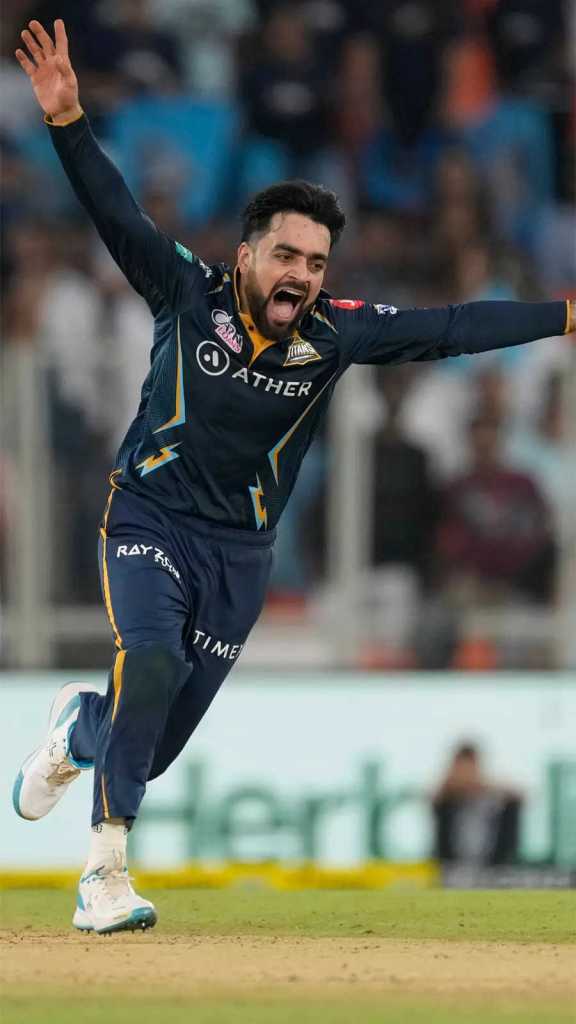
The Inspiring Story of Rashid Khan

Rashid Khan celebrating a wicket in his signature ‘airplane’ celebration

Afghanistan and Cricket!!  1935. Abdul Aziz Durani catches the eye of the Jamsaheb of Nawanagar with his wicket-keeping skills. He offers him a job as a sub-inspector and the Afghan family moves to Jamnagar with their one-year-old son born near the Khyber Pass in Afghanistan.  Salim Durani grows up to be the flamboyant Indian Test cricketer known for his big sixes.  He was born before his time. He would have taken to T20 cricket and the IPL like a duck to water. Sadly the great all-rounder passed away this April and the tributes and obituaries all highlighted his Afghan lineage.

In the 2019 ICC World Cup, the Afghanistan cricket team went winless in all 9 matches. But such is the soft power of sports and cricket that there were no bomb blasts or attacks on the day of the matches in the troubled nation.

Today the 24-year-old Rashid Khan is Afghanistan’s first global sporting superstar and cricketing icon. Born in eastern Afghanistan his family fled to Peshawar during some turbulent years of the Afghan war and even lived in the refugee camps. This is where the young boy picked up the game of cricket. After their return to their homeland, he continued to play the game but mostly with his 6 brothers. It was not till 2014 that Rashid who fancied himself as an opening batsman converted into a spin bowler. He taught himself through endless hours bowling on the concrete passageways, and then fields, and in the nets, in a country that had just become an affiliate member of the ICC when he was born. Today- the Afghan hero, IPL millionaire, and T20 smash hit- the Rashid Khan story is celebrated and savored by all cricket lovers.

Just 17, he made his debut for Afghanistan on the Zimbabwe cricket tour in October 2015. Just 2 years later he was picked up by SunRisers Hyderabad for $600,000 at the IPL auction. He then picked up franchise deals with the Guyana Amazon Warriors and helped the Adelaide Strikers to win their first BBL (Big Bash) title in 2018. He then also played in the PSL for the Quetta Gladiators and the Lahore Qalandars. Rashid Khan, without exaggeration, is the busiest cricketer in the world and a globe-trotter. He is invariably amongst the top wish-list of teams in big cricket leagues around the world. In 370 T20 matches, he has taken 500 wickets with an economy rate of 6.33, and sustaining these numbers across years, various leagues and oppositions, and playing conditions have been a remarkable achievement.  Many cricket pundits rate him as the best T20 bowler of all time.

 5 seasons with the Sunrisers in the IPL had led to a wicket haul of 93 wickets with an economy rate of 6.3. With the Gujarat Titans in 2022- 19 wickets and the IPL trophy. In 2023, 27 wickets and a loss in the finals to CSK. Listen to another great spinner Harbhajan Singh on Sports Today, “Rashid Khan is a great player from a different league.  He is picking up wickets in heaps, he is scoring runs, he is a gifted fielder, and he led GT whenever Captain Hardik was not available. He has done everything and excelled. GT is exceptionally lucky to have a player like Rashid Khan in their ranks.”

What is it that makes him such a great bowler? L Sivaramakrishnan has this to say, “He is an unorthodox leg-spinner. His arm action is so quick that he has to release the ball at the right moment. He is very accurate. His grip doesn’t change much for leg spin and googly. Because his grip is more like an off-spinner with a big gap between the index finger and middle finger, it allows him to bowl a better googly.”

Rashid himself said in an interview that he usually bowls between 90-91 kmph. That extra 5-6 kmph above the normal spinners is what harries the batter. ‘’Opposition batsman may know what is coming- they are just not sure what to do” (Wisden Cricket Monthly).  Ravi Bopana has acutely observed, “You can’t pick him from the hand. If you pick him from the pitch by the time you have worked out which way it’s going to turn it is too late for playing the big shot. You nudge him around. Finally, you try to take him down in the last over. That’s when he bags a couple of more wickets.”

Like most other world-class spinners more than half of his deliveries are on the good length and most of the remainder are just short of a good length. The batters don’t reach the pitch of the ball and the speed ensures that they don’t have time for the cut or the pull. His speed through the air is modeled on his idol Shahid Afridi while maintaining a stump-to-stump line.  Rashid’s biggest weapon and mind-game ploy is the lethally accurate googly and he has multiple variations in his arsenal. In the T20 format, the most effective method of dismissals is to control the runs and force the batter to take more risks. Rashid Khan knows how to keep the pressure lid on.

This self-taught genius has picked up some bowling tips from watching his idols Afridi and Anil Kumble on TV and video. But take a peek into the sheer dedication of the man- “I place bottle tops at different spots on the pitch and I bowl until I hit each one. It doesn’t matter how long it takes-1hr, 2hrs, 3 hrs, or only 5-6 balls. I have to hit every one of the bottle tops.” Is it surprising that he has airbrushed many a middling total to a match-winning one for his team?

Plus his ingrained discipline. In the 2017 IPL, he was given to eating unhealthy foods like biryani, bread, and sweets. He quickly made the switch to barbecues or grilled food with lots of salad. This has given him the fitness and strength to take on his punishing cricketing schedule. It has given him that extra energy to consistently bowl at 90+kmph and even touch 99-100 kmph at times. He has sheepishly confessed that he cheats for one meal a month; also that he is unable to eat if he does not do his regular workout.

In 2017, ICC declared him as the T20 Associated Player of the Year. His 96 T20 wickets in 2018 inspired the headline-‘Prodigy to Superstar’ (Wisden Cricket Almanac). Then, Rashid Khan was lauded as the ICC T20 player of the decade. Just before the ICC  T20 World Cup cricket legends like Ricky Ponting, Mark Waugh, and Mahela Jayawardene picked him amongst their top 5 players across teams. Yet, the young Afghan yearns to be the MVP (Most Valuable Player) in an IPL season.

There is more to him than just being a champion spinner. With the bat, he is capable of clearing the ropes in the slog overs. Over the years he has evolved into an extravagant, destructive lower-order batsman.  In his early teens, he had dreamt of being an opening batsman like his idol Sachin Tendulkar. As a fielder also he has been agile and focused, giving his all for the team.

In the history of IPL in India the most popular foreign players have been AB de Villiers and Chris Gayle. Rashid Khan has now been embraced by Indian cricket fans as one of their own.  What adds to the aura of this young cricketer is his grounded approach; his close-knit family life with his 10 siblings and their families; the regular requests from his nephews and nieces that he shows them his ‘airplane celebration’ after taking a wicket; how his parents have taught him how to handle success and fame. As he himself puts it, “Money doesn’t give you good fame, good personality, good image. The only thing that gives you that is being humble. Being kind to everyone. Also if a fan asks for a photo and I ignore it, I don’t think I will be able to sleep. I never want to hurt someone’s feelings.” Small wonder that the spin maestro is so warmly welcomed by fans around the world.

Rashid Khan gives a lot of credit to his SunRisers Hyderabad mentor VVS Laxman and Captain Kane Williamson for keeping him calm, positive, and focused. Referring to the latter he has said that he put his arms around my shoulder, “You just need to enjoy and keep smiling. That’s the only thing I want from you.  Doesn’t matter whatever the result at the end but I want you to be smiling on the ground.”

His former national team captain Asghar Afghan has this to say, “The one special thing about Rashid is that whenever Afghanistan wins any match, the dinner is on him. Everyone gathers in his room and all expenses are borne by him. He really has a very big heart. Irrespective of whether he has performed or not if we win he takes the initiative for treating us to dinner. Even the 12th man of our team prays that we win so that Rashid can treat us to dinner.”

The cricketing superstar is just 24 years old. His full name is Rashid Khan Arman. Arman is the male Persian name for ‘Wish’ and ‘Hope.’ In Turkish and Armenian it also means ‘God’s Man’.

Management Lessons from THALA (The Leader)

In the classic IPL 2023 finals, 3 images have stayed with millions of cricket buffs and with me. Deepak Chahar drops a sitter with the classy and prolific Shubham Gill at just 3. Pan to MSD. A calm, stoic face and the game moves on; then Jadeja beats Gill as he lunges forward. Dhoni’s lightning fast reflexes are on show as he removes the bails in a flash (0.01 seconds). The bowler runs towards the wicket-keeper with eyebrows raised and the latter nods quietly. Yes, they have stumped the batter. It’s quite clear that Shubham Gill has been plotted out; as CSK are crowned champions Mahibhai is called to lift the trophy. But he has already invited Ambati Rayudu (who has announced his retirement)and Jadeja whose cameo hitting sealed the match on the last ball to join him on stage to receive the trophy. Then as the entire CSK contingent is celebrating we see the smiling captain at the back and corner.

The most impressive trait of the man is his unflappable temperament.  Ravi Shastri acknowledges this in his foreword to Bharat Sundaresan’s book, ‘The Dhoni Touch’, “Captain Cool may sound clichéd now but in many ways, it was an apt description as nothing could frazzle Dhoni. I have seen him remain steadfast and inscrutable as a monk in victory or in defeat.” The crucial lapse by Chahar could have rattled the team had their captain let out a stream of invectives and abuses. “But Thala is known to take the pressure off his players. He has always looked at the bigger picture in tight situations or even after a couple of defeats. Things will balance out in the longer run,” says Michael Hussey. In some of his interviews, Dhoni has revealed his mental resolve, “I feel frustrated. I feel angry at times. I feel disappointed. But none of these are constructive. What needs to be done is more important than any of these emotions.” His calmness both as India and CSK captain has soothed the nerves of the rest of the team and ensured that they stay focused and continue to believe in themselves. Not losing composure in stressful situations is the key to positive team spirit and sustainable success. Our Corporate Managers can take a leaf from MSD’s book. Business targets have morphed into targeting team members- especially down the line. The simple mantra is that a good work environment (dressing room culture) translates into good results.

Some Corporate leaders today tend to complicate things, by an overdose of reviews and meetings and analysis. Dhoni is not too invested in cricket data analytics. He relies more on his observation skills and his deep appreciation of every nuance of the game. THALA has a genius for keeping things simple. Everything is not within our control. “Control the controllable things and attend to the small details and address the ground realities. More often than not results will be in your favour. If you don’t get desired results, accept and work to improve,” from a Dhoni interview. In a company setup, the controllables are mobilizing the right resources, deputing people to the right assignments, defining their roles and giving them space to deliver, facilitating teamwork & co-ordination, selecting the right leaders + Training, Upskilling, Motivation, Appreciation, and having their backs when there are bad days at the office. It’s not surprising to know that MSD often has dinner with the younger members of the team to put them at ease and to jell with them.

This attribute of MSD of having faith in and backing his players is a recurrent theme. Spinner Yuzi Chahal who has experienced his best days under his captaincy says, “Newcomers or with 15-20 match experience-MSD backs you and trusts you. A couple of bad matches does not shake his faith in you.” It’s only a game that is an oft-quoted response from Dhoni after losing a match or even a series. Connect the dots to the high success ratio at both the international levels and also in the IPL tournament. Hence it is that you don’t see much chopping and changing of players in the Dhoni era as became the norm later. Merit more than loyalty mattered to him.

This sanguine, down-to-earth mindset of Dhoni is commended by Shastri, “even in the new set up with Kohli as captain and with many youngsters- his mature understanding of the players and dressing room dynamics – Dhoni morphed into a pillar, advisor, and mentor without intruding into team management space.” Mahi had even earlier proved that he was the master of quietly taking charge without rocking the boat. The Art of Managing Egos. Catapulted to captaincy ahead of several Indian cricket superstars and former captains, he took his time, didn’t interfere with their proven methods, and managed to extract the best performances from these legends and the upcoming stars without ruffling feathers. Lest we forget the 2007 T 20 WC winning team was completely raw and the current CSK team was at best, average on paper.

MS Dhoni is an enigma to many as he is an unorthodox leader and a unique personality. His art of taking ownership has many levels- Being in the Present; keeping it simple but looking to improve;  thinking about results only puts more pressure on the team, so focus on the process; keeping emotions under control is more constructive- anger and frustration lead to wrong decisions; don’t throw in the towel till the result is decided. Devon Conway (CSK opener) gives more insights in an interview with Harsha Bhogle, “MS gives us a role and backs us to do the role. He steps into their shoes as everybody reacts differently to pressure.” So it is little surprise that Thala’s pre-match meetings last only 10 mins but he has a sequence of one-to-ones. Also what he has to say in team meets is already known to seniors but helps to get the others on the same page. His simple take is- A captain is only as good as his team.

At the workplace also, team members reciprocate and feel a sense of belonging and responsibility based on the trust shown to them by the leader.

Leading from the front has been his hallmark. A corporate honcho has to herself/himself excel in one or more domains-Sales, Finance, HR, Operations, Technology or their leadership will always be in doubt. Delegation is good but one cannot be a non-playing captain. MSD has been at the top of his game as a wicketkeeper, a batter (at various slots), and a captain responsible for every action on the field. The innovative and effective helicopter shot is synonymous with him. He personifies genuine multi-tasking across various formats of the game and often raises the bar. This means living in the moment and in leading the charge in whatever the role demands. Not everything he has touched has turned into gold. But he has always appeared in total command on the field- not scurrying around to mitigate a difficult situation.

The Best Finisher accolade he has earned is well deserved for his utmost capability to lead from the front even as the asking rate appeared to be beyond reach. An astonishing stat is that he has scored 4,000 runs in a winning cause batting at No. 5 or lower.  In ODI’s power hitting came into vogue because of him. No score was considered safe if he was batting for India. His batting average in successful chases in the ODI’s is the highest for any player in history- an incredible 102.71. The six to finish off the 2011 WC final is etched in a nation’s consciousness and has become part of folklore.

With 294 Test dismissals, 444 ODI dismissals and 91 T20 dismissals MS Dhoni is in a league of his own- the Don with gloves on… But as wicketkeeper cum captain he morphs into a different avatar. The stump mic has caught him advising bowlers on what and where to bowl or talking about the batter’s mind frame. Yuzi Chahal certifies that the plans have worked more than 70%of the time over a few overs.

Cricket is a game of glorious uncertainties. But the Thala halo also speaks of a brilliant cricketing mind. It has been said that he has the game all mapped out in his head. Amazingly, he is often on the right course. Shubham Gill was outwitted by the Dhoni-Jadeja combination in the IPL finale. But few may know that in the 2011 WC final a Dhoni-short of runs- promoted himself above the Man of the Tournament Yuvraj Singh in the batting order. His rationale- danger-man Muralitharan was bowling and he had played him often in the CSK nets. In the Champions Trophy of 2013 he asked Rohit Sharma to open with Shikhar Dhawan and a hundred partnership opened the floodgates to many more runs. The sharply observant Dhoni saw things that others overlooked.

Adam Gilchrist has commented about the MSD aura, “Sheer calm and confident body language evoked great respect and even fear in the opposition camp.” The ultimate tribute has come from the master himself-Sachin Tendulkar, “Calm, positive and always one step ahead of the opposition. The best captain I have played under.”

He has always shared credit with the team and taken the heat for the losses. The 2011 WC winning team photograph also shows him in a corner with other team members at the front and center. After this heady win, it was all downhill for Dhoni and the Men in Blue as they faced one embarrassing loss after another in the Test series in England and Australia. It took great strength of character to bounce back with the sheer weight of performance once again. His announcement to retire from Test cricket during the Australia series in 2014-15 speaks volumes about the man.  “90 Tests. The temptation to reach a milestone 100 is almost impossible to resist not to mention the power of captaincy. But he bid adieu as he believed he couldn’t give it his all,” comments Ravi Shastri.

MSD has always had the street-smart brain to cut through the clutter and reach a decision correctly. His technique both behind and in front of the stumps has been unconventional to say the least. He himself believes that millions connect with him as his cricket mirrors their gully cricket style. The sea of yellow at stadiums across India during the IPL is an unusual social phenomenon. It goes way beyond hero worship to a massive cult following. That this man from Jharkhand has been so warmly embraced by the people of Chennai and Tamil Nadu has a powerful message for our political netas. His respect for the people, their culture, and his humanity and simplicity, have made him their very own ICON.

In this era of omnipresent social media, this celebrity cricketer is totally missing from Instagram, Twitter, and Facebook. He considers it a distraction and an addiction. In his own wry manner, he says, “Core job is to play well for India in cricket. If you do that there will be enough likes and enough followers.”

The incredible journey of this railway ticket collector from Ranchi to Chennai and beyond has not been without controversy. The CSK-RR match-fixing scandal and the banning of both teams from the IPL for two seasons must have scarred him badly. He has called it the lowest point in his life. The 2016 film, ‘MS Dhoni-the Untold Story’ produced by his friend Arun Pandey did not reveal anything. Mahi only spoke about it in the documentary ‘Roar of the Lions’ on Hotstar in 2019. Another cautionary tale is the conflict of interest issue with Rhiti Sports (where Dhoni had a 15% stake) also managing the careers and fortunes of his CSK team-mates- Raina, Jadeja, and Ojha.

The 2023 IPL final was heralded as MSD’s ‘Last Dance’ with the CSK team.  But the cricketing legend has now metamorphosed into a national emotion. After his recent knee surgery he will likely return to CSK in IPL 2024 as a captain for a few matches and as a Mentor for the team and franchise. The final hurrah will be played out at Chepauk.

Viv Richards- Masterclass

Getty Images

As in other major sports, in cricket too success and failure is all too measurable. It is not only the fans and the experts but also the players who take an obsessive interest in statistics. Very rarely comes a cricketer who transcends numbers, who is beyond records. Say ‘Viv Richards’ and the stats, impressive as they are, fade into the background. The talk is all about his sheer brilliance and his swag. The profound influence he has had on redefining batsmanship and the game itself.

His impact on the teams he has represented has been phenomenal. For the Windies, Clive Lloyd was the father figure, the mentor, the captain. But it was Viv who became the talisman, the catalyst who turned a bunch of easy-going Calypso cricketers into the great West Indian teams from the late 70’s to the early 90’s. His aura on the field, his charisma at the crease and his dominating will to win embodied the Caribbean cricket revolution. Kallicharan, Greenidge, Haynes, Roberts, Holding all rode the waves of their talents and skills and realised themselves as champions.

Take the 1976 tour of England which transformed their cricket. Still hurting from the 5-1 thrashing Down-Under in 1975-76. Tony Greig, the England captain, said that he would make them ‘grovel’. Cricket lore has it that Richards checked out the meaning in the dictionary, “In other words he was going to have us down on our knees-begging for mercy. This was the greatest motivating speech the England captain could have given the West Indian team.” In 4 Tests he smashed 829 runs and the English team into submission. Helped by other impactful performances, it was a historic 3-0 win for Lloyd’s men.

Somerset, till the mid-70’s, were the laggards in county cricket. Enter Richards (+ Ian Botham). The county became the ODI team of the era with 5 trophies in 5 seasons. The Richards effect- instilling self- belief in small town players who had never possessed it before. At the fag-end of his career he signed up with Glamorgan, another struggling team and inspired them to a fairy tale win in the 1993 ODI Axa League title. The aroma of the daffodil win still lingers with the Welsh. Small wonder, that both the English counties have voted him as the best overseas player in a recent BBC sports poll.

Viv Richards- the man for the big occasions. In the inaugural edition of the World Cup finals in 1975, this live-wire fielder ran out Alan Turner and the Chappell brothers as the Windies became world champions. His 138 not out vs hosts England in ‘79 sealed a one-sided final with Collis King firing from the other end. It is widely acknowledged that the turning point in India’s great upset win in WC’ 83 was Kapil Dev’s superb catch to dismiss Richards (33 in 28 balls) just as he was moving into top gear.

In the 2 seasons of Kerry Packer’s World Series cricket against the world’s best bowlers on Aussie wickets he was the pick of the batsmen with 1200 plus runs at an average of 60. On the testing pitches of England and Australia he stamped his class as the best touring batsman of his time. His compatriot and fast bowling great Michael Holding sums it best, “Viv is the best batsman I have seen against anything and everything. He never got intimidated. Hadlee in New Zealand, Lillee in Australia, Qadir in Pakistan, Bedi in India, Botham in England. He got runs against anybody and everybody.”

There are runs and runs. Some runs count more than others for the team. Like the 189 not out at Old Trafford ’84, adding 106 runs for the last wicket and scoring 94 of those runs. Like the 61 not out in 36 balls against India at Sabina Park ‘83 to take his side to a dramatic win. The blistering 60 of 40 balls at the Benson & Hedges Cup final in Australia’ 88-89. Time and again he showed up to change the fortunes of a match, a series or a tournament.

His ability to play attacking cricket, improvise and control the game changed cricket itself. In the mid 70’s batting in Test matches was all about technique and temperament. Bill Lawry, Geoff Boycott and even Sunil Gavaskar were cast in this classic traditional mould. Runs came at a slowish pace with only the bad deliveries put away for four. Hitting the ball in the air was a cardinal sin, against the tenets of the game. There were stroke players like Kanhai and Sobers, Pataudi and Vishwanath, Gower and Ian Chappell who batted with flair and elegance and kept the score board ticking at a faster clip. However, Richards revolutionised the art of batting itself. His very presence at the crease unnerved bowlers. He captured the public imagination with his aggression and raw intent to tear apart the bowling attack. Let’s also not forget that he did this at a time where pitches were more challenging, boundaries were longer, fielding restrictions as of today were not there. He faced upto the fastest bowlers without wearing a helmet. Listen to Jeff Dujon, the Windies keeper-batsman, “He never wore a helmet but had the courage to hook the fastest of deliveries of his face. He never liked to be dominated.” His lightning hand-eye coordination, his flair in the middle and his remarkable performances all put together to make him a truly extraordinary batsman.

Dickie Bird, the famous English umpire, called him “A great character. There are very few left in sports.” Richards took swagger to another level. Scyld Berry, the well-known cricket writer, captures the persona,’ before anyone thought of the phrase, Viv Richards walked the walk. Head held high, jaw working his gum; the maroon cap- never, never the helmet and brandishing his choice of weapon- a Slazenger in his right hand. No choreographer equipped with spotlights and sound effects could have improved upon his entrance. Nobody batted like Richards either. His mental power and the awesomely muscular yet athletic 5’10’’ frame. By the second ball of a Viv Richards innings there were very few, if any, teams who did not recognise the Master in their midst.’

Who better to comment on the MAN than the great rival bowlers of the era. Bob Willis- “The best batsman by a mile. He had this fear factor about him. Even if you bowled a good ball, he could destroy you. He could win matches on his own.” Imran Khan talks about “This complete genius” with “amazing reflexes” who could destroy any attack. Jeff Thomson doffs his cap with his, “Nobody better than Viv” comment. His mate Dennis Lillee, “I just loved bowling to the man. It was such a challenge. I regarded him as one of the supreme players, if not the supreme player.” The great off-spinner Prasanna has called him, “One of the greatest of all time” and Bedi, Underwood and Qadir have all paid fulsome tributes.

The great batsmen peers have all saluted the Caribbean maestro. Gavaskar called his batting ‘Sensational’. Martin Crowe, “He walked out to own the stage.” Inzamam has it that Richards changed the very concept and idea of batting. He remains the ‘hero’ for Tendulkar and Kohli, Sehwag, Gilchrist and Jayasuriya.

The West Indian champion batter was a generation ahead, way ahead of his time. His 100 in 56 balls against England at Antigua ‘86 was only eclipsed by Brendon Mccullum’s century in 54 balls in 2016. Richards would have taken to the T20 format like a fish to water. Imagine the plight of bowlers the world over. Franchisees like the billionaire Mukesh Ambani would have rolled out the red carpet to get this most destructive of batsmen on board. With a blank cheque to write his price.

Hardly surprising that he makes every honour list in cricket. The Wisden’s top 5 cricketers of the last century. Amongst the best 5 Test batsmen ever. The finest ODI batsman in history. 31 man of the match awards in 187 matches at a strike rate of 90 tells its story. Strike rate on par with Kohli today. In 1994 he was knighted for his services to cricket by the Queen of England .(OBE). In 1999 his native Antigua and Barbuda conferred on him the title of Knight Commander of the Order of the Nation. (KCN).

Some may remember that he refused to be a part of the rebel West Indies team to apartheid South Africa in 1983-84. Despite being repeatedly offered a blank cheque. Despite repeated calls from the SA President’s office. Despite the offer of being made an ‘honorary white man’, whatever that means. In the same vein he publicly thanked Ian Botham for always being in his corner and never turning his back on him when the Englishman received hate-mails during their shared apartment years at Taunton, Somerset.

The mettle of the man. In the WC’ 83 semi-final against Pakistan, Qadir deceived him with a googly but the catch was dropped at leg-slip. Richard’s 80 not out propelled his team into their third successive final. Whilst walking back, he approached  Qadir with a hand-shake and a, “Well bowled, Sir.’

After India’s disastrous 2007 WC, Tendulkar was planning to retire from cricket. The turmoil in Indian cricket (read Greg Chappell) plus his own inability to bat like the younger Sachin weighed on his mind. A 45 mins call with his ‘hero Viv’ changed all that. The West Indian urged him to continue as he still had a lot to give to Indian cricket. Become the Shaolin master- a mentor and inspiration for the younger guys.  The message resonated from one master to the other.

Watch any of his interviews or panel discussions on TV or You-tube. You see a grounded person, generous in his praise for his team-mates and rivals. Bob Willis called him a lovely person who left all his aggression on the field. His emotional eulogies for Abdul Qadir and Bob Willis after their passing in 2019 are touching. For him Gavaskar is the ‘Godfather’ of Indian cricket. He has high praise for Tendulkar and Lara, Dravid and Ponting, Kohli and AB and encouragement for youngsters like Bumrah and KL Rahul. Respect for Akram and Lillee, Bedi and ‘mystery man’ Chandra. He has humorously confessed to being a nervous wreck against our spin quartet on his debut tour of India in 1974. He could not read Chandrashekar at all. That the spinners took the new ball in the fourth over itself psyched him out.

Along with Andy Roberts he has changed the fortunes of Antigua and Barbuda. These had been relegated to forgotten backwaters after the exploitative sugarcane plantations were stopped in the mid ’50’s. Their fame brought international cricket to Antigua in 1981 and opened the doors for tourism. Today these islands attract around 3 lakh tourists annually, thrice the size of the population.

Viv Richards has founded the SVRF to promote education, sports and recreation and health. Thousands of locals have benefitted. He has used his stature and influence to persuade the Indian Manipal group to open its educational and medical facilities in Antigua. The colleges attract more than 100 Indian students every year.

Isaac Vivian Alexander Richards is one of the very few sportsmen who have enriched their sport beyond measure. Federer in tennis, Jordan in basketball, Bolt in athletics, Messi in football.  Richards belongs to this exalted company- through his seminal influence and lasting impact on the evolution of cricket and enhancing its appeal-beyond measure.

Has Cricket Become a Batsmen’s Game?

Image by Lisa scott from Pixabay

The scales in cricket have been tilted in favour of the batsmen. It has not really been a level playing field. But not too long ago, there still prevailed the ideal of a battle between bat and ball and a battle of wits between the bowler and the batter. Quality time was spent on discussing the pace-threat and the guiles and skills of spin. I remember Richie Benaud commenting on an Ashes Test. The elegant English stroke player was struggling with a packed slip cordon and Jeff Thomson was on fire. As the captain waved a couple of fielders to long-leg and deep square, the astute veteran sensed a trap. Along came the shoulder-high bouncer and went straight down the throat at long-leg. This was the charm of the game. Even with radio commentary one could visualise the game plan.

The champion bowlers were celebrated and appreciated. Pundits in the sports magazines and newspapers would wax lyrical about Chandra’s flipper or Bedi’s tantalising flight and control. They were on the covers of even the popular periodicals. The flipper we learnt was a back-spin ball which kept deceptively low after pitching- to deadly effect. The legendary Gary Sobers in his ‘spin avatar’ bowled the chinaman– decoded to us by the experts as the left arm bowler’s leg spin. The sharp turn came into the right hand batsmen or moved away from the south-paw. Kuldeep Yadav is the current exponent but our run-happy hyperbolic commentators have little to say on this fine craft of bowling. Tony Cozier, the West Indian expert, educated us about Colin Croft’s toe-crusher yorker and the deceptive slower, swinging one. Cricket aficionados learnt about the 3 variants of bouncer in Andy Robert’s arsenal. The reverse swing of Wasim Akram evoked admiration as did Murali’s doosra (the other one in Hindustani). A regular off break delivery with a wrist twist which made the ball spin in the opposite direction. Cricket was more than a physical sport. At times it was almost a chess-match between bat and ball. It blew your mind.

In the seething cauldron of the MCG, fans used to chant ‘Lillee, Lillee’ as their gladiator ran into bowl at express pace. Roberts, Holding, Croft and Joel Garner of the Fab Four have inspired Caribbean Calypsos. There was deathly silence at Ahmedabad as Holding and Marshall dismantled our second innings in the 1983 Motera Test. Even in the pall of disappointment, I sensed Respect. We had witnessed a sensational bowling display. The crowd stood up to applaud the great West Indian team. Shane Warne’s ‘ ball of the century’  to dismiss Gatting in the 1993 Test match still remains a hot You-Tube favorite.  Harbhajan ‘Turbanator’ Singh’s hat-trick at the 2001 Test vs the Aussies electrified the packed 1,00,000 crowd at the Eden Gardens and virtually brought the country to a stand-still.

Within the prime cricketers fraternity there is mutual and genuine respect between the bowlers and batsmen. Here is Ian Chappell’s (the reputed Aussie captain) take on our great off-spinner Prasanna. He had taken 25 wickets in 4 tests against a formidable batting line-up Down-Under in 1967-68, “the best spinner he had ever faced. He was trying to get you out every ball. A test to your brain. He put his engineering background to good effect by employing things he had learnt as an engineer. He pulled it back on a bloody string.” The awe is obvious, ‘aerodynamics, biomechanics, pitching the ball at length. Psychology. Baiting a batsman over after over to induce a mistake.’ Phew. Cricket is deemed to be a religion in India. Are we missing out on good chunks of its scriptures.?!!

Brian Lara on Wasim Akram’ He made me feel stupid at times. Feared to face the Sultan of Swing ‘and more.’ He was fast and furious. He bowled over and around the wicket, swung the ball both ways, a master of reverse swing. ‘At times he cut the ball prodigiously.’ Such a tribute from an all-time great batsman. The reverse swing is the art of swinging the ball in towards the batsman rather than away from him. One side of the old ball gets scruffy and the other retains its shine to get this movement. A lethal delivery later in the innings. A blessing as else even a good pace bowler would be regularly hit out of the park on a true track. Akram was the original master of this Art of Fast bowling. Then, why does the game seem so one-dimensional now? Runs, fours and sixes. That’s all it takes to hit the cricket pop charts!

So what has eroded the bowler’s stature in cricket. First, the shrinking of the playing fields. From 75-85 mtrs boundaries to 65-70 mtrs to the ropes from the centre of the pitch. In New Zealand, down to 55-60 mtrs of turf expanse. Yes, the hoardings and the ad billboards, the media spots and the dug-outs have also encroached into the playing space. This is the unspoken reality behind the sudden glut of sixes.

The bats have gotten larger and heavier. Chris Gayle wields a 1.36 kgs willow. With the thicker edges, a top edge flies for a six.  We have the swooning commentators going ga-ga. The batsman has been beaten by the pace, bounce or swing but the cheers and bugles are for the ultimate shot. Inadvertently, perhaps, but the bowler is being reduced to a side-role in the cricket show-time.

Let’s look at the pitch report. Mostly, flat and true even if offering some pace and bounce. WACA (Perth in West Australia) used to be a dreaded track, very fast and bouncy. A graveyard for touring willow-wielders. Not anymore. The extra bounce, pace and rip have gone. Touring batsmen from all over the world have heaved a collective sigh of relief. Let’s also listen in to Gary Barwell, head groundsman at Edgbaston, Birmingham. ‘One day pitches in England are the best in the world. Well, if you are a batsman, that is. The tracks are flat and true. It enables batsmen to hit through the ball.’

An interesting bowling nugget from the 1970’s on the wicket conditions. The English team it was said carried left arm quickish spinner Derek Underwood like an umbrella, in case it rained.  On sticky or drying surfaces he was unplayable and would simply run through the opposition batting.

The protective gear now worn by the batters has diminished the aura that the best fast bowlers had. Fear and Intimidation is a thing of the past. Pace like Fire as unleashed by the great West Indies fast men of the 70’s and 80’s is now part of cricket folk-lore. Catch it on the riveting documentary, ‘Fire in Babylon’. Helmets, metal visors, pads, gloves, chest and elbow padding, abdominal guards or the box are effective PPE’s. So should they be. The 5.75 ounces of leather bowled at over 90 miles per hour is a deadly projectile. Who can forget the tragic death of Phil Hughes despite the helmet gear?

The rules of the game also help the batsmen. One bouncer an over in T-20’s and two in ODI’s and Tests. Next the fielding restrictions. During the T20 power play (first 6 overs) only 2 fielders outside the 30 yard circle. For the rest of the innings, a max of 5 fielders outside the defined space. Ditto for ODI’s in the first 10 power-play overs. Then relaxed to 4 fielders in the deep for 10-40 overs and a max of 5 fielders in these positions for the last 10 overs. The bowlers and their captains have little strategic space to test the weaknesses of the batsman. Moreover, a bowler can bowl a max of 10 overs in the 50 over game and 4 overs in the T20 format. The skipper has to use 5 or more bowlers to get through the innings. If anyone is below par on the day or a part-timer is getting taken to the cleaners, the captain can only hope and pray for an end to the mayhem. Why not tweak the rules to allow one main or in-form bowler to have an extra 2 or 5 overs in the two limited over formats? Some latitude to balance out the game. Some push-back on the batsmens’ privileges.

Look at the concept of a ‘Free Hit’. A free hit is given to the batsman for the next delivery if the bowler over-steps with his front foot or his back-foot does not land within the return crease. Both versions of the No Ball. Do the batters require any more largesse in a T20 or ODI game where conditions are skewed in their favour. Catch the poor leg-spinner. The LBW rule says that for a ball pitched outside the leg-stump, the batsman cannot be given out even if the ball had turned and gone on to hit the stumps. For Leggie’s Sake! the pads are protective gear and not a second line of defence. The bowler is being defanged of his venom.

Another nugget to expose the bias. Stuart Broad, the English fast bowler, recently crossed the 600 wicket mark in Test cricket. A remarkable landmark.  But social media in India was flooded with comments about whether he was the same bloke whom Yuvraj Singh had clobbered for 6 sixes in an over. Why do batting exploits have to dominate cricket conversations? Why not salute his indomitable spirit and hail this amazing achievement?

Let’s hark back to the World Cup 2019 thriller finals. England and New Zealand both ended up at the same score even after the Super over. The trophy was handed over to England by a strange rule that they had scored more sixes and fours than their rivals. The run-rate was the same. Again bat over ball. The Kiwis had taken 10 English wickets and lost 8 whilst batting. This did not count in the ICC scheme of things.

Is it any surprise that batting records are being smashed all over the cricketing world? 10 teams have breached the 400 runs mark in the ODI tournaments. Getting 250 runs in a T20 match is entirely possible. Rohit Sharma leads the pack with 4 centuries in the shortest international format.

The advantage is firmly in the batsmen’s crease but cricket administrators and marquee cricketers are waking up to the fact. The DRS review appeals has come as a boon for the bowlers too. This has put pressure on the umpires to be neutral, alert and zoned-in especially on LBW issues. The notoriety of some in the not too distant past still lingers on. The host side at times played with 13 active players. Some officials also came under the match-fixing cloud. The Snick-o-meter with the third umpire or match referee also bats for the bowlers and helps their cause. It analyses the video and sound as to whether a fine snick or noise occurs as ball passes bat.

 The other booster for the pace bowlers should be the 2 new white ball rule- 25 overs from each end in the ODI’s. Sachin Tendulkar has a different perspective, “this is not the perfect recipe as each ball is not given time to get rough and old and reverse. We haven’t seen reverse swing, an integral part of the death overs.” Further, in 2017, the ICC did come up with a half measure on bats-  ‘edges can’t be more than 40 mm in thickness and the overall depth of the bat measured from the highest part of the spine should not be more than 67mm.’

One major ally for the bowlers is the support on the fielding front. The extraordinary enhancement in fitness and fielding skills have not only saved runs but kept the pressure lid on. The conversion ratio of run-outs and direct hits has spiked. Extraordinary catches, especially in the outfield, have become the norm.

So is this just a lament for the plight of the bowlers. Are batsmen the villains?  Absolutely not! The rules and the playing eco-system have to be changed to ensure a fair and engaging contest between bat and ball. Else, why are low scoring matches so thrilling? !! Tendulkar and Dravid, Kohli, Smith and AB DeVilliers, Ponting and Lara, Dhoni and Sangakara have enriched the game beyond measure. They are Maestros. Their exploits with the bat have packed stadiums and commanded a huge and loyal viewership. As the formats have changed, they have been at the forefront of amazing innovations in batting technique and flair. AB is known as the 360 degree genius. The upper-cut, switch-hit, reverse sweep, paddle shot, Inside-Out stroke and the Periscope shot are now all part of the cricket lexicon. The last named because the motion ends up with the batter holding the bat like a protruding periscope. Who can forget Ganguly’s break-out century at Lords in 1996? The Sachin master-class knock of 98 against Pakistan at the Centurion in WC 2003. The Very Very Special Laxman-Dravid partnership which snatched victory from the jaws of defeat against the rampaging Aussies- Eden Gardens 2001. Or Kapil Dev’s iconic 175 not out at Turnbridge Wells in the 1983 World Cup. But let us not forget the critical contributions to the 1983 WC triumph from our under-rated bowling squad.

Baseball is a distant cousin of cricket. The Pitchers have their own variations- the curve ball, the slider, the fast ball. In the All Time great lists they rub shoulders with the batters with almost equal representation. They hog their fair share of the limelight in the MBL Hall of Fame. This is also a statistically obsessed game. But their analysts and fans cover all the bases. However, in Indian cricket, the media and the fans cannot stop talking about the number of centuries, the big hits,the strike rate and in the IPL context- the Orange Cap.

Stats do not tell the whole story and they can be misleading at times. Instead, look at the Impact Players. Whose performances have changed the fortunes of a match or a series. A  Bumrah for India or a Rabada for South Africa with key wickets at the right junctures. Even for a batsman-evaluate the innings in the context of the match, the pitch conditions and the quality of the opposition attack. A fifty on a difficult wicket in a low scoring match is worth much more than a century on a docile pitch.

In the 80’s and 90’s a widely held belief was that a 5 wicket haul in a Test or ODI was equal to a century. Anil Kumble has had 35 five wicket hauls in Tests and 2 in ODI’s. Equals to at least 35 centuries. Places him deservedly amongst the batting greats. His extraordinary 10 wicket haul in an innings against Pakistan at the Ferozshah Kotla in 1999 should catapult him into the exalted cricketer realm. Not quite. If you do an informal survey in your own circle about the 6-7top Indian cricketers for the last 25 years, batting masters with celebrity names will quickly fill up most lists. Kumble, Zaheer Khan, Harbhajan Singh may at best sneak into a few.

On that note, let’s call it stumps.