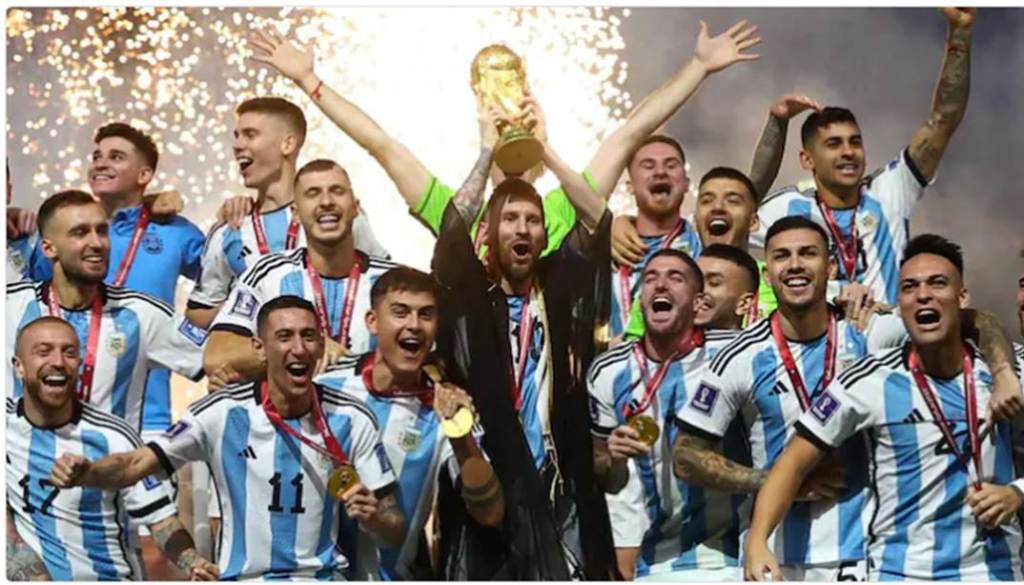
22nd November 2022. The first World Cup Group C match in Qatar. Score-line Saudi Arabia 2-1 Argentina. A stunning upset. A huge disappointment and shock for the millions of Messi fans across the globe rooting for his first World Cup victory with Argentina in his fifth appearance. The dream seemed to have ended before it even began. Social media trolls brutally took over and the GOAT (Greatest Of All Time) was ridiculed by comparisons with the Camel; unflattering memes became viral with graphic references to what happened to the GOAT.
Not winning the World Cup with Argentina has long been the albatross around Messi’s neck. Many pundits have derisively called him out with, ‘What has he done for the national team?’ For the record, he won the Olympics gold medal with the Argentine squad in 2008. In 2005, he won the U-20 WC and picked up both the Golden Boot (top scorer) and Golden Ball (player of the tournament). He carried an average team on his shoulders to the finals of the 2014 WC where Argentina lost 1-0 to Germany. Pictures of a forlorn Messi holding the Golden Ball trophy, looking at the one which mattered the most, made headlines around the sporting world. In 2015 and 2016 he again powered an ordinary national side to the finals of the Copa America. The defeat by Chile in 2016 devastated him to such an extent that he retired from international football. Thankfully, he changed his mind a few months later. Even in his home country, he was not embraced wholeheartedly as he had moved to Barcelona, Spain as a young teenager. The huge shadow of the flamboyant legend Maradona, who won the WC in 1986 for Argentina, seemed to follow him everywhere on the international stage.
In 2021, Messi finally broke the jinx by captaining Argentina to the Copa America trophy and once again being adjudged as the Golden ball winner. In the same year, he won a record 7th Ballon d’Or trophy putting him in the stratosphere of one of the greatest footballers of all time. He graced the Barcelona jersey from 2004-21 scoring 672 goals with 266 assists in 778 games and winning 34 trophies. The intensely loyal Messi would probably have played his last game at Nou Camp. However, shockingly the talisman player’s contract was not renewed by the Catalan club due to a financial crises, aggravated by the pandemic. Very few sportsmen have achieved such glorious success over such a long career at the high levels of competitive sport. But after winning his 5th Ballon d’Or our sporting icon said, “I would prefer the World cup over five Ballon d’Or trophies.” Vamos Argentina!!
Over these years Messi’s magic has been such that it has added another X factor to the beautiful game. Exponents like Pele, Garrincha, Jiarzinho, Zico, Ronaldo and Ronaldinho from Brazil instantly come to mind. Osvaldo Ardiles and Diego Maradona also spiced up the South American flavour and servings. Messi’s artistry and ball skills have often been called ‘Insane’, ‘Other worldly’ and ‘Alien’. His vision, balance, sudden turns and acceleration have stupefied both defenders and spectators. His saucy dribbles, sublime free kicks and the art of the chip finish have brought gasps and smiles and sheer jaw drops. Take his assist to Alvarez for the goal against Croatia in the just concluded WC. A great solo run, dribbles and feints and even stopping once before making that lethal pass backward from outside the goal post for the goal strike. The Croatian defender Jorko Gvandiol is recognised as one of the best in the business. But the Argentine maestro simply outclassed and outmanoeuvred him. The Brazilian great Ronaldo has observed that the 35-year-old Messi has changed his game with his age, “The 30 scoring actions and passes are now reduced to 10 but he remains the decisive player. His sporadic entries into the box but he is the killer. He plays on the minds of the opponents all the time.” The Brazilian champion pays Messi the ultimate compliment that, “He is happy that Messi has won the WC with the caveat that otherwise the 2 Latin American nations are bitter rivals on the football field.”
Lionel Messi, the idol, is adored by his Argentine teammates. They passionately worked and played to hold aloft the Holy Grail of football for their country, their team and especially for their captain. Angel Di Maria who impressed and scored in the final with a Messi assist had this to say, “I always dreamed of playing with him, having him by my side every day. Every time we go with Argentina national team it seems very short.” Martinez, who won the Golden Gloves award as the best goalkeeper, is even more heartfelt, “I want to give him life. I want to die for him.” Please check out the viral video when after the penalty shootout against the Netherlands, the entire team runs towards the goal scorer but Messi crosses the field to hug Martinez who is lying on the ground. The goalie’s saves had won them the match. Messi the match-winner has scored 98 goals in 172 games for Argentina. Equally critical has been his role as a team player and creator with 58 assists. Assist refers to that final definitive pass to a team-mate or setting up a team-mate to take the goal shot. It is worth pointing out here that Brazil, France and England were favoured to win the WC. But coach Scaloni built up a team around Messi with the likes of Martinez, Di Maria, Hernandez and upcoming star Alvarez who scored 4 goals. Lionel Messi was blessed to have a team which grew from strength to strength with every outing.
What about the Messi Mania? It’s a global, social phenomenon rarely witnessed. The world went bonkers. Not only did the sale of the No 10 Messi T-shirts break all records but there are social media posts of guys getting married in these T-shirts. Prayers were conducted at places of worship across the world for the folk hero to achieve his dream. Kerala, Goa and Kolkata saw huge cut-outs of the star with fresh garlands put on every day. What is there about the Argentine football legend which has touched millions of hearts across the planet?
His humble upbringing was in Rosario, Argentina. His growth hormone disorder (GHD) and the medical treatment his modest family could not afford. Then Destiny intervenes. FC Barcelona (thanks to their scouts) sign up a 13-year-old Messi and agree to pay for his medical treatment. Probably, the best deal in the history of football. Then, the youth team at the Barca Academy and the rest is history. Still, it astounds many many football fans as to how a 5 ft & 7 inches Messi has been outrunning and outsmarting much taller and better-built opponents for so many years. There is also the undeniable fact that very few human beings have carried the burden of expectations this man has and has ultimately triumphed on every count. During all his struggles, he has shown that a monster competitor lurks within him co-existing with his sublime skills and sporting nature. Despite the intense pressure, he has conducted himself with grace, poise and a sportsmanlike attitude. The private Messi has kept a low profile about the outstanding work of the Leo Messi Foundation in the areas of health, education and sports. Many pundits are now hailing him as the greatest athlete on the planet and not just the GOAT footballer. How the hell can a 35-year-old play all the matches full-time in the high-pressure WC and still rise to the occasion whenever it mattered? Lionel Messi has transcended his sport.
Let’s listen in to another great sportsman cast in the same mould. Roger Federer, “Fairy Tale stuff, Argentina. Time and again you Leo Messi have redefined greatness. It’s a privilege to watch you. Congrats, Leo. Special and historic.”
So it is that most of the footballing world and fraternity rejoiced when Messi and Argentina lifted the WC trophy. It was both relief and ecstasy after the greatest final game ever played. A fairy tale ending for Messi and his team. A small nugget of interesting trivia. Both Messi and Mbappe, the French star, play for PSG (Paris Saint Germain) which is owned by the Emir of Qatar through the Qatar Sports Foundation. Some things are meant to happen. As Messi’s ( Golden Ball winner) incredible career draws to a close, the 23-year-old Mbappe (Golden Boot winner) will be looking forward to more goals and glory.
The greatest individual player in a quintessentially team sport is an anomaly and incongruity of sorts. This has not stopped the billion plus football-crazy fans mulling over just that or umpteen expert panels on TV debating just that. For the elderly generation of Brazil football fans the answer is obvious. Move the clock forward to the 80’s and all of Argentina and Naples and much of the world shouts the name ‘Maradona’. Step forward to the modern era and many find it difficult to comprehend that there has ever been a player that does magical things with the football that a certain Barcelona player does. The GOAT debate simmers on with country and club loyalties thrown in and generational perspectives kicking in.
Membership of this ultra-elite club demands longevity and consistency in impactful performances, trophies & international laurels and of course – goals and assists. The latter criteria modified to embrace the great goalkeepers, defenders and mid-fielders and their wonderful saves, interceptions and passes. After all, soccer is the ultimate team sport.
Pele (Edson Arantes Do Nascimento) of Brazil and FC Santos needs no introduction. Fifty years after his last World Cup, he still tops most GOAT lists. 3 time World Cup medal winner (1958, ‘62, ‘70). 77 goals in 92 appearance in the Canary yellow Jersey (the iconic No 10), 650 goals in 694 matches for his clubs. Voted the International Athlete of the Century by the IOA (International Olympic Association). Pele combined speed with creativity, skill with physical power and stamina with athleticism at a level never seen before. Johann Cyruff, the Dutch legend, said that, “Pele was the only player who surpassed the boundaries of logic.” His lowest point was the WC ‘66, where the Bulgarians fouled and kicked him out of the second game. Then Portugal took over with shockingly violent fouls and the great man hobbled through the 90 mins as substitutes were not allowed at that time. The world’s best player was kicked and stamped out of the tournament with the referees looking the other way. He vowed never to play in another World Cup. But come 1970 and faith was restored in the beautiful game. By Pele and a Brazilian squad still considered one of the best ever- Jairzinho, Tostao, Rivelino, Gerson. Brazil were champions once again and Pele crowned ‘the Player of the Tournament.’
Pele had become the global face of football- powering its endless and exponential growth. In 1975 near retirement, he signed a $7 million deal with the New York Cosmos making him the richest athlete in the world. We also remember the hysteria in Calcutta when he came over with the Cosmos side in 1977 for an exhibition match with Mohan Bagan. 25,000 policemen were deployed in the city, at the hotel and the stadium to prevent this feverish enthusiasm from boiling over. Exactly 10 years earlier he had played in another exhibition match in Lagos in war ravaged Nigeria. The military and the separatists had announced a 48 hour cease-fire to allow this special event to happen.
Lev Yashin, the Soviet footballer, is considered by many as the greatest goal keeper in the history of the sport. The only goal keeper to be awarded the Ballon d’Or in 1963. With his club Dynamo Moscow he won 5 league championships. His influence can be gauged by the fact that over a 27 game season he let in only 7 goals. He emerged as a star as part of the 1956 Olympic gold medal winning Soviet team conceding only 2 goals and led the team to their best ever FIFA WC finish- 4th place- in 1966. Over his career he is said to have stopped over a 100 penalty kicks. His athleticism, positioning and acrobatic saves made him an inspiring figure in the goal. Yashin’s physical stature, sheer reflexes and bravery made him a Hero of the Soviet Union. His face adorned all the FIFA 2018 WC posters. It will not be an exaggeration to say that he invented the concept of a sweeper- goal keeper. He dramatically changed the role of goalkeeping by always being ready to act as an extra defender or by starting dangerous counter-attacks through a quick throw or a precisely directed kick.
In the Soviet psyche of his times the goalkeeper virtually represented the last line of defence. As his wife stirringly mentioned after his death, “Any mistakes a goalkeeper makes, everyone sees it. They remember it. They talk about it. The goalkeeper is the last line, the one on the border. If that border is breached, it’s a goal.” She should know. In the ‘62 WC Lev Yashin let in 2 soft goals as his team crashed out 2-1 to Chile. His house in Moscow was attacked. Placards and banners of ‘Yashin, Retire!’ & ‘Get out and take your pension’ were all over the city.
Johann Cyruff, the Dutch mid-fielder revolutionised the game as we see it today. He and his mentor, Rinus Michels, created the ‘Total Football’ philosophy with club Ajax- a tactic which allowed for versatility to the players all over the pitch irrespective of their positions. This disruptive flexibility meant that their position was immediately filled by another player. Ajax were unstoppable from the late 60’s, winning 6 titles from 1966-73 and a hat-trick of European Cups in 1971-72-73. He was the European player of the year thrice and also won the Ballon d’Or thrice. He scored 204 goals to propel Ajax to greatness as a club and netted 23 as the Dutch captain. Between 1970-74 the Netherlands lost only one of the 29 matches in which Cyruff featured i.e. the 1974 WC final against hosts Germany. He moved on the field like a grandmaster. He created the most chances, completed the most passes in the final third of the pitch and simply befuddled the opponent defences. In his prime, the Ajax club side and the Dutch national team enjoyed the maximum possession of the ball. They set the pace, they controlled the game.
Gordon Banks, the English goalkeeper was named the FIFA goal keeper of the year an incredible 6 times. He had 73 caps for England between 1958 and 1972 and 600 plus club appearances for Leicester and Stoke City. He started every England match in their glorious WC quest in 1966 and let in only 3 goals. In the 1970 edition he made what is regarded as one of the greatest saves to prevent a Pele goal. He also starred in the 1972 league win by Stoke. Sadly, the same year he lost his right eye in a car crash ending his career at the highest level.
Franz Beckenbauer was named in the World team of the 20th century. He is often credited as the inventor of the modern sweeper or libero. A central defender, he retained the ability to charge up the pitch with the ball at his feet. Fearless and effective. This versatility made him a dangerous player. He notched up 427 appearances for the elite German club, Bayern Munich and 103 for the German national side. As captain of his country, he won the European Championship in 1972 and the World Cup in 1974. At club level Bayern Munich won the UEFA Cup Winners Cup in 1967 and under his leadership 3 European Cups from 1974 to 1976. Add to all these triumphs, the Ballon d’Or in 1972. No wonder, he was nicknamed ‘Der Kaiser’, for his elegant style, dominance and leadership aura on the field.
Diego Maradona became a global phenomenon after the 1986 World Cup in Mexico. He did something truly extraordinary- carrying an average Argentinian team to a World Cup victory. The controversial ‘Hand of God’ goal against England is still talked about but the superlative second goal still takes our breath away. As does the artistry and brilliance of the double strike in the semis against Belgium. At a mere 5 ft 5 inches, compact and built low to the ground he was exceptional at evading defenders with sheer ability and ball skills. It has been said that he had the stamina of a full back, the strength of a centre back, tackling ability of a defensive mid-fielder, passing acumen of a playmaker and the finishing ability of a great striker. He has been named FIFA player of the century along with who else, Pele. Maradona, a midfielder, has scored 34 times for his country in 91 matches and 259 times in 490 club appearances. He is still worshipped as a saint in Naples. The fairy tale title win in 1987 is still savoured as is the Napoli encore in 1990. Rumour has it that 1988 also would have been their year- as the team were cruising along- had the Mafia not stepped in. Another Serie A win would have ruined their betting syndicates. Maradona had moved to the Italian League after a couple of turbulent seasons with FC Barcelona. But not before lifting the Catalan club to a couple of titles.
Sadly in the 1994 US WC, he played only 2 matches scoring one goal. He was sent home in disgrace having failed a drug test. The cocaine addiction was taking its toll and his health worsened drastically .It would be no exaggeration to say that Fidel Castro and the Cuban public health service saved his life. The Cuban leader who had become a father figure over the years ensured that he got the best treatment and rehabilitation the healthcare system had to offer. Sadly, a couple of weeks back, Maradona passed away at the age of 60. As the foot balling world mourns the loss, some great players lauded him as the G.O.A.T in their fulsome tributes.
The Brazilian Ronaldo Nazario is considered one of the most lethal goal poachers in football. His immense speed and power made him a handful for the best of the defenders. 62 goals in 98 matches for his country; an astounding 15 goals in 2 World Cups (1998, 2002) speaks volumes about his sterling abilities. The WC winner medal in 2002 plus the Golden Boot award. FIFA player of the year thrice. Stellar careers at illustrious clubs like AC Milan, FC Barcelona, Real Madrid and PSV Eindhoven. The mysteriously low point for Ronaldo was the ‘98 WC final against France. He is said to have convulsed before the match at the team hotel. Shaking and with froth in his mouth. Definitely not fit to play. But then he took the field, a shadow of himself and watched the French romp to a 3-0 win. It was widely reported that the star player had been forced to play under pressure from the sponsors, Nike. Another theory was that it was an injection for a knee injury which had gone wrong. However, Brazil kept its faith in Ronaldo and he repaid it with the World Cup four years later.
Paolo Maldini, Italy and AC Milan, has to be one of the most complete players the game has seen. A left back and central defender, he read the game wonderfully well. He was skilled with his feet, excellent in the air and had the uncanny ability to marshal a staunch defence even at the fag-end of an exhausting match. He dispossessed the opposition player by a mixture of anticipation, interception and physicality. He redefined defending as a beautiful art form and was imperiously consistent. His oft repeated quote, “If I have to make a tackle then I have already made a mistake” summed up his classy approach to defending. A one-club player he turned out for Milan a record 902 times. With his club he won 7 Serie A titles and the UEFA Championship League trophy 5 times. He donned the Italian jersey for 4 World Cups including at the 94 WC final loss. He captained the national team for 8 years and 74 matches (out of 126 caps). As fate would have it he got a call up to play for Italy at the 2006 WC, “I said no to the call-up in 2006 and they won.”
Zinedine Zidane is another name which universally makes the cut. A physically imposing central mid-fielder he was light on his feet and his elegance with the ball was incredibly brilliant. He also possessed this uncanny knack of reading the game several moves ahead. His high point was the 1998 World Cup win for France against favourites Brazil. He scored twice in the finals and became the toast of the nation. Capped 108 times for France he also won the UEFA Euro 2000 and was named player of the tournament. With 31 international goals and 128 more in club football with Real Madrid and Juventus this attacking midfielder broadened the dimensions of the game to amazing levels. A master playmaker and an effective interceptor. A Ballon d’Or winner, 3 times FIFA player of the year. Unfortunately, he is also remembered for the head-butt incident in the 2006 WC final. After a slow start Zidane dragged a lack-lustre French squad into the final with Italy. Italy’s Materazzi made some unprintable comments on Zizou’s sister and the latter lost it for a moment. The red-card and the heart-breaking loss. I recall a head-line which went like this, “In dragging France to the 2006 WC final Zidane hinted at immortality and once they got there he proved his mortality.”
Think Ronaldinho and you think of the bucktoothed grin, the sublime free-kicks and the sense of fun he brought to the field. Football was an expression of self. Entertainment always seemed to be the top priority and even above winning but his super skills usually ensured both. The WC winners medal in 2002 and the Ballon d’Or in 2005 simply happened along the way. As did 66 free kick goals. The training regimen and the ultra-professional habits of the world’s best footballers were not for this Brazilian magician. The right wing midfielder achieved so much even without trying. In 2005 he achieved the unthinkable. With 2 magical goals for FC Barcelona against arch rivals Real Madrid. The packed Bernabeu was on its feet applauding the beauty of what they had witnessed. Sad to say, one of the world’s best No 10 has become prisoner no 194. In jail for 32 days with his brother on charges of travelling on a false passport to Paraguay and money laundering. He has posted a $1.6 million bail and recently been freed after pleading guilty to the passport fraud.
Gianluigi Buffon, the famous Italian goalkeeper finally announced his retirement in 2018 after 176 caps for Italy. In a career spanning 27 years and 649 Serie A matches, he spent the majority of the time with Juventus and has become a folk-hero in Turin. 7 Serie A & 4 Coppa Italia titles with Juventus , the UEFA Cup with Parma. A decisive role in Italy’s WC win in 2006 conceding only 2 goals in 7 matches, that too a penalty and an own goal by a teammate. His speciality lay in his exceptional positioning in set-piece situations; his long and athletic frame plus his agility and exceptional reflexes made him very capable of blocking penalty kicks and angled headers. Hence, Buffon has a jaw-dropping 300 plus clean-sheets to his name and career.
At the age of 13, Lionel Messi’s precocious footballing talents so impressed the FC Barcelona scouts and management that he moved to the Catalan city. The club paid for his expensive treatment for growth hormonal deficiency. In just 4 years he moved to the first team and the rest is history. 10 La Liga wins, 4 UEFA trophies, 6 Copa del Rey. A stupendous 678 goals for Barcelona at a mind-boggling 0.92 goals per game.36 La Liga hat-tricks and 26 El Classico goals against arch-rival Real Madrid. The only player to net more than 40 goals for 10 consecutive seasons. 6 Ballon d’Or (the highest), 6 European Golden Shoe awards and 10 player of the year citations. The accolades go on….. But they don’t tell the full story. For Messi to millions of football fans all over transcends awards and stats. He is the modern maestro of the Beautiful Game- the biggest box office draw today. His ability to manipulate the ball with deft touches and quick movements have often been described as ‘Out of this world’. Seasoned commentators and great yester year players have gone ga-ga whilst commenting about the magic he weaves on the pitch. What adds to the aura of his genius is the sheer number of assists he conjures up for country and club. An all-time high 42 assists for the national side + 71 goals in 142 games. A record 183 assists in the La Liga. The albatross around his neck is the lack of international titles with the national side. Just an Olympic gold medal in Beijing 2008. In the WC final against Germany in 2014 and the 3 Copa America finals he has ended up on the losing side. No matter that he won the Golden Ball at WC ‘14. His legions of fans speak about the fragility of the Argentinian team and how he had to single-handedly qualify them for the WC in Russia two years back. Then the shadow of Maradona spreads across the pitch. The other painful story is how the Barca dream has fallen apart this season. After 20 years at the club & 14 glorious years as its inspirational player Messi will be exiting in June next year. The ineptitude and indifference of the Club President and Management has been shocking to say the least.
CR7. Cristiano Ronaldo of Portugal, Man U, Real Madrid, Juventus and possibly Man U again. He has netted 451 times in 438 games for Real Madrid averaging a little over a goal a match. Mind boggling. With the Spanish club he has won 4 European Cups, 3 Club World Cups, 3 UEFA Super Cups, 2 La Liga titles and 2 Copa del Rey. In 2016 he captained the Portuguese side to the European Championship triumph. A 5 time Ballon d’Or winner. A rare specimen of supreme physical fitness, his tall frame and tremendous pace terrorises defences. Add an almost unstoppable free kick to the arsenal. A unique feature of this very fast player is the exhibition of the double scissors and chop moves which allows him to quickly change directions. In 2018, the Turin medical staff did a medical test on this supreme athlete and found that his condition at 34 was the same as a 20 year old. With an incredible 50% muscle and 7% body fat. Watch the insane 2.65 metre jump header against Sampdoria in the Serie A match last year. Awesome. One of the greatest goals of all time. The prolific striker has added 2 Italian championship titles to his remarkable trophy haul. As the highest paid footballer and the athlete with the highest social media following, Ronaldo is in a league of his own. Both he and Messi have only a year or two left at the very top. Will be interesting to see how things pan out for them. But the Messi vs Ronaldo debate is not going to end any time soon. His fans often make the point that the Argentine tends to disappear in some matches whilst their Man has his moments even in a below par game. CR 7’s global popularity has also seen him evolve as an entrepreneur with set goals. His footwear line ‘CR 7 footwear’ is making footprints across the Middle East, South East Asia & Latin America. His association with a Portuguese hotel chain have led to expansions in Lisbon, Madrid and New York. And of course there is the lifetime mega contract with Nike Inc.
So is there a definitive G.O.A.T ranking. Not quite. Football associations and sports magazines and TV channels conduct their own surveys and publish their own results. A recent French Sports list anointed Buffon as the best goalkeeper of all time. Another by Sport Bible and BBC put Lionel Messi on top of the charts. Moreover football aficionados have their own choices, their own way of looking at things. This adds another dimension to the never-ending discussion especially on social media.
RESPECT. Old timers may recall Alfredo Di Stefano and the Golden Age of Real Madrid. Or Hungarian Ferenc Puskas hailed as the top scorer of the 20th century and in whose name a FIFA award has been instituted. The bow-legged Brazilian dazzler, Garrincha, recepient of 2 WC winner medals and still revered in his country. The Roll of Honour includes the English midfielder Bobby Charlton of the 1966 WC champions team and the Ballon d ‘Or winner in the same year. A survivor of the great Manchester United team which lost several of its players in the Munich plane crash of 1958. Gerd Muller, the hero of the’74 WC for hosts Germany. Named ‘Der Bomber’ for his precise and deadly strikes. There will be enthusiastic support for the elegant Michel Platini of France and the savvy German captain Lothar Matthaus. For the mercurial genius of George Best the winger for Man U and Northern Ireland; for David Beckham of ‘Bend It like Beckham’ fame and the ‘Flying Dutchman’- Robin Van Persie. There will be millions rooting for the Italian goalie Dino Zoff who led his team to the ’82 WC triumph at the ripe age of 40 and holds the record for conceding no goals for 1142 minutes. The almost impregnable Oliver Kahn under the German goal-post. Didier Drogba the famous Chelsea and Marseille striker and the most beloved person in the West African nation of Ivory Coast. The show will go on.
The legends, celebrated in the blog, are the recurrent names which resonate across the global footballing fraternity. Animated discussions continue in TV studios and magazine offices, clubs and bars all over the globe. It keeps the pot boiling and certainly adds flavour and spice to the world’s favourite sport.
The scales in cricket have been tilted in favour of the batsmen. It has not really been a level playing field. But not too long ago, there still prevailed the ideal of a battle between bat and ball and a battle of wits between the bowler and the batter. Quality time was spent on discussing the pace-threat and the guiles and skills of spin. I remember Richie Benaud commenting on an Ashes Test. The elegant English stroke player was struggling with a packed slip cordon and Jeff Thomson was on fire. As the captain waved a couple of fielders to long-leg and deep square, the astute veteran sensed a trap. Along came the shoulder-high bouncer and went straight down the throat at long-leg. This was the charm of the game. Even with radio commentary one could visualise the game plan.
The champion bowlers were celebrated and appreciated. Pundits in the sports magazines and newspapers would wax lyrical about Chandra’sflipper or Bedi’s tantalising flight and control. They were on the covers of even the popular periodicals. The flipper we learnt was a back-spin ball which kept deceptively low after pitching- to deadly effect. The legendary Gary Sobers in his ‘spin avatar’ bowled the chinaman– decoded to us by the experts as the left arm bowler’s leg spin. The sharp turn came into the right hand batsmen or moved away from the south-paw. Kuldeep Yadav is the current exponent but our run-happy hyperbolic commentators have little to say on this fine craft of bowling. Tony Cozier, the West Indian expert, educated us about Colin Croft’s toe-crusher yorker and the deceptive slower, swinging one. Cricket aficionados learnt about the 3 variants of bouncer in Andy Robert’s arsenal. The reverse swing of Wasim Akram evoked admiration as did Murali’s doosra (the other one in Hindustani). A regular off break delivery with a wrist twist which made the ball spin in the opposite direction. Cricket was more than a physical sport. At times it was almost a chess-match between bat and ball. It blew your mind.
In the seething cauldron of the MCG, fans used to chant ‘Lillee, Lillee’ as their gladiator ran into bowl at express pace. Roberts, Holding, Croft and Joel Garner of the Fab Four have inspired Caribbean Calypsos. There was deathly silence at Ahmedabad as Holding and Marshall dismantled our second innings in the 1983 Motera Test. Even in the pall of disappointment, I sensed Respect. We had witnessed a sensational bowling display. The crowd stood up to applaud the great West Indian team. Shane Warne’s ‘ ball of the century’ to dismiss Gatting in the 1993 Test match still remains a hot You-Tube favorite. Harbhajan ‘Turbanator’ Singh’s hat-trick at the 2001 Test vs the Aussies electrified the packed 1,00,000 crowd at the Eden Gardens and virtually brought the country to a stand-still.
Within the prime cricketers fraternity there is mutual and genuine respect between the bowlers and batsmen. Here is Ian Chappell’s (the reputed Aussie captain) take on our great off-spinnerPrasanna. He had taken 25 wickets in 4 tests against a formidable batting line-up Down-Under in 1967-68, “the best spinner he had ever faced. He was trying to get you out every ball. A test to your brain. He put his engineering background to good effect by employing things he had learnt as an engineer. He pulled it back on a bloody string.” The awe is obvious, ‘aerodynamics, biomechanics, pitching the ball at length. Psychology. Baiting a batsman over after over to induce a mistake.’ Phew. Cricket is deemed to be a religion in India. Are we missing out on good chunks of its scriptures.?!!
Brian Lara on Wasim Akram’ He made me feel stupid at times. Feared to face the Sultan of Swing ‘and more.’ He was fast and furious. He bowled over and around the wicket, swung the ball both ways, a master of reverse swing. ‘At times he cut the ball prodigiously.’ Such a tribute from an all-time great batsman. The reverse swing is the art of swinging the ball in towards the batsman rather than away from him. One side of the old ball gets scruffy and the other retains its shine to get this movement. A lethal delivery later in the innings. A blessing as else even a good pace bowler would be regularly hit out of the park on a true track. Akram was the original master of this Art of Fast bowling. Then, why does the game seem so one-dimensional now? Runs, fours and sixes. That’s all it takes to hit the cricket pop charts!
So what has eroded the bowler’s stature in cricket. First, the shrinking of the playing fields. From 75-85 mtrs boundaries to 65-70 mtrs to the ropes from the centre of the pitch. In New Zealand, down to 55-60 mtrs of turf expanse. Yes, the hoardings and the ad billboards, the media spots and the dug-outs have also encroached into the playing space. This is the unspoken reality behind the sudden glut of sixes.
The bats have gotten larger and heavier. Chris Gayle wields a 1.36 kgs willow. With the thicker edges, a top edge flies for a six. We have the swooning commentators going ga-ga. The batsman has been beaten by the pace, bounce or swing but the cheers and bugles are for the ultimate shot. Inadvertently, perhaps, but the bowler is being reduced to a side-role in the cricket show-time.
Let’s look at the pitch report. Mostly, flat and true even if offering some pace and bounce. WACA (Perth in West Australia) used to be a dreaded track, very fast and bouncy. A graveyard for touring willow-wielders. Not anymore. The extra bounce, pace and rip have gone. Touring batsmen from all over the world have heaved a collective sigh of relief. Let’s also listen in to Gary Barwell, head groundsman at Edgbaston, Birmingham. ‘One day pitches in England are the best in the world. Well, if you are a batsman, that is. The tracks are flat and true. It enables batsmen to hit through the ball.’
An interesting bowling nugget from the 1970’s on the wicket conditions. The English team it was said carried left arm quickish spinner Derek Underwood like an umbrella, in case it rained. On sticky or drying surfaces he was unplayable and would simply run through the opposition batting.
The protective gear now worn by the batters has diminished the aura that the best fast bowlers had. Fear and Intimidation is a thing of the past. Pace like Fire as unleashed by the great West Indies fast men of the 70’s and 80’s is now part of cricket folk-lore. Catch it on the riveting documentary, ‘Fire in Babylon’. Helmets, metal visors, pads, gloves, chest and elbow padding, abdominal guards or the box are effective PPE’s. So should they be. The 5.75 ounces of leather bowled at over 90 miles per hour is a deadly projectile. Who can forget the tragic death of Phil Hughes despite the helmet gear?
The rules of the game also help the batsmen. One bouncer an over in T-20’s and two in ODI’s and Tests. Next the fielding restrictions. During the T20 power play (first 6 overs) only 2 fielders outside the 30 yard circle. For the rest of the innings, a max of 5 fielders outside the defined space. Ditto for ODI’s in the first 10 power-play overs. Then relaxed to 4 fielders in the deep for 10-40 overs and a max of 5 fielders in these positions for the last 10 overs. The bowlers and their captains have little strategic space to test the weaknesses of the batsman. Moreover, a bowler can bowl a max of 10 overs in the 50 over game and 4 overs in the T20 format. The skipper has to use 5 or more bowlers to get through the innings. If anyone is below par on the day or a part-timer is getting taken to the cleaners, the captain can only hope and pray for an end to the mayhem. Why not tweak the rules to allow one main or in-form bowler to have an extra 2 or 5 overs in the two limited over formats? Some latitude to balance out the game. Some push-back on the batsmens’ privileges.
Look at the concept of a ‘Free Hit’. A free hit is given to the batsman for the next delivery if the bowler over-steps with his front foot or his back-foot does not land within the return crease. Both versions of the No Ball. Do the batters require any more largesse in a T20 or ODI game where conditions are skewed in their favour. Catch the poor leg-spinner. The LBW rule says that for a ball pitched outside the leg-stump, the batsman cannot be given out even if the ball had turned and gone on to hit the stumps. For Leggie’s Sake! the pads are protective gear and not a second line of defence. The bowler is being defanged of his venom.
Another nugget to expose the bias. Stuart Broad, the English fast bowler, recently crossed the 600 wicket mark in Test cricket. A remarkable landmark. But social media in India was flooded with comments about whether he was the same bloke whom Yuvraj Singh had clobbered for 6 sixes in an over. Why do batting exploits have to dominate cricket conversations? Why not salute his indomitable spirit and hail this amazing achievement?
Let’s hark back to the World Cup 2019 thriller finals. England and New Zealand both ended up at the same score even after the Super over. The trophy was handed over to England by a strange rule that they had scored more sixes and fours than their rivals. The run-rate was the same. Again bat over ball. The Kiwis had taken 10 English wickets and lost 8 whilst batting. This did not count in the ICC scheme of things.
Is it any surprise that batting records are being smashed all over the cricketing world? 10 teams have breached the 400 runs mark in the ODI tournaments. Getting 250 runs in a T20 match is entirely possible. Rohit Sharma leads the pack with 4 centuries in the shortest international format.
The advantage is firmly in the batsmen’s crease but cricket administrators and marquee cricketers are waking up to the fact. The DRS review appeals has come as a boon for the bowlers too. This has put pressure on the umpires to be neutral, alert and zoned-in especially on LBW issues. The notoriety of some in the not too distant past still lingers on. The host side at times played with 13 active players. Some officials also came under the match-fixing cloud. The Snick-o-meter with the third umpire or match referee also bats for the bowlers and helps their cause. It analyses the video and sound as to whether a fine snick or noise occurs as ball passes bat.
The other booster for the pace bowlers should be the 2 new white ball rule- 25 overs from each end in the ODI’s. Sachin Tendulkar has a different perspective, “this is not the perfect recipe as each ball is not given time to get rough and old and reverse. We haven’t seen reverse swing, an integral part of the death overs.” Further, in 2017, the ICC did come up with a half measure on bats- ‘edges can’t be more than 40 mm in thickness and the overall depth of the bat measured from the highest part of the spine should not be more than 67mm.’
One major ally for the bowlers is the support on the fielding front. The extraordinary enhancement in fitness and fielding skills have not only saved runs but kept the pressure lid on. The conversion ratio of run-outs and direct hits has spiked. Extraordinary catches, especially in the outfield, have become the norm.
So is this just a lament for the plight of the bowlers. Are batsmen the villains? Absolutely not! The rules and the playing eco-system have to be changed to ensure a fair and engaging contest between bat and ball. Else, why are low scoring matches so thrilling? !! Tendulkar and Dravid, Kohli, Smith and AB DeVilliers, Ponting and Lara, Dhoni and Sangakara have enriched the game beyond measure. They are Maestros. Their exploits with the bat have packed stadiums and commanded a huge and loyal viewership. As the formats have changed, they have been at the forefront of amazing innovations in batting technique and flair. AB is known as the 360 degree genius. The upper-cut, switch-hit, reverse sweep, paddle shot, Inside-Out stroke and the Periscope shot are now all part of the cricket lexicon. The last named because the motion ends up with the batter holding the bat like a protruding periscope. Who can forget Ganguly’s break-out century at Lords in 1996? The Sachin master-class knock of 98 against Pakistan at the Centurion in WC 2003. The Very Very Special Laxman-Dravid partnership which snatched victory from the jaws of defeat against the rampaging Aussies- Eden Gardens 2001. Or Kapil Dev’s iconic 175 not out at Turnbridge Wells in the 1983 World Cup. But let us not forget the critical contributions to the 1983 WC triumph from our under-rated bowling squad.
Baseball is a distant cousin of cricket. The Pitchers have their own variations- the curve ball, the slider, the fast ball. In the All Time great lists they rub shoulders with the batters with almost equal representation. They hog their fair share of the limelight in the MBL Hall of Fame. This is also a statistically obsessed game. But their analysts and fans cover all the bases. However, in Indian cricket, the media and the fans cannot stop talking about the number of centuries, the big hits,the strike rate and in the IPL context- the Orange Cap.
Stats do not tell the whole story and they can be misleading at times. Instead, look at the Impact Players. Whose performances have changed the fortunes of a match or a series. A Bumrah for India or a Rabada for South Africa with key wickets at the right junctures. Even for a batsman-evaluate the innings in the context of the match, the pitch conditions and the quality of the opposition attack. A fifty on a difficult wicket in a low scoring match is worth much more than a century on a docile pitch.
In the 80’s and 90’s a widely held belief was that a 5 wicket haul in a Test or ODI was equal to a century. Anil Kumble has had 35 five wicket hauls in Tests and 2 in ODI’s. Equals to at least 35 centuries. Places him deservedly amongst the batting greats. His extraordinary 10 wicket haul in an innings against Pakistan at the Ferozshah Kotla in 1999 should catapult him into the exalted cricketer realm. Not quite. If you do an informal survey in your own circle about the 6-7top Indian cricketers for the last 25 years, batting masters with celebrity names will quickly fill up most lists. Kumble, Zaheer Khan, Harbhajan Singh may at best sneak into a few.



 A Fistful of Salt