Unknown's avatar

About SV Rao

Insurance professional by day. A teacher by choice. A sports-buff, traveler, movie-nut, bookworm, and, a lover of vintage Hindi-film songs, seeking sense within all this noise. Welcome to my take; a fistful of salt is recommended.

Viv Richards- Masterclass

Getty Images

As in other major sports, in cricket too success and failure is all too measurable. It is not only the fans and the experts but also the players who take an obsessive interest in statistics. Very rarely comes a cricketer who transcends numbers, who is beyond records. Say ‘Viv Richards’ and the stats, impressive as they are, fade into the background. The talk is all about his sheer brilliance and his swag. The profound influence he has had on redefining batsmanship and the game itself.

His impact on the teams he has represented has been phenomenal. For the Windies, Clive Lloyd was the father figure, the mentor, the captain. But it was Viv who became the talisman, the catalyst who turned a bunch of easy-going Calypso cricketers into the great West Indian teams from the late 70’s to the early 90’s. His aura on the field, his charisma at the crease and his dominating will to win embodied the Caribbean cricket revolution. Kallicharan, Greenidge, Haynes, Roberts, Holding all rode the waves of their talents and skills and realised themselves as champions.

Take the 1976 tour of England which transformed their cricket. Still hurting from the 5-1 thrashing Down-Under in 1975-76. Tony Greig, the England captain, said that he would make them ‘grovel’. Cricket lore has it that Richards checked out the meaning in the dictionary, “In other words he was going to have us down on our knees-begging for mercy. This was the greatest motivating speech the England captain could have given the West Indian team.” In 4 Tests he smashed 829 runs and the English team into submission. Helped by other impactful performances, it was a historic 3-0 win for Lloyd’s men.

Somerset, till the mid-70’s, were the laggards in county cricket. Enter Richards (+ Ian Botham). The county became the ODI team of the era with 5 trophies in 5 seasons. The Richards effect- instilling self- belief in small town players who had never possessed it before. At the fag-end of his career he signed up with Glamorgan, another struggling team and inspired them to a fairy tale win in the 1993 ODI Axa League title. The aroma of the daffodil win still lingers with the Welsh. Small wonder, that both the English counties have voted him as the best overseas player in a recent BBC sports poll.

Viv Richards- the man for the big occasions. In the inaugural edition of the World Cup finals in 1975, this live-wire fielder ran out Alan Turner and the Chappell brothers as the Windies became world champions. His 138 not out vs hosts England in ‘79 sealed a one-sided final with Collis King firing from the other end. It is widely acknowledged that the turning point in India’s great upset win in WC’ 83 was Kapil Dev’s superb catch to dismiss Richards (33 in 28 balls) just as he was moving into top gear.

In the 2 seasons of Kerry Packer’s World Series cricket against the world’s best bowlers on Aussie wickets he was the pick of the batsmen with 1200 plus runs at an average of 60. On the testing pitches of England and Australia he stamped his class as the best touring batsman of his time. His compatriot and fast bowling great Michael Holding sums it best, “Viv is the best batsman I have seen against anything and everything. He never got intimidated. Hadlee in New Zealand, Lillee in Australia, Qadir in Pakistan, Bedi in India, Botham in England. He got runs against anybody and everybody.”

There are runs and runs. Some runs count more than others for the team. Like the 189 not out at Old Trafford ’84, adding 106 runs for the last wicket and scoring 94 of those runs. Like the 61 not out in 36 balls against India at Sabina Park ‘83 to take his side to a dramatic win. The blistering 60 of 40 balls at the Benson & Hedges Cup final in Australia’ 88-89. Time and again he showed up to change the fortunes of a match, a series or a tournament.

His ability to play attacking cricket, improvise and control the game changed cricket itself. In the mid 70’s batting in Test matches was all about technique and temperament. Bill Lawry, Geoff Boycott and even Sunil Gavaskar were cast in this classic traditional mould. Runs came at a slowish pace with only the bad deliveries put away for four. Hitting the ball in the air was a cardinal sin, against the tenets of the game. There were stroke players like Kanhai and Sobers, Pataudi and Vishwanath, Gower and Ian Chappell who batted with flair and elegance and kept the score board ticking at a faster clip. However, Richards revolutionised the art of batting itself. His very presence at the crease unnerved bowlers. He captured the public imagination with his aggression and raw intent to tear apart the bowling attack. Let’s also not forget that he did this at a time where pitches were more challenging, boundaries were longer, fielding restrictions as of today were not there. He faced upto the fastest bowlers without wearing a helmet. Listen to Jeff Dujon, the Windies keeper-batsman, “He never wore a helmet but had the courage to hook the fastest of deliveries of his face. He never liked to be dominated.” His lightning hand-eye coordination, his flair in the middle and his remarkable performances all put together to make him a truly extraordinary batsman.

Dickie Bird, the famous English umpire, called him “A great character. There are very few left in sports.” Richards took swagger to another level. Scyld Berry, the well-known cricket writer, captures the persona,’ before anyone thought of the phrase, Viv Richards walked the walk. Head held high, jaw working his gum; the maroon cap- never, never the helmet and brandishing his choice of weapon- a Slazenger in his right hand. No choreographer equipped with spotlights and sound effects could have improved upon his entrance. Nobody batted like Richards either. His mental power and the awesomely muscular yet athletic 5’10’’ frame. By the second ball of a Viv Richards innings there were very few, if any, teams who did not recognise the Master in their midst.’

Who better to comment on the MAN than the great rival bowlers of the era. Bob Willis- “The best batsman by a mile. He had this fear factor about him. Even if you bowled a good ball, he could destroy you. He could win matches on his own.” Imran Khan talks about “This complete genius” with “amazing reflexes” who could destroy any attack. Jeff Thomson doffs his cap with his, “Nobody better than Viv” comment. His mate Dennis Lillee, “I just loved bowling to the man. It was such a challenge. I regarded him as one of the supreme players, if not the supreme player.” The great off-spinner Prasanna has called him, “One of the greatest of all time” and Bedi, Underwood and Qadir have all paid fulsome tributes.

The great batsmen peers have all saluted the Caribbean maestro. Gavaskar called his batting ‘Sensational’. Martin Crowe, “He walked out to own the stage.” Inzamam has it that Richards changed the very concept and idea of batting. He remains the ‘hero’ for Tendulkar and Kohli, Sehwag, Gilchrist and Jayasuriya.

The West Indian champion batter was a generation ahead, way ahead of his time. His 100 in 56 balls against England at Antigua ‘86 was only eclipsed by Brendon Mccullum’s century in 54 balls in 2016. Richards would have taken to the T20 format like a fish to water. Imagine the plight of bowlers the world over. Franchisees like the billionaire Mukesh Ambani would have rolled out the red carpet to get this most destructive of batsmen on board. With a blank cheque to write his price.

Hardly surprising that he makes every honour list in cricket. The Wisden’s top 5 cricketers of the last century. Amongst the best 5 Test batsmen ever. The finest ODI batsman in history. 31 man of the match awards in 187 matches at a strike rate of 90 tells its story. Strike rate on par with Kohli today. In 1994 he was knighted for his services to cricket by the Queen of England .(OBE). In 1999 his native Antigua and Barbuda conferred on him the title of Knight Commander of the Order of the Nation. (KCN).

Some may remember that he refused to be a part of the rebel West Indies team to apartheid South Africa in 1983-84. Despite being repeatedly offered a blank cheque. Despite repeated calls from the SA President’s office. Despite the offer of being made an ‘honorary white man’, whatever that means. In the same vein he publicly thanked Ian Botham for always being in his corner and never turning his back on him when the Englishman received hate-mails during their shared apartment years at Taunton, Somerset.

The mettle of the man. In the WC’ 83 semi-final against Pakistan, Qadir deceived him with a googly but the catch was dropped at leg-slip. Richard’s 80 not out propelled his team into their third successive final. Whilst walking back, he approached  Qadir with a hand-shake and a, “Well bowled, Sir.’

After India’s disastrous 2007 WC, Tendulkar was planning to retire from cricket. The turmoil in Indian cricket (read Greg Chappell) plus his own inability to bat like the younger Sachin weighed on his mind. A 45 mins call with his ‘hero Viv’ changed all that. The West Indian urged him to continue as he still had a lot to give to Indian cricket. Become the Shaolin master- a mentor and inspiration for the younger guys.  The message resonated from one master to the other.

Watch any of his interviews or panel discussions on TV or You-tube. You see a grounded person, generous in his praise for his team-mates and rivals. Bob Willis called him a lovely person who left all his aggression on the field. His emotional eulogies for Abdul Qadir and Bob Willis after their passing in 2019 are touching. For him Gavaskar is the ‘Godfather’ of Indian cricket. He has high praise for Tendulkar and Lara, Dravid and Ponting, Kohli and AB and encouragement for youngsters like Bumrah and KL Rahul. Respect for Akram and Lillee, Bedi and ‘mystery man’ Chandra. He has humorously confessed to being a nervous wreck against our spin quartet on his debut tour of India in 1974. He could not read Chandrashekar at all. That the spinners took the new ball in the fourth over itself psyched him out.

Along with Andy Roberts he has changed the fortunes of Antigua and Barbuda. These had been relegated to forgotten backwaters after the exploitative sugarcane plantations were stopped in the mid ’50’s. Their fame brought international cricket to Antigua in 1981 and opened the doors for tourism. Today these islands attract around 3 lakh tourists annually, thrice the size of the population.

Viv Richards has founded the SVRF to promote education, sports and recreation and health. Thousands of locals have benefitted. He has used his stature and influence to persuade the Indian Manipal group to open its educational and medical facilities in Antigua. The colleges attract more than 100 Indian students every year.

Isaac Vivian Alexander Richards is one of the very few sportsmen who have enriched their sport beyond measure. Federer in tennis, Jordan in basketball, Bolt in athletics, Messi in football.  Richards belongs to this exalted company- through his seminal influence and lasting impact on the evolution of cricket and enhancing its appeal-beyond measure.

The Magic of Agatha Christie

A hundred years ago Agatha Christie’s first crime novel ‘The Mysterious Affairs at Styles’ hit the book stores. It had been written 4 years earlier on a dare from the author’s sister. After 6 rejections it finally found a publisher. During WW1, she had served as a hospital dispenser and had become familiar with drugs and poisons. It was the latter knowledge which she used to deadly effect in her first novel and then in many others.

The book also introduced Hercule Poirot, a well-known Belgian detective. Agatha Christie first visualised him amongst the stream of refugees from Europe during the first Great War. The foppish little man with a fetish for order and neatness. The egg-shaped head held at a slight tilt and the eyes turning green when excited. The dapper clothes and the patent leather shoes, the taste for tisane and the delicate stomach- all fleshed out the famous persona. The magnificent moustaches added to the flamboyance. But it was his reliance on ‘the little grey cells’ which captured the public imagination. Over the years, he evolved into one of the world’s great fictional characters. Hercule Poirot remains the only fictional character to be honoured by an obituary in the New York Times after ‘Curtain-Poirot’s Last Case’ was released in 1975.

‘The Murder of Roger Ackroyd’ in 1926 was that break-out book which took Christie and Poirot into the rarefied celebrity levels. It is still considered a must read for crime fiction connoisseurs. A classic village murder mystery garnished with intrigue and suspicion. The novel garnered huge acclaim due its unique narrative style and a startling denouement.

Another masterpiece featuring Poirot was the ‘Murder on the Orient Express’ which came out in 1934. The plot was inspired by the kidnapping tragedy of the baby boy of the famed American aviator Charles Lindbergh, two years earlier. Poirot’s flair for deduction makes it a journey to remember. He does not miss out on the physical evidence but it is his order and method approach and uncanny understanding of human nature that uncovers the crime.

In 1930 with ‘Murder in the Vicarage’ arrived a fascinating amateur sleuth, Miss Jane Marple. A little, old spinster from the village of St Mary’s Mead, whose insights into the comings and goings of village life and the universality of human nature facilitates the solutions to gory murders. Unnoticed and considered harmless, the old lady picks up clues and snatches of conversations and nudges the hapless police in the right direction. “Intuition,” says Miss Marple, “is like reading a word without having to spell it out.”

It is surmised that through her character Agatha Christie was taking a sly dig at the spinster stereotype which had become a recurrent theme in the UK between the wars. Women outnumbered men and single ones were seen as lonely, superfluous and sexually frustrated. Hence, the irony of an old, independent- minded spinster sleuth stepping in to right the course of the police investigation.

‘The Moving Finger’ – A flurry of poison pen letters wrecks a peaceful village life and leads on to, what else, murders. The novel has a unique Christie clue that means something different from what is normally assumed. If the reader cracks this, everything falls into place. Miss Marple appears periodically to readjust the focus and to guide the investigation.

She plays the central role in ‘4.50 from Paddington’. The fascinating premise is drawn from the fact that her friend sees a murder being committed in a passing train. “She stared out of the carriage as a man remorselessly tightened his grip on the neck of a young woman.” No body, no other eye-witnesses and no suspects- the authorities do not believe her. However, Miss Marple believes her and takes it upon herself to put together and solve this amazing crime-puzzle.

Poirot appears in 33 novels and 50+ short stories; Miss Marple in 12 books and 20 short stories. Interestingly, the former’s last case (Curtain) was actually written in the early 40’s- prompted by the devastations of war and the desire to give the detective a fitting finale. For three decades this work lay in the vaults. Likewise ‘Sleeping Murder’ with Miss Marple was published posthumously in 1976 but likely penned a couple of decades earlier.

Agatha Christie’s most celebrated book, ‘And Then There Were None’ does not showcase either sleuth. The author called it her most difficult book to conceive. Ten strangers are forced to confront their dark pasts as they are trapped on an isolated island. It becomes clear that everybody is doomed- their fate caught up in the verses of a macabre poem. There is mystery and suspense to increase the heartbeats but what stays with the reader is the sinister atmosphere.

‘The Witness for the Prosecution’ a shocking tale of lust and betrayal remains as popular as ever. This chilling short story has been reimagined for different media- stage/film/TV- starting as a radio play ‘Three Blind Mice’ with its haunting background score. The stage version won the coveted Edgar award in 1955. Released as a major film two years later, directed by Billy Wilder, it hit the BO bulls-eye and was nominated for 6 Academy awards. The film’s poster read- “You’ll talk about it. Please don’t tell the ending.”

Another Christie creation ‘The Mousetrap’ has created history as the longest running play in history. 28000 shows have been staged at London’s West End since 1952. “Nobody is what they seem,” says a character adding to the chills. Everyone is trapped inside a guesthouse in a snowstorm. There is no contact with the outside world. And the murderer is one of them. Today, watching the play has become a part of the London experience for tourists.

So, what is the secret behind the enduring appeal of her books? What makes her the Maestro of the Whodunits? Agatha Christie was a brilliant exponent in the art of misdirection but she never cheated the readers. Yes, there are red-herrings and dead ends; she had the consummate magician’s sleight of hand and adroitly played with the cards. But the reader is provided with all the information needed through deftly placed clues and conversational pointers. In ‘Towards Zero’ we are told that it was dark and raining on the night of the murder. Should it raise the antennae of the readers?!! Or is it just general narration. Readers became arm-chair detectives joining in the quest to solve the crime.

Her books are easy reads. However, her control over the plot was sublime. She completely understood the arc of the set-up, development and payoff. Although unpredictable and original, her plots were linked to a single fascinatingly clever idea. “‘After the Funeral’ does something very clever on the motive front. It offers us a two layer motive of the following sort- X committed the murder for reason Y. And why did X have reason Y as a motivation. Because of reason Z.” said Sophie Hannah-crime writer.

Her unorthodox brilliance shows up again in another class act- where she assembles a cast of characters to be at a certain place at a certain time. ‘Towards Zero’. The book cover succinctly says, “It is all part of a carefully laid plan for murder.”

Some of the cleverly devised conversations have their own undercurrents in the context of the story.  Sample this from ‘Witness for the Prosecution’, “Curious things,habits. People themselves never know they had them.” The author’s observation on human nature was acute and revealing. They added spice and depth to the narrative.

Her simple, succinct ways of stoking curiosity at the end of a chapter made many of her novels a single-sitting experience. Consider Poirot’s unusual remark in ‘The Murder of Roger Ackroyd’, “Three motives. It is almost too much. I am inclined to believe, after all, that Ralph Paton is innocent.”

Her characters were perfectly suited to the genre of books she wrote. Miss Lemon, Poirot’s secretary, with her passion for the perfect filing system, Captain Hastings, Poirot’s very own Watson, and, the good Chief Inspector Japp. Ariadne Oliver, the novelist, a delightful dig at herself as the writer. Dr Shepherd in Roger Ackroyd, the good country doctor, with his dry wit and his coaxing of Poirot out of retirement. The tyrannical Simeon Lee in Hercule Poirot’s Christmas, whose character is at the very centre of the grisly tale of murder and revenge.

But even the super successful have their critics. Agatha Christie books have been dismissed as cozy, ingenious puzzles which lack art. Others have panned her for not developing and detailing her characters as per classic literature works. Her prose has been derided as flat and functional. She was roasted in comparisons with her two contemporary writers and rivals, Margery Allingham and Dorothy Sayers.

Ahem!!! Her book sales have only been surpassed by the Holy Bible and Shakespeare’s works. A billion copies plus in English and a billion and a half in other languages. Amongst her avid readers at that time were Sigmund Freud, TS Eliot, PG Wodehouse, Queen Mary, French philosopher Roland Barthes… and the British POW’s.

Agatha Miller was born in 1890 into an upper class family in Torquay, Devon in south west England.   She was largely home-schooled and got into reading at the late age of 8. She married Colonel Archibald Christie in 1914 and they had a daughter, Rosalind. Her biggest unsolved mystery revolved around herself when she disappeared for 11 days in December 1926. More than 1000 people were involved in a nationwide search which included Arthur Conan Doyle and Dorothy Sayers. She re-appeared at a hotel where she had registered in the name of her husband’s lover. A very private person she later claimed it was amnesia. Many speculated that it was revenge against her philandering spouse whom she divorced in 1928. Some even mentioned that she had contemplated suicide but her Christian beliefs had kept her away from this sin. Does this relate with the anguished and then re-born Angus MacWhirter character in ‘Towards Zero’?

She remarried in 1930, Max Mallowan a well-known archaeologist. Her dry humour again surfaces through her comment, “An archaeologist is the best husband a woman can have. The older she gets, the more interested he is in her.” Every year she spent months with him at his digs in the Middle East getting a first-hand experience of his profession. This was beautifully presented in the ‘Murder in Mesopotamia’.

Agatha Christie became Dame Commander of the British Empire ( DBE) in 1971. Max Mallowan had been knighted in 1968.  Plaudits continued to pour in even posthumously. In 2013, ‘The Murder of Roger Ackroyd’ was voted as the finest crime novel by an association of 600 established crime writers. Two years years later ‘And Then There Were None’ was acclaimed as the World’s favourite Christie.

Sophie Hannah wrote a Christie continuation Poirot novel ‘The Monogram Murders’ in 2014. Translated into 34 languages, it made the best-seller lists in 20 countries. Such is the Agatha Christie legacy.

The 1974 film adaptation of ‘The Murder on the Orient Express’ directed by Sidney Lumet became the biggest British film grosser. ‘The Mirror Crack’d’ , a Miss Marple mystery, had Elizabeth Taylor in the role of the glamorous film star. For the latter, Agatha Christie had again turned to real life for inspiration. Influenced by the tragic story of American star, Gene Tierney, who gave birth to a disabled child after a chance meeting with a fan.

‘And Then There Were None’ had its first motion picture release in 1945. It was successfully adapted as ‘Gumnaam’  in Hindi, in 1965. It made for a sensational TV series in Russia in 1987 and by Asahi TV in Japan in 2017. Some other inspired Indian movies have been ‘Dhund’ in Hindi- ‘The Unexpected Guest’, ‘Shubho Mahurat’ in Bengali- ‘The Mirror Crack’d’  and the Malyalam film ‘GrandMaster’‘ABC Murders’. ‘The Mousetrap’ has long been a favourite play for many Indian theatre groups. And her books continue to sell across Indian languages in packs of 4’s and 6’s.

The major British ITV series ‘Agatha Christie’s Poirot’ screened from 1989 to 2013. 13 blockbuster seasons with 70 episodes. Starring David Suchet in the eponymous role it became a phenomenon. Reigniting fond memories for the oldies and striking a chord with even the millennials.

So what about the constant query- Is she still relevant in this age of gritty realism and bloody gore?!! The answer- her books have never been out of print and continue to sell around 5 million copies a year. The Harper Collins contract with the Agatha Christie Ltd now extends till 2030. The global footprint keeps expanding through plays, movies and TV serials and now the OTP platform. Across peoples, races, generations and borders, Agatha Christie continues to influence, entertain and delight.

A salute to the Queen of Crime!

Has Cricket Become a Batsmen’s Game?

Image by Lisa scott from Pixabay

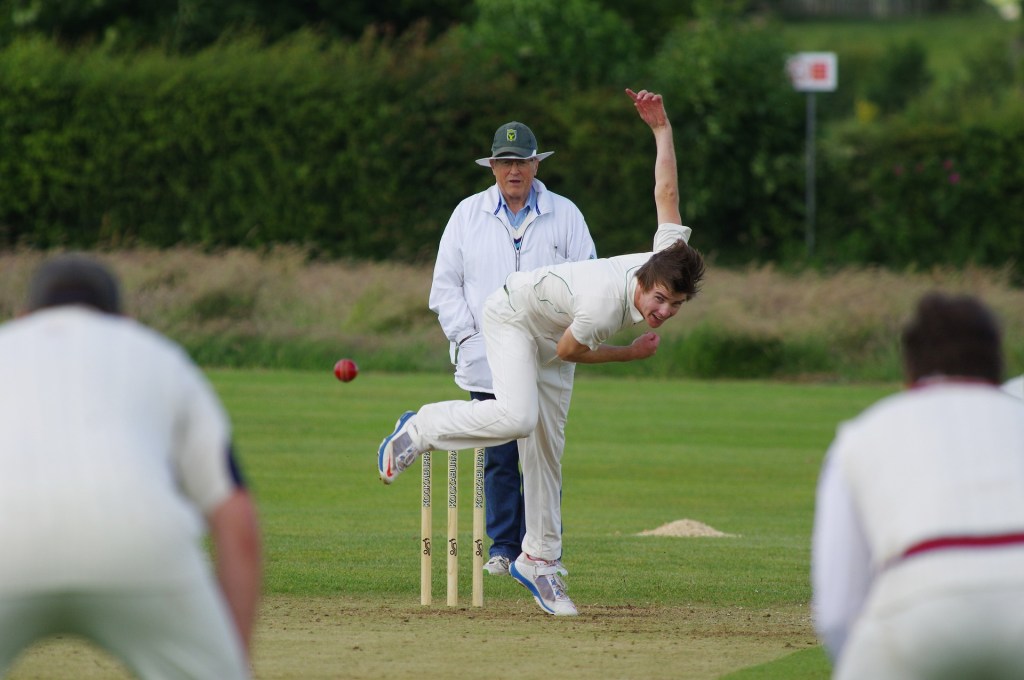
The scales in cricket have been tilted in favour of the batsmen. It has not really been a level playing field. But not too long ago, there still prevailed the ideal of a battle between bat and ball and a battle of wits between the bowler and the batter. Quality time was spent on discussing the pace-threat and the guiles and skills of spin. I remember Richie Benaud commenting on an Ashes Test. The elegant English stroke player was struggling with a packed slip cordon and Jeff Thomson was on fire. As the captain waved a couple of fielders to long-leg and deep square, the astute veteran sensed a trap. Along came the shoulder-high bouncer and went straight down the throat at long-leg. This was the charm of the game. Even with radio commentary one could visualise the game plan.

The champion bowlers were celebrated and appreciated. Pundits in the sports magazines and newspapers would wax lyrical about Chandra’s flipper or Bedi’s tantalising flight and control. They were on the covers of even the popular periodicals. The flipper we learnt was a back-spin ball which kept deceptively low after pitching- to deadly effect. The legendary Gary Sobers in his ‘spin avatar’ bowled the chinaman– decoded to us by the experts as the left arm bowler’s leg spin. The sharp turn came into the right hand batsmen or moved away from the south-paw. Kuldeep Yadav is the current exponent but our run-happy hyperbolic commentators have little to say on this fine craft of bowling. Tony Cozier, the West Indian expert, educated us about Colin Croft’s toe-crusher yorker and the deceptive slower, swinging one. Cricket aficionados learnt about the 3 variants of bouncer in Andy Robert’s arsenal. The reverse swing of Wasim Akram evoked admiration as did Murali’s doosra (the other one in Hindustani). A regular off break delivery with a wrist twist which made the ball spin in the opposite direction. Cricket was more than a physical sport. At times it was almost a chess-match between bat and ball. It blew your mind.

In the seething cauldron of the MCG, fans used to chant ‘Lillee, Lillee’ as their gladiator ran into bowl at express pace. Roberts, Holding, Croft and Joel Garner of the Fab Four have inspired Caribbean Calypsos. There was deathly silence at Ahmedabad as Holding and Marshall dismantled our second innings in the 1983 Motera Test. Even in the pall of disappointment, I sensed Respect. We had witnessed a sensational bowling display. The crowd stood up to applaud the great West Indian team. Shane Warne’s ‘ ball of the century’  to dismiss Gatting in the 1993 Test match still remains a hot You-Tube favorite.  Harbhajan ‘Turbanator’ Singh’s hat-trick at the 2001 Test vs the Aussies electrified the packed 1,00,000 crowd at the Eden Gardens and virtually brought the country to a stand-still.

Within the prime cricketers fraternity there is mutual and genuine respect between the bowlers and batsmen. Here is Ian Chappell’s (the reputed Aussie captain) take on our great off-spinner Prasanna. He had taken 25 wickets in 4 tests against a formidable batting line-up Down-Under in 1967-68, “the best spinner he had ever faced. He was trying to get you out every ball. A test to your brain. He put his engineering background to good effect by employing things he had learnt as an engineer. He pulled it back on a bloody string.” The awe is obvious, ‘aerodynamics, biomechanics, pitching the ball at length. Psychology. Baiting a batsman over after over to induce a mistake.’ Phew. Cricket is deemed to be a religion in India. Are we missing out on good chunks of its scriptures.?!!

Brian Lara on Wasim Akram’ He made me feel stupid at times. Feared to face the Sultan of Swing ‘and more.’ He was fast and furious. He bowled over and around the wicket, swung the ball both ways, a master of reverse swing. ‘At times he cut the ball prodigiously.’ Such a tribute from an all-time great batsman. The reverse swing is the art of swinging the ball in towards the batsman rather than away from him. One side of the old ball gets scruffy and the other retains its shine to get this movement. A lethal delivery later in the innings. A blessing as else even a good pace bowler would be regularly hit out of the park on a true track. Akram was the original master of this Art of Fast bowling. Then, why does the game seem so one-dimensional now? Runs, fours and sixes. That’s all it takes to hit the cricket pop charts!

So what has eroded the bowler’s stature in cricket. First, the shrinking of the playing fields. From 75-85 mtrs boundaries to 65-70 mtrs to the ropes from the centre of the pitch. In New Zealand, down to 55-60 mtrs of turf expanse. Yes, the hoardings and the ad billboards, the media spots and the dug-outs have also encroached into the playing space. This is the unspoken reality behind the sudden glut of sixes.

The bats have gotten larger and heavier. Chris Gayle wields a 1.36 kgs willow. With the thicker edges, a top edge flies for a six.  We have the swooning commentators going ga-ga. The batsman has been beaten by the pace, bounce or swing but the cheers and bugles are for the ultimate shot. Inadvertently, perhaps, but the bowler is being reduced to a side-role in the cricket show-time.

Let’s look at the pitch report. Mostly, flat and true even if offering some pace and bounce. WACA (Perth in West Australia) used to be a dreaded track, very fast and bouncy. A graveyard for touring willow-wielders. Not anymore. The extra bounce, pace and rip have gone. Touring batsmen from all over the world have heaved a collective sigh of relief. Let’s also listen in to Gary Barwell, head groundsman at Edgbaston, Birmingham. ‘One day pitches in England are the best in the world. Well, if you are a batsman, that is. The tracks are flat and true. It enables batsmen to hit through the ball.’

An interesting bowling nugget from the 1970’s on the wicket conditions. The English team it was said carried left arm quickish spinner Derek Underwood like an umbrella, in case it rained.  On sticky or drying surfaces he was unplayable and would simply run through the opposition batting.

The protective gear now worn by the batters has diminished the aura that the best fast bowlers had. Fear and Intimidation is a thing of the past. Pace like Fire as unleashed by the great West Indies fast men of the 70’s and 80’s is now part of cricket folk-lore. Catch it on the riveting documentary, ‘Fire in Babylon’. Helmets, metal visors, pads, gloves, chest and elbow padding, abdominal guards or the box are effective PPE’s. So should they be. The 5.75 ounces of leather bowled at over 90 miles per hour is a deadly projectile. Who can forget the tragic death of Phil Hughes despite the helmet gear?

The rules of the game also help the batsmen. One bouncer an over in T-20’s and two in ODI’s and Tests. Next the fielding restrictions. During the T20 power play (first 6 overs) only 2 fielders outside the 30 yard circle. For the rest of the innings, a max of 5 fielders outside the defined space. Ditto for ODI’s in the first 10 power-play overs. Then relaxed to 4 fielders in the deep for 10-40 overs and a max of 5 fielders in these positions for the last 10 overs. The bowlers and their captains have little strategic space to test the weaknesses of the batsman. Moreover, a bowler can bowl a max of 10 overs in the 50 over game and 4 overs in the T20 format. The skipper has to use 5 or more bowlers to get through the innings. If anyone is below par on the day or a part-timer is getting taken to the cleaners, the captain can only hope and pray for an end to the mayhem. Why not tweak the rules to allow one main or in-form bowler to have an extra 2 or 5 overs in the two limited over formats? Some latitude to balance out the game. Some push-back on the batsmens’ privileges.

Look at the concept of a ‘Free Hit’. A free hit is given to the batsman for the next delivery if the bowler over-steps with his front foot or his back-foot does not land within the return crease. Both versions of the No Ball. Do the batters require any more largesse in a T20 or ODI game where conditions are skewed in their favour. Catch the poor leg-spinner. The LBW rule says that for a ball pitched outside the leg-stump, the batsman cannot be given out even if the ball had turned and gone on to hit the stumps. For Leggie’s Sake! the pads are protective gear and not a second line of defence. The bowler is being defanged of his venom.

Another nugget to expose the bias. Stuart Broad, the English fast bowler, recently crossed the 600 wicket mark in Test cricket. A remarkable landmark.  But social media in India was flooded with comments about whether he was the same bloke whom Yuvraj Singh had clobbered for 6 sixes in an over. Why do batting exploits have to dominate cricket conversations? Why not salute his indomitable spirit and hail this amazing achievement?

Let’s hark back to the World Cup 2019 thriller finals. England and New Zealand both ended up at the same score even after the Super over. The trophy was handed over to England by a strange rule that they had scored more sixes and fours than their rivals. The run-rate was the same. Again bat over ball. The Kiwis had taken 10 English wickets and lost 8 whilst batting. This did not count in the ICC scheme of things.

Is it any surprise that batting records are being smashed all over the cricketing world? 10 teams have breached the 400 runs mark in the ODI tournaments. Getting 250 runs in a T20 match is entirely possible. Rohit Sharma leads the pack with 4 centuries in the shortest international format.

The advantage is firmly in the batsmen’s crease but cricket administrators and marquee cricketers are waking up to the fact. The DRS review appeals has come as a boon for the bowlers too. This has put pressure on the umpires to be neutral, alert and zoned-in especially on LBW issues. The notoriety of some in the not too distant past still lingers on. The host side at times played with 13 active players. Some officials also came under the match-fixing cloud. The Snick-o-meter with the third umpire or match referee also bats for the bowlers and helps their cause. It analyses the video and sound as to whether a fine snick or noise occurs as ball passes bat.

 The other booster for the pace bowlers should be the 2 new white ball rule- 25 overs from each end in the ODI’s. Sachin Tendulkar has a different perspective, “this is not the perfect recipe as each ball is not given time to get rough and old and reverse. We haven’t seen reverse swing, an integral part of the death overs.” Further, in 2017, the ICC did come up with a half measure on bats-  ‘edges can’t be more than 40 mm in thickness and the overall depth of the bat measured from the highest part of the spine should not be more than 67mm.’

One major ally for the bowlers is the support on the fielding front. The extraordinary enhancement in fitness and fielding skills have not only saved runs but kept the pressure lid on. The conversion ratio of run-outs and direct hits has spiked. Extraordinary catches, especially in the outfield, have become the norm.

So is this just a lament for the plight of the bowlers. Are batsmen the villains?  Absolutely not! The rules and the playing eco-system have to be changed to ensure a fair and engaging contest between bat and ball. Else, why are low scoring matches so thrilling? !! Tendulkar and Dravid, Kohli, Smith and AB DeVilliers, Ponting and Lara, Dhoni and Sangakara have enriched the game beyond measure. They are Maestros. Their exploits with the bat have packed stadiums and commanded a huge and loyal viewership. As the formats have changed, they have been at the forefront of amazing innovations in batting technique and flair. AB is known as the 360 degree genius. The upper-cut, switch-hit, reverse sweep, paddle shot, Inside-Out stroke and the Periscope shot are now all part of the cricket lexicon. The last named because the motion ends up with the batter holding the bat like a protruding periscope. Who can forget Ganguly’s break-out century at Lords in 1996? The Sachin master-class knock of 98 against Pakistan at the Centurion in WC 2003. The Very Very Special Laxman-Dravid partnership which snatched victory from the jaws of defeat against the rampaging Aussies- Eden Gardens 2001. Or Kapil Dev’s iconic 175 not out at Turnbridge Wells in the 1983 World Cup. But let us not forget the critical contributions to the 1983 WC triumph from our under-rated bowling squad.

Baseball is a distant cousin of cricket. The Pitchers have their own variations- the curve ball, the slider, the fast ball. In the All Time great lists they rub shoulders with the batters with almost equal representation. They hog their fair share of the limelight in the MBL Hall of Fame. This is also a statistically obsessed game. But their analysts and fans cover all the bases. However, in Indian cricket, the media and the fans cannot stop talking about the number of centuries, the big hits,the strike rate and in the IPL context- the Orange Cap.

Stats do not tell the whole story and they can be misleading at times. Instead, look at the Impact Players. Whose performances have changed the fortunes of a match or a series. A  Bumrah for India or a Rabada for South Africa with key wickets at the right junctures. Even for a batsman-evaluate the innings in the context of the match, the pitch conditions and the quality of the opposition attack. A fifty on a difficult wicket in a low scoring match is worth much more than a century on a docile pitch.

In the 80’s and 90’s a widely held belief was that a 5 wicket haul in a Test or ODI was equal to a century. Anil Kumble has had 35 five wicket hauls in Tests and 2 in ODI’s. Equals to at least 35 centuries. Places him deservedly amongst the batting greats. His extraordinary 10 wicket haul in an innings against Pakistan at the Ferozshah Kotla in 1999 should catapult him into the exalted cricketer realm. Not quite. If you do an informal survey in your own circle about the 6-7top Indian cricketers for the last 25 years, batting masters with celebrity names will quickly fill up most lists. Kumble, Zaheer Khan, Harbhajan Singh may at best sneak into a few.

On that note, let’s call it stumps.

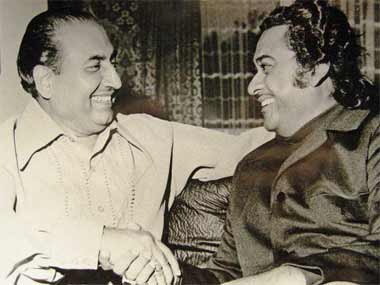
Rafi Saab and Kishore Da

A picture taken when Kishore Kumar visited Rafi at his son’s Khalid’s place in London. Image courtesy: Yasmin Rafi.

In a village near Amritsar, the young Mohammad Rafi would fly kites with his friends. He would look up and say, “meenu aasman di udai leni hai” (I want to fly in the sky- in Punjabi as told in his biography by Sujata Dev). A few years later the family moved to Lahore to join his father. Here the boy came under the singing spell of a fakir (religious ascetic) who he would follow down the streets of his neighbourhood. Then destiny smiled. In 1943, the programme executive of All India Radio (AIR) Lahore heard him sing as he worked at his brother’s saloon. He became a radio singer, performed at mehfils and even recorded for a Punjabi film. For a short period, he learnt the basics of classical singing from the maestro himself, Chote Ghulam Ali Khan. Then it was Bombay calling. In 1946, Naushad saab gave him his first big break in Anmol Ghadi. The music-composer remained his mentor and guide till the very end.

His homage to Gandhiji in 1948, ‘Suno Suno O Duniyawalon, Bapu Ki Amar Kahani’ brought Nehruji to tears. The young Rafi received a silver medal from the Prime Minister to commemorate India’s first Independence Day.

He became the rage in the 50’s and 60’s. His range was awesome and the masses loved his mellifluous voice. The patriotic song from Shaheed, ‘Aye Watan Aye Watan’ still gives us the goosebumps. ‘Hum Bekhudi Me Tumko Pukare’ the ghazal from Kaala Paani still weaves its elegant magic. Rafi saab sang many soulful bhajans. ‘O Duniya Ke Rakhwale’ from Baiju Bawra carries divine stirrings. The qawali ‘Pardah Hai Pardah’ from Amar Akbar Anthony in the late 70’s had the fans clapping in accompaniment. ‘Main Zindagi Kaa Saath Nibhata Chala Gaya’ (Hum Dono) remains evergreen and a spirit booster to this day.

Dilip Kumar in the foreword to the cited biography (Mohammad Rafi- Golden Voice of the Silver Screen by Sujata Dev) says that, “With Rafi saab it was a mystical bonding as if he was a part of me when he sang for me without being told how I would perform the song during the filming of the sequence.” Tune into the melancholic Devdas, the peppy numbers of Naya Daur or the unforgettable Bhojpuri rendition in Ganga Jamuna.  Shammi Kapoor broke the mould of the lead star with his exuberance and it was Rafi who heralded it with the Junglee song. Even the career graph of comedian Johnny Walker is embellished with famous songs like ‘Sar Jo Tera Chakraye’ in Pyaasa to ‘Yeh Hai Bombay Meri Jaan’ from CID.

Film songs and music were critical to the Box office of Hindi films till the late 70’s. Mohammad Rafi played a seminal role in the stardom of Rajendra Kumar, Pradeep Kumar, Bharat Bhushan, Biswajit , the young Jeetendra, and Shashi Kapoor and many others. His songs added to the aura of Dilip Kumar, Shammi Kapoor and Guru Dutt.

Despite all this, he won only 6 Filmfare awards and 1 National Award in his 24 year career (the Filmfare Awards had prestige then). This was largely because the first singer awards were instituted in 1959 and the Best Male and Female categories were opened up only in 1968. But if you tune in to the Golden Oldies Rafi nominations which missed the cut you will shake your head in disbelief. The National Award was for ‘Kya  Hua Tera Wada’ in 1978 for Hum Kissi Se Kum Nahin. Add to that a Padma Shri in 1967. This glaring wrong can certainly be righted posthumously.

This legendary artiste was considered a Farishta (Angel) in the film world. He was totally immersed in his music and songs. Even in his heydays he never missed out on a morning riyaaz (practice). Otherwise, it was all time with family and close friends. He remained a Punjabi foodie, enjoyed kite-flying and spent good time on the badminton courts. He was also amongst the first from the film world to entertain our jawans at the border.

The only major controversy was the feud with Lata Mangeshkar, the superstar female singer. They did not sing a duet together between 1963 and 67. The fall-out was related to getting a share of the royalty payments. Music directors were entitled to a 5% royalty from the sale of records. Lata and some other singers fought for 50% of these proceeds. Rafi’s personal opinion was that he was being paid fees upfront. Possibly, he was too creative a person to be much involved with the commercial aspects of his talent.

On 31st July 1980, just 55, Rafi saab passed away at Bombay Hospital with his family in attendance. At this critical time in his last voyage, who should step forward to help out- Uttam Singh (Sikh), Bhupinder Singh (Hindu), Kersi Lord (Parsee) and Leslie Coutinho (Christian – a drummer), all musicians and singers. The Universe bowing down to this epitome of Insaniyat (humanity).

Kishore Kumar’s maverick journey seems to have started young. His brother Ashok Kumar has stated that he had a shrill voice. At the age of 10, he injured his foot badly in a kitchen accident. He cried and sobbed for a month and his voice changed. Later in Khandwa (MP) his father, a successful lawyer, used to give him 2 annas for entertaining guests and visitors with a KL Saigal song. The rate was halved for his star sibling when he came over from Bombay.

Towards the mid 40’s Kishore moved to Bombay to stay with Ashok dada, a leading star. In 1948 he got his first solo break in Ziddi. Big brother nudged him towards acting and thus started a career of more than 80 films. His purple patch only came in the late 50’s with films like New Delhi, Aasha, Chalti Kaa Naam Gaadi and later Half Ticket and Padosan. As a singer a turning point was his meeting with SD Burman. The composer rebuked him for imitating Saigal and asked him to ‘find his own voice’. Burman da remained a mentor and guide for over 25 years. But the playback opportunities remained limited to singing some songs for Dev Anand (a big star) and for his own screen forays. The versatile genius dabbled in everything- production, direction, writing, music director. ‘Door Gagan Ki Chaon Mein’ stands out as a testimony to his creativity as a director and for composing memorable tunes.

In 1969, it was Dada Burman again. The film Aradhana and the lead man- Rajesh Khanna who stoked a nationwide hysteria. Kishore with ‘Mere Sapnon Ki Rani’ and ‘Roop Tera Mastana’ exploded on the charts. Then came a time where every leading star wanted Kishore in his playback corner. The old guard of Dilip Kumar and Shammi Kapoor were coming to the end of their lead-man days. Rajesh Khanna, Amitabh Bachchan, Vinod Khanna, Rishi Kapoor and others stepped up to take the baton forward with songs from the inimitable Kishore Kumar.

His years as an actor helped him to project his voice for the other actors. He captured the charm of Rajesh Khanna and the debonair gestures of Dev Anand on screen with effortless elan. For an untrained singer to carry off the semi-classical numbers from Amar Prem, Kudrat and Mehbooba was a triumph. The folk-songs like ‘O Majhi Re’ were a legacy from the Burman days. The poignant ‘Zindagi Ka Safar’ (Safar) retains its recall value as a classic as does the playful ‘Khaike Paan Banaraswala’ from Don. And when needed he simply switched on the rich deep tone for a Big B song.

Dev Anand said that Kishore had the voice of ‘a hero’. Their bonding went back to Ziddi in 1948. The great Manna Dey had fond memories of their crazy, rollicking duet , ‘Ek Chatur Naar’ in Padosan. The rehearsals over 8 days and good food at each other’s houses. The final recording in 2 phases. Manna da spoke admiringly about the mad-cap genius of Kishore, his improvisations which made the song a cult-classic. Javed Akhtar, the well-known lyricist, in his TV program ‘Classic Legends’ goes so far as to say that in any duet, Kishore’s voice held its own distinctive appeal. When 2 versions of the same song were there in the film, it is his rendition that stays with you. Check out Kudrat and Pyaar ka Mausam.

Hindi film aficionados know all about his yodelling skills inspired by the American country singer Jimmie Rodgers and the New Zealand born vaudeville star Tex Horton. Lesser known is that he and Burman Dada introduced falsetto singing in the Hindi film world. Singing notes higher than their normal range or as the composer put it, ‘gala tod ke gaana.’ ‘Chala Jaata Hoon’ from Mere Jeevan Saathi effectively captures this musical nuance.

Some will remember that his songs were banned on AIR and Doordarshan for many months during the Emergency years. He had the gumption to say No! to Sanjay Gandhi’s orders to perform at a Congress meet at Bombay. He had also turned down instructions to sing some songs to hype up the party’s 20 point program. Dev Anand, Manoj Kumar and Shatrughan Sinha also stood up during these dark months and had to pay a price. Although, Kishore da bagged 8 Filmfare awards, his Padma award and National award shelf remained empty.??!!

Stories of his eccentricities are legion. Like the framed message near the front door ‘I want the Money’ directed at the producers. Like locking up a producer in a cupboard for getting him into trouble with the Income Tax people. Like walking around his garden with a journalist and talking to the trees on personal terms. He had been called at times a sad and lonely man. Possibly the roller-coaster years with many of his films not doing well and a limited acceptance as a singer took their toll.

Unlike the serene Rafi saab, his life was a tumultuous journey. Four marriages including the one to the beautiful Madhubala.  His fellow-artistes have variously described him as moody and whimsical and  warm, funny and a live-wire at the recording studios. His packed concert tours saw an invariably energetic and entertaining performer.

Little is said about his helping hand to friends and relatives. His financial support helped Bipin Gupta to complete the movie ‘Dal Mein Kaala’ in 1964. After the untimely demise of a friend and fellow-actor Arun Mukherjee, his consistent help was critical for the family. He sang the Tagore song in Ray’s ‘Charulata’ for free as he admired them both. Earlier he had helped out Satyajit Ray with Rs 5000 to complete his path breaking film ‘Pather Panchali’.

He passed away on the 13th Oct 1987, his brother Ashok Kumar’s birthday. His body was taken to Khandwa for the last rites. Kishore da had been actively thinking of a retired life in his beloved hometown.

Rafi saab and Kishore da sang 33 duets together.  At every concert, Kishore would sing a few Rafi numbers with the respectful disclaimer’ I do not possess the vocal talent of Rafi saab but I would like to present some of his melodies.’ On another occasion when he learnt that Mohammad Rafi had been paid less than him for a duet he quietly corrected the situation with the producer. On his part, the senior singer treated him with affection like a younger brother. He took only a rupee as token compensation for the 2 songs he sang in ‘Chalti Kaa Naam Zindagi.’ The industry lore has it that whenever a Kishore song touched him, the younger compatriot would be invited for a feast, possibly a biryani spread. ‘Dukhi Man Mere’ from Funtoosh, ‘Koi Hamdam Na Raha’ from Jhumroo and ‘Tum Bin Jaoon Kahan’ from Pyar Kaa Mausam were such daawat occasions. Remember, that Rafi had done the playback of the last song for the hero Shashi Kapoor.

Rafi saab and Kishore Da. Both legends. Poles apart as personalities. Respect and Camaraderie. Rivals yet friends. Their unique jugalbandi story – Inspirational and Heart warming.

Cans of Worms

Pixabay

The mysterious deaths of the talented actor, Sushant Singh Rajput (SSR) and his one-time manager Disha Salian have created frenzy in the media space and in political circles. There are some who dismiss it as TRP sensationalism when the country is facing a COVID and economic crises. They do have a very valid point. The Lutyens group and their Bollywood cronies have derided it as the media trial of a helpless Rhea Chakraborty and her decent, middle-class family. A veritable witch-hunt.! A chorus of other reasonable people question why an actor’s apparent suicide is deflecting attention from a 23% drop in GDP and the tense confrontation with China at the LAC. Pause. The palpable panic which has gripped the Maharashtra coalition government tells a different story. B-town after the usual sarcasm from the usual suspects has gone deathly silent. That the Mumbai police is being played by their political masters is becoming more obvious by the day. What a fall from grace for the professional Bombay force of the Julio Ribeiro days.

There is something rotten in the state of Mumbai. The cover-up of SSR’s death has inadvertently opened up a can of worms.  A smelly, filthy, ugly can of worms. The Narcotics Control Bureau (NCB), Enforcement Directorate (ED) and the Central Bureau of Investigation (CBI) probe is haunting the powers that be- politicos, cops, Bollywood, drug cartels and the larger Mafia. The investigation has become an expose not only of possible homicides or abetted suicide but of a huge drug ring, hawala racket, narco-terrorism and even a deliberate undermining of our nation’s security and interests. The ‘Janata’ following the case for 3 months are keeping their fingers crossed.

It is my hope and prayer that this Trimurti effort be entrusted to the best professionals and be given a free hand.  Let the facts come out. Let the truth prevail. Let this not be an elaborate ploy just to get the BJP party back in power in the State. If the Aghadi Sarkar comes down be sure that the politicians will again show their true colours- cling on to whatever power or position they can. President’s rule for a couple of years will be the right decision. The BJP should not forget that this can of worms has taken a multi-dimensional life of its own.

I have long been convinced that political parties have a secret pact of their own. They may spew vitriol at each other in public but there is a tacit understanding in private. Whichever party is in power will not go after the big fish in the opposition ranks. There is a mutual protection agreement amongst the political elite. Please do not get misled by the occasional case of a Jayalalitha or Lalu Yadav spending some time in comfortable confinement.

The investigative dossiers may be there, so also the proofs. But nobody goes the whole hog. Mr Chidambaram spends sometime in the cooler on alleged corruption charges. Remember that he had sent the present Home Minister to jail when he was the Home Minister…?! This money laundering case too will linger on and the public will forget. Most intriguing was the ₹ 15,000 crore bogus stamp papers Telgi scam. His narco-tests were suddenly shown on some TV channels, whispering the name of a political strongman. The head of a national level party just sending a not so veiled message to a political opponent.?!!!

It must be emphasized that in all fairness such issues should not be kept simmering indefinitely. If there be no conclusive evidence, the government of the day ( the BJP led govt now) should give it a closure. It should not be raked up again for a hit job during the next election season.

Independent India’s first official scam was the Jeep scam. Krishna Menon, High Commissioner to UK, bypassed protocol in 1948 and ordered around 2,000 refurbished jeeps from a little known foreign company for our military use. A substantial amount of the then ₹ 80 lakhs deal was paid upfront. Only 155 jeeps were delivered but did not pass the Defence Ministry tests. Pandit Nehru’s patronage ensured that even the judicial inquiry was dropped in 1955. In Jan 1956, Mr Menon became a member of the Union Cabinet ending with his glory days as Defence Minister in the disastrous Indo-China war of 1962.

1957- The Mundhra scam. The Calcutta industrialist was given ₹ 1.26 crores from the LIC to bail out his six troubled companies, without the approval of the LIC investment board. Further, Mr Mundhra had just had a forged shares episode in 1956. Government pressure prevailed. Till one Mr Feroze Gandhi, MP, raised the issue in the Lok Sabha.  A one man inquiry committee in MC Chagla was appointed and he submitted his report in only 24 days (he was later one of India’s best External Affairs Ministers).  TT Krishnamachari had to resign as the Finance Minister and Mundhra was sentenced to 22 years imprisonment.  Feroze Gandhi had hit a home run. He was the son-in-law of PM Nehru. Their rift continued to grow.

The Nagarvala case of 1971 gets curioser and curioser. He called up Mr Malhotra, Manager, SBI, in presumably Mrs Gandhi’s voice asking for Rs 60 lakhs for a mission of national importance. He got the money!! and disappeared for all of a day. On 22nd May he was picked up at the airport. On the 26th May 1971 after a day’s trial and a confession he was sentenced to 4 years in jail. He died a few months later. So did the police officer assigned to the matter- in a road accident! Was Nagarvala an ex-RAW agent and a fraudster or simply a courier with things going awry? As the Mitrokhin papers have revealed India had been infiltrated by the KGB by this time. Ministers, bureaucrats, journalists, professors did their bidding. Or were these secret funds for a geo-political purpose?

On the late night hours of the 2nd December 1984, the ghastly Bhopal Gas tragedy happened. Lethal gas leak from the Union Carbide plant. 20,000 died. Lakhs more developed severe health complications. On December 7th 1984, their CEO Warren Anderson was quietly airlifted from Bhopal to Delhi at the orders of the CM.  Mr Rajiv Gandhi, the PM, allowed him a free pass to the USA. It is speculated that this was done as a quid-pro-quo for a US Presidential pardon for Adil Sharyar, a close friend of the Gandhis, who had a long prison sentence ahead. Finally in 1989 the Supreme Court ordered a $470 million compensation. One of the legal eagles consulted by Union Carbide – Mr Arun Jaitley.

In 1982, there had been the HDW submarine $300 million deal with the West German Company. Fat commissions and middle-men were involved. 6 people including the Secretary in the Defence Ministry and Mr GP Hinduja, industrialist in London were under the scanner. VP Singh later said that he resigned as Defence Minister in 1987 because of this corrupt arrangement. No money trail. No closure. No notable convictions.  Just political capital for VP Singh, Mr Clean, as he became the PM in 1989.

This was also the fall-out of the famous Bofors scandal in 1987 when a Swedish whistle-blower exposed the money sleaze in this ₹ 1,500 crs contract for 410 field howitzer guns. The middleman was Ottavio Quattrochi, an Italian citizen, said to be close to India’s first family. But again a lot of noise and confusion signifying nothing. The CBI botched up everything- delaying lodging the FIR, dragging their feet on the Interpol Red Corner notice, de-freezing Quatrocchi London bank account, shoddy extradition follow-ups…Sounds very familiar doesn’t it?

After the Mumbai bomb blasts in 1993, the then CM added one location to the 12 actually impacted by the blasts. He said that he did this to avoid a communal conflagration by fictitiously bringing in a minority dominated locality into the picture. His presence of mind was lauded by some in the media and also by the SriKrishna commission. The CM also repeatedly stated that the LTTE may be behind the blasts. But was this an attempt to deflect attention from Pakistan and Dawood Ibrahim. The Vohra Committee was appointed in July 1993 and gave its 100+ page findings by October 1993. Some in the know say that it contains explosive revelations of the nexus between senior Maharashtra politicians and babus and D company. The report has never seen the light of the day and the Home Ministry now says that it has been misplaced. Connect the dots. A sense of dejavu.  Almost 30 years later we are again talking about the same underworld links. If only the Vohra Committee report had been tabled and discussed responsibly and in the national interests.

The 26/11 attacks have been categorically tracked back to Pakistan and the ISI by the Indian intelligence agencies under the UPA regime and fully corroborated by the international intelligence community. But Digvijay Singh and Mahesh Bhatt presided at the launch of the book ‘26/11- A RSS Conspiracy” in December 2010. The former to please his political masters in Delhi as a loyal courtier and to counter the growing threat of the BJP. The latter’s son Rahul hobnobbed and moved around with David Coleman Headley, the ISI agent and mastermind for almost a year- a recce of all the spots where the terror attacks took place. A rattled and fragmented Indian government gave this B town scion a surprisingly easy pass. It did not matter that innocent foreigners and Indians, hotel staff and police had been brutally killed in a terror attack managed from Karachi. In 2020 also, these insidious elements and manipulators who have hollowed out India into a soft country, continue to thrive. If only it were not so disgraceful, it could have been shrugged off as ridiculous.

In 2009, Ramalinga Raju admitted to a ₹ 14,000 crore fraud. Falsifying accounts, inflating company revenues, raising false invoices, diverting money to real-estate. He was fined ₹ 5 crore and finally sentenced to 7 years in jail. In 2011 itself, he was on bail as the CBI had still failed to file a charge-sheet. He has done a total time of just 35 months and is now involved with his family’s successful health-care and agri businesses. Not even a slap on the wrist. The rich and the connected are above the law.

The Sahara scam of ₹ 24000 crore is well known in the public domain. With full political backing Subrata Roy was going great guns in 2011 with 3 crore ( mostly fictitious) investors. From 2008 he had been raising money without complying to the Regulatory framework. SEBI stepped in and stood its ground and finally the Supreme Court brought him to book in 2014. But Sahara Shree has been enjoying regular parole since 2016 . After all, he has had such close associations with several big time politicians.

Breaking news is that civil courts in Hyderabad and Patna have granted an injunction restraining Netflix from airing its new web series Bad Boy Billionaire from the 2nd Sept 2020. Mr Raju and Mr Roy say that it is an invasion of privacy and tarnishes their good name. Holy Shit!!!

The Saradha Chit Fund rip-off in Bengal has also hit the headlines. A Ponzi cum Pyramid scheme where more than ₹ 20000 crore has been siphoned off from mainly 1.7 million lower income investors lured by the promise of high returns. In 2014, the Supreme Court had to order a CBI investigation as nothing was moving at the State level. Two TMC MP’s and one State Minister have been arrested. Sudipto Sen, the MD, turned out to be a former Naxalite who had undergone a complete identity change. Recently, the high profile Kolkata Police Commissioner Rajeev Kumar has been grilled by the CBI for tampering with evidence to protect the accused and also some TMC politicians The West Bengal CM gallantly protected him from the Central investigators for as long as she could. Resonates with what is happening today in Maharashtra, what??

In 2002, a drunk Salman Khan is alleged to have killed one and injured 4 other pavement dwellers in a hit and run. Consider what happened afterwards. Singer and friend Kamaal Khan who was also in the vehicle catches the first flight back to London. But Ravindra Patil, the constable bodyguard sitting next to the star reports to the Bandra Police station that Salman was driving the vehicle in a drunken state. This police eye-witness, officially assigned, is repeatedly threatened and driven into hiding. He misses 5 hearings and the police issue a non-bailable warrant against their own. He is even thrown into jail. His testimony is dismissed as not reliable. The broken guy, without a job, dies in 2007, an alcoholic and TB patient. The powerful can get away with just about anything. The much-vaunted Mumbai police had started showing its true colours many years back.

The 2017 Unnao (UP) gang rape case starkly shows the criminalization of politics. At the centre, the BJP MLA Kuldeep Singh Sengar, touted as the Bahubali in these parts.!! The 17 year old victim tried to immolate herself in front of the CM’s residence in April 2018. Thankfully, the media and the activists jumped into the fray.But the Supreme Court and the CBI had to step in for this hardened criminal to be sentenced for life behind bars in Dec 2019.In this shameful case, the father of the victim was wrongfully accused of being the perpetrator and died in judicial custody. In another sinister incident in July 2019 a truck rammed into a car causing serious injury to the victim and the death of two of her relatives.Eerily reminiscent of the movie-‘ Article 15’. Outrageously, the BJP continued to support the goon till the shit hit the ceiling.

Just 2 small rotten nuggets to add to this unpalatable fare being served. For the list is long and growing. The Harshad Mehta stock-market scam, Coalgate, Irrigation Ghotala (scam) , DHFL collapse, ICICI Bank-Videocon corrupt deals, the Nirav Modi super swindle…The $2 billion dollar diamond fraudster runs away from the country in Jan 2018 under the watch of the BJP led Centre. Taking the cue from the ‘King of Good Times.’ Vijay Mallya, an independent Rajya Sabha MP with friends across the political spectrum, coolly chatted with them on the 1st March 2016. The next day, this defaulter of ₹ 9000 crore from 17 Indian banks flees to London. Have the authorities been napping at the wheel? Or well-wishers told him to move on? Take your pick.

A few days back we all celebrated Teacher’s day – the birthday of our second President Dr Radhakrishnan. His mentee for Doctorate, Jadunath Sinha filed a case against him in the Calcutta High court in 1929. For infringement of copyrights and plagiarism from his published and thesis material for the Professor’s books. The case was settled out of court three years later. Radhakrishnan was a close of friend of Mr Nehru and his left leanings endeared him further to the PM. Hence, Ambassador to the Soviet Union, Vice President and President of the Republic in 1962. The first Teacher’s day was commemorated that year. We should move it to the 15th October every year as homage to Dr Abdul Kalam, our only great President.

Corruption, Inefficiency and Cabalism hurts the poor and the middle-class the most. 70+ years after independence we have to shed our feudal regard for politicians and bureaucrats. Not foolishly adulate some as modern day Chanakyas. We have to demand accountability. Performance. Delivery on promises. They are counting on our short public memory span. Divide and Rule still works for them. Manipulating and distracting is their modus operandi. And to paraphrase GB Shaw, “Politics is the first refuge of the scoundrel”. We have to stop joining them in kicking all these cans of worms off the roads and out of sight.

Use the power of genuine public activism and an effective social media to make things uncomfortable for these so-called leaders. Give them no place to hide. Persuade & Influence the Prime Minister to use his majority to push through these structural reforms before the end of 2021. Indeed, the NDA has been paying lip service for many years. (a) the police reform Act to make the force independent, autonomous and totally professional. Ditto for the Central Agencies.  (b) Make political financing transparent. (c) Keep criminals out of political positions.  (d) bring in one-third reservation for women at the Lok Sabha and Rajya Sabha. The States will have to follow suit. (e) Finally, strengthen and enable the judiciary that critical cases are fast-tracked over a few months. Justice has to be seen to be fair and impartial with nobody above the law. Justice has not only to be done but also seen to be done.

Management Lessons from the Sports Field

Think over these phrases. ‘Hitting the targets’, ‘achieving the goals’, ‘passing the baton’, ‘ knock it out of the park’, ‘ ball in their court’, ‘run the last mile’. All part of the sporting lexicon. Also commonly found in management jargon and vocabulary.

There is a lot that sports can bring to the Management space. Valuable lessons for corporates, institutions, government bodies, colleges and even organisations like political parties. These examples resonate as they connect to hearts and minds and are out there for all to experience.

Institutional culture flows from the top. Coach, Manager, Captain. CEO, CXO, Manager. Take the case of Greg Chappell, Head cricket coach for the Indian team for 2 turbulent years till the ignominious exit at the World Cup 2007. Tendulkar writes in his book, “Greg was like a ringmaster who imposed his ideas on the players without showing any signs of being concerned about whether they felt comfortable or not.” In many entities also, the leader seeks to remould the team in his/her own image. No reaching out. Few consultations. Just top to down orders.  A recipe for disaster.

Let’s turn to Liverpool, the current EPL champions after a 30 year wait. They also won the European Championship last year. Here’s what Mo Salah, their star forward, has to say about the Manager-Jurgen Klopp, ‘He always wants to do his best for the team. To make everyone smile and be happy. Which means every player wants to give 100% for him.’ There it is. A management lesson in a nutshell.

Rewind to the famous Ashes series of 1981. England under Ian Botham had not won even one of the previous 12 Tests. Enter Brearley as captain. An awkward and challenging situation, right! He brings out the best in the players to lift the Urn and Botham owns the series. As Rodney Hogg, the Aussie fast bowler, remarked in admiration, “He (Brearley) has a degree in people.” Do corporate leaders have any time for people skills? Do they listen?  Bond with their team? Cheer wins? Have their backs when things do not work out? A good work environment breeds good results.

Team bonding exercises are a yearly ritual in corporate life. But camaraderie and trust takes time to build. Collaboration does not happen overnight. Where is the patience and vision to invest in team spirit?  Although the dividends will be rich and consistent. To appreciate team spirit log in to the careers of Michael Jordan and Lionel Messi. True team players. Not larger than the team. MJ has averaged an incredible 30 points and 5.3 assists per game over his basketball career. Messi has a 70:30 ratio in his 1000 goals football score card. (Assist is passing the ball to a teammate in a way that leads to a score or goal).

‘The Last Dance’ portrays the Chicago Bulls winning streak in the NBA championships in the 90’s. 1998 was their last hurrah as champions. What happened? The GM, Jerry Krause, had a grouse with the Coach, Phil Jackson. MJ and Phil and the team were getting too much credit. The CB organisation deserved the plaudits. With a compliant owner in his corner, the GM dismantled the team. Players became free agents, were traded or retired like MJ did. Since then the Chicago Bulls have disappeared into the shadows. Sounds familiar? In the corporate world, the work force is often taken for granted. Cost to Company. Dispensable. Not an important stake-holder in the growth and success. Further, how many organisations have suffered because of internal ego clashes and politics. Finally, change for the sake of change is not a good idea, especially when things are going well.

Managers tend to come down hard on failures. Tongue or mail lashing is the norm even if the recipient has had a good track-record. A poor appraisal can derail the career or destroy the morale. One below-par year can even shut down an office. The Brazilian footballer Ronaldo won the Golden Boot at FIFA 1998. But the red hot favourites lost to the hosts France in the final where the star player did little of consequence. This could have haunted him for the rest of his life. An albatross around his neck! But the powers that be in his home nation reposed their faith in him and built a very talented squad around him. This vote of confidence- despite him coming out of injury just months before the gala event- the WC 2002. He repaid that belief in him and how! Two striking goals in the finals against Germany. The Golden Boot award was his again for his 8 goals in the tournament. But this was just the icing on the cake. Brazil were the champions again.

Mentoring is an aspect of management which is largely ignored. S/he becomes the guru for the younger members and the freshers to take them through the paces. All do not need hand-holding or supervision. Some just require the occasional advice and appreciation to keep them going. Acknowledgement of good work is the key. Credit be given where it is due. Even small wins be celebrated to keep the environment humming. P Gopichand is not just a badminton coach but a mentor. He is a task-master but also a pillar of support. Hence, Saina Nahiwal comes back to the Academy after leaving for a year in 2016. PV Sindhu continues to make badminton headlines. Two world beaters trained and nurtured for many years. But Gopi has carved out separate spaces for them to thrive.

Sports also guides us on how and where to scout for the right talent. In India, the long ostracised Bhil tribals are now major hopes for an Olympic gold medal in archery. Small town cricketers have shown that they have what it takes to reach the top. Corporate chiefs should pay heed. They should also look beyond the prime college campuses. Look out for ‘the fire in the belly’ candidates albeit with modest qualifications. They will bring value to the Boardroom table.

They can also take a leaf out of Paralympic Sports. Multi-sports events for athletes with physical disabilities and intellectual impairments. Surely, some workstations can be found to give the blind and the deaf and the physically handicapped a start in their work-life.

At many companies, there is a generalised approach to training and orientation. Everyone goes through the same stuff at some stage. Let’s bring in Usain Bolt, the 100/200 metres champion. He has never run a mile in his life, even in training. The sprinters’ focus is all about speed and muscle. The 90 mins daily gym workout, the nutrition and diet regimes and the speed dashes are carefully calibrated to achieve this. Endurance tests are for the long distance runners. L&D (learning & development) can experiment with need-to-know basis modules. Plus Upskilling courses to meet market expectations and needs. Specialised sessions to keep the line experts sharp. Most of all organise more workshops to develop soft skills and leadership proficiency.

Federer and Nadal. The fiercest rivalry ever in tennis. The Grand Slam encounters were virtually battlegrounds. But out of court, their respect for each other is heart-warming. Their aura as role-models goes well beyond their sport. What makes a Company an enduring brand? When all the bases are covered. There is respect and trust from the customers, vendors, employees, share-holders and the market at large.

Some cricketing nuggets for the Managers to chew on. Clive Lloyd’s team were humiliated by the Aussies on the 74-75 tour at the hands of Lillee and Thompson. The Captain resolved to fight pace with more pace, fire-power with greater fire-power. Thus started the assembly line of great fast bowlers. The Windies dominated the turf from the late 70’s till the early 90’s. Like Lloyd, companies can chose to do what major competition is doing. Only do it much better.

Sri Lanka were the proverbial minnows in cricket. Till they won the 1996 World Cup. The openers Jayasuriya and Kaluwitharana attacked from the word go taking advantage of the fielding restrictions in the first 15 overs. Cricket logic had been turned on its head. This success formula soon had other successful imitators. The disruptive strategy of the Lankan captain, Ranatunga, also has its takers in the corporate world. Technological innovation which upends the game in say customer service deliverables. Or Product positioning. FMCG companies discovered the brisk uptake in small-town India when their prime shampoos were marketed in affordable sachets and pouches.

HR becoming a part of business strategy. Horses for courses. The right people in the right places. Consider reading the pitch to decide the team composition. Whether to play with 4 quicks or 2 spinners or with 6 batsmen, or else, different players for different formats- T 20 or Tests?

The Fosbury flop which won the American athlete Dick Fosbury the high –jump gold at the 1968 Olympics revolutionised the technique. A straight approach, twisting on take-off, going over heads first with the back to the bar. Not the scissors cut or straddle or the western roll. “The physics of the FLOP allowed the athlete to bend the back around the bar at the peak and clearing the bar whist the centre of mass travelled under the bar ‘’ says a Stanford Education study. All the elite jumpers now use this innovative backward style. Corporates have to innovate to stay relevant and ahead of the relentless competition. They are finding ways of raising the bar and clearing it.

Analytics.  E-Commerce firms are already putting it to great use for customer profiling and figuring out buying patterns.  Others are playing catch-up for cross-sell and up-sell opportunities and understanding the market dynamics better. At top level sports, analytics is a must and pros travel with the teams. They have to keep a tab on rival teams. Check-out tactics, evaluate the strengths and weaknesses of the opponents. Focus on neutralising the key players. In hockey, the goal keeper studies the kinematics (the ball movements) of the penalty corner conversions of the other team. The batter in baseball pores over videos on how to decode the curveball or slider from the pitcher. In business, analytics helps to stay a step ahead of the competition and have more clarity on the way forward. Additionally, the company can reinforce its position by adopting the good practices of other peer companies.

Sports offers both inspiration and guidance to the management fraternity. Our work lives would be much better if those in a position of power and influence imbibe the lessons from the Sports fields.

The Bollywood Bazaar

Image by dan123ny from Pixabay

Behind the glamour and glitz of Bollywood is the Hindi film industry. It churns out 350-400 films a year. Most go unnoticed and do not recover their costs. Some quality movies get very limited releases but then hopefully a fresh lease of life on the streaming OTT platforms. A few do well in the C & D centres. A significant data point is that there are only 6,700 single screens + around 2,400 multiplex screens in India for 1,600+ films a year, compared to the 40,000 in the US and 55,000 in China.

With the Mumbai film world also in a lockdown, let’s look at how the real business works. Brush aside the myths and make-believe narrative about the mega-stars and the celebrity film makers. After all, these are tales spun by PR agents, TV anchors, critics and trade people on their pay-roll. Social media facilitators take the hype and hero-worship to another level.

Glorify, hype, manipulate, seduce, deflect, misinform are all tricks of the trade. Add snuff- out competition.

The big production houses, superstars, media outlets and the social media apparatus have together created powerful cabals which dominate B-Town.

Let’s look at some real numbers. Sushant Singh Rajput’s Chhichhore grossed ₹ 200+ crore last year on a budget of ₹ 45 crore. It managed to get a 1200 screen release in September last year and the audience lapped up the content. Uri-the Surgical Strike, with Vicky (who??) Kaushal in the lead, garnered ₹ 245 crore in domestic collections alone, on a budget of ₹ 25 crore only.  Again a 1200 screen opening. A smash hit, wouldn’t you say. The chatter media has largely kept quiet, even played it down.

Salman bhai’s magnum opus Bharat, has a 2,000 plus screen grand release. Just touches ₹ 200 crore with inflated ticket prices at the multiplexes. Production costs are touted at ₹ 80 crore. But it is the time to go ga-ga. This is the tried and tested formula for Mr BO. His films come out on a major festival which along with week-end gives it a 7 day free run with no competition to speak off. His die-hard fans plus the holiday mood kicks in. All the moolah is raked in over the first week. Then it is all down-hill.  The average cine-goer forgets the movie as soon as he/she steps out of the theatre. Tubelight and Dabangg 3 have flickered briefly and flopped. No industry insider dares to say so. The Sultan continues to walk with a swag.

Take the case of King Khan. A disappointing run for the last 6-7 years but his stardom has not dimmed. A few average movies and some big duds. Remember Zero. Fades in comparison to Kamal Hassan’s Appu Raja and AB’s Paa. A critic for a leading paper panned it with a 1 star rating. But couldn’t resist saying that it was not worthy of the SRK talent. I naively thought that he had the clout to command scripts, choose directors and co-stars… In fact the works. Mainstream actors like Matt Damon and Tom Hanks use their stardom to get better projects and quality content. Jab Harry met Sejal was a disaster. The critic in another leading English paper drooled, “SRK is like old wine. The more he matures, the better he romances.” Are these guys made of Teflon? Nothing sticks to them. Is it too much to hope for a Swades again!!!

You can now see why we wallow in such mediocrity. The eco-system pampers the stars and the so-called show-men. There is no reality check. The camp culture keeps them in a comfort zone. They have become lazy and repetitive and are taking all of us for granted.

Only politicians and movie stars get away with such trash in India. A 2 time world cup winning captain like Dhoni is asked if he is past his shelf life. Take another analogy. Will investors be gung-ho about a corporate which has given average or negative results over the last 12 quarters.

Let’s move on to the accomplices- like celebrity critics Rajeev Masand & Anupama Chopra, whose bias and fandom is there for all to see. Fortunately, independent You Tube reviewers and Netizens are pushing back and calling a spade a spade. Both these big names refused to review a significant film, The Tashkent Files presumably as the filmmaker is a BJP supporter.  Based on a validated expose of how from the late 50’s the KGB had infiltrated and possibly compromised people at the highest levels of the Indian government, academia, media and even the film fraternity. It was this stuff which was difficult for their ideological gut to digest. And the mystery of Shastriji’s death was too much to handle.

The A-list filmmaker, husband of one of these reviewers released Shikara on the streaming platform, billed as ‘the Untold Story of Kashmiri Pandits’. Sadly the story remains untold. The film makes little mention of the genocide, violence and rape which led to the exodus of half a million of this community from their centuries old homes. If anything, more screen time is given to justifying the cause of the militants- funded and armed by our ever friendly neighbour State.

A few more examples- Tanhaji (₹ 200 crore club) was treated by these intellectuals with some disdain. A Maratha warrior taking on the Emperor Aurangzeb. Really? Research and history be damned. Ajay Devgns third film on unsung Indian heroes may calm their nerves. It celebrates the great football coach- Syed Abdul Rahim- and the golden period of Indian football from 1952-62. I look forward to this homage to a sporting icon.

Akshay Kumar’s terrific run at the box-office is shrugged away as hyper-nationalism.  Mission Mangal, Kesari and Airlift are inspiring, true stories and make for good cinema. I recall that their take on Uri was punctuated with the word ‘Jingoism’.

Bollywood is loath to admit the superior quality of films from other regions, esp. the South and Maharashtra in recent times. More movie buffs are discovering the same on Netflix or Prime. Consider Kumbalangi Nights and Virus (Malyalam), Super-Deluxe (Tamil) or  Tumbbad (Marathi). They ooze with creativity and story-telling.

The Hindi films award shows are a farce.  Gully Boy getting ten! LOL!  An engaging film. Not an all-time classic. Think of the opportunity missed in hailing some real actors and technicians. It must be great to belong to this close-knit clique.

Their inflated egoes will never acknowledge the biggest box-office bonanzas which have been helmed at other centres. Bahubali 2 tops the India box office with a staggering ₹ 1400 crore collection. Surprise, Surprise-its Hindi version topped ₹ 570 crore. Rajnikanth’s 2.0 follows with ₹ 564 crore (multiple language release). Then Dangal with ₹ 538 crore and Bahubali – the Beginning at ₹ 516 crore. KGF (Kannada) scored a BO century on home turf itself. Sairat (Marathi) made at a modest ₹ 6-7 crore breached the historic ₹ 100 crore mark. It was immediately remade in Hindi with star kids.

Global BO numbers of Hindi films are largely driven by the Indian diaspora. Very few have made the cross-over and resonated with foreign audiences. Dangal has smashed records in China pulling in over ₹ 1,000 crore. Earlier 3 Idiots had really connected with audiences in South Korea, China, Japan & South East Asia.  Secret Superstar (made for ₹ 15 crore) had an India score of ₹ 75 crore and a China tally of ₹ 750 crore.  Andhadhun also hit the ₹ 300 crore jackpot in China. But this also is not trumpeted in the media domain.

The Bollywood kitty of the world box-office revenue of $40 billion is just under 5%.

Some earlier films to make the breakthrough were Awara & Shree 420 ( Soviet Union & China), Mughal-e-Azam,  Naya Daur,  Anand, Sholay, Deewar, Trishul, DDLJ, Lagaan, My Name is Khan…..Disco-Dancer had Russians and East Europeans dancing to its tunes. Rajni’s Muthu touched the hearts of the Japanese. Satyajit Ray’s films created a loyal, niche audience especially in Europe.

Let’s turn the clock back for another interesting take. How much would the blockbusters of yesteryears taken at the ticket counters today. An eye-opener for today’s movie nut clued into the ₹100/200/300 crore clubs instituted by the trade people. Adjusted for inflation, Sholay and Mughal-e-Azam would probably rub shoulders with Bahubali and Dangal in the ₹ 2,000 crore stratosphere. Mother India would have set the cash registers ringing for say ₹1,300 crore. Awara would be in the ₹ 1,000 crore club. Mass entertainers like Johnny Mera Naam, Amar Akbar Anthony & Disco Dancer would have crossed the ₹ 700 crore mark. To be fair, DDLJ and Hum Aapke Hain Kaun would also have pole vaulted into the ₹ 1,000 crore collection zone in today’s times. But the perspective to take here is that Raj Kapoor, Dilip Kumar and Amitabh Bachchan would have featured in the top grosser list many times over. (These are estimate numbers sourced from articles on the internet by cinephiles, journalists and pundits.)

Those were also times when this abject sycophancy did not exist. Raj Kapoor’s Mera Naam Joker was called out as a flop. In contrast SRK’s ambitious Ra-One was quietly laid to rest. In the mid-70’s itself Rajesh Khanna was being discussed as a super-star in decline. I recall reading in a popular magazine that his mannerisms had become stale. Indeed, trade papers and critics had dismissed the multi-starrer Sholay as a dud in its first week itself. They had to eat their words for the next 5 years and more.

Till the end of the seventees it was not all about the stars. Technicians were given their due. DOP’s like Dwarka Divecha and Fali Mistry were feted and lauded. Musicians and lyricists had their names on hoardings and posters. The legendary singers-Mohd Rafi & Kishore Kumar, Lata Mangeshkar & Asha Bhonsle…. could pack concert halls on their own. Today they piggyback on a star tour. Everybody had their place in the sun- the directors, character actors, editors, choreographers, production designers.

The raw business truth is that today it is the distributor and exhibitor who are taking the real risk. The star packaged product is sold out to all the 11 territories by the big production house. Plus they rake in the big bucks from the overseas markets, the music rights and deals made with other media and streaming outlets.

Finally, it is upto the audience to demand better value for money. The success of Andhadhun, Chhichhore, Uri, and Article 15 shows that there is a large and growing market for good content films. The distributors and exhibitors should wake up to the fact that this involves lesser risks and higher margins and ROI. More screens and shows is the only way for good talent to show what they are capable of.  The creative juices will then really flow in the Mumbai film world. A good story, well told, will carry the day.

The show must go on. But it is high time that we as consumers call for a more fulfilling experience.

Vodoo Magic and All That…

Photo by Joshua Newton on Unsplash

This remains one of the most extraordinary experiences of my life. The memories are so vivid that even after almost 40 years I can see it unfolding before me. And I get goose bumps every time, even as I write this blog.

In deference to the quiet, decent man at the centre of this tale, I have not mentioned names of people or places. However, he feels that his unusual anecdote is worth sharing.

The story goes like this. As a new joinee, I was welcomed by the office fraternity. Just a few days later, something unusual happened. As I opened the washroom door, I heard a low moaning and whimpering sound. A young man stood looking into the mirror at the opposite end and splashing his face with water. His face was contorted. He seemed to be in anguish and pain.

I quickly walked back to my desk, unable to process what I had seen. I glanced at the wall-clock. It was a few minutes after 3pm. Just as I was about to reach out to a senior colleague, I was relieved to see Nagendra (name changed) come back to his table looking composed and normal. He was one of the typists- a quiet and sincere guy.

We were amongst the first ones to reach the office. This led to a bonding of sorts. He was very much into cricket and flying kites. We hit it off on both counts. So it was that one day I asked him about the washroom episode. He just gave a wry smile and shrugged.

A few weeks later it was peak summer and on a public holiday I was invited to his home for lunch. In those days the area was on the outskirts of the city. An independent house with a small garden and a swing in the front porch.  Nagendra opened the door as soon as he heard the front gate latch clanking.

As I entered the house, I felt an odd sensation. Just for a moment. The windows were closed and curtains drawn in the front room and a ceiling fan whirred a bit noisily.  Then I was taken into the dining room where the lunch table had already been set. I was introduced to his mother and younger sister who had laid out an elaborate feast.

My hostess was very gracious and kept serving me with various delicacies. Soon, we began talking as if we had known each other for years. They were curious about my background and family story. Nagendra’s mother was then a teacher in social sciences at a nearby secondary school. His sister was studying law and hoped to practice at the high court. Sadly the father had passed away some months back from a heart attack. Although he had BP problems, his death had come as a shock. I looked at his photo-frame on the mantelpiece with a garland and a diya burning.

At around 3 pm, it was time again for tea and snacks. As we sat on the comfortable drawing room chairs, the talk had dried up. They kept looking at the clock and stealing glances at each other and at me.

Then it happened. As the clock struck three, there was a noisy clattering from the kitchen. I got up startled but was restrained by Nagendra. This bizarre event had apparently happened earlier also. Kitchen utensils would fall from their stands and those in the wash basin would rattle. It was all over in a couple of minutes. I had earlier entered the kitchen to place my lunch plate.  This time I saw the fallen clutter of vessels.

It was then that his mother and sister told me the story. The main character kept quiet during the animated conversation. The family could trace its roots to a cluster of villages and small towns in the heart of India, some 200 kms away. A scenic area with lakes and hills and the vibrant charm of tribal culture and ethos. Growing in popularity with the local tourists. More than a year back they had gone for a traditional alliance for their son. At the engagement ceremonies they had been introduced to a half veiled but nice looking young woman who also briefly spoke like an educated person. My friend had immediately said ‘Yes’ and the preparations started. A few months later they were Man and Wife. Not quite. The wife turned out to be the elder sister who sadly was slow-witted. It came to light later that the younger sibling and her paramour- a local politician cum businessman- had planned this charade to solve the family’s problems. An angry and bewildered Nagendra and family had disowned the entire ceremony and left the new bride at her village.

The strange occurrences had started soon after. Deeply disturbed they ran for help to their large and close-knit family relations. It was around this time that the father figure suddenly passed away leaving all desolate and in deep grief. Family elders brought in a temple priest to help the distraught family. He performed a hawan to drive away the bad energies. Then came a tantric with his occult rituals and the black amulet which Nagendra had to wear on his right upper arm. The young man traversed the 15 kms to his office every day on his father’s motor cycle. He had been advised to get on the vehicle within the house gates and only get off at the basement office parking lot. No stops for any meetings or household chores on the way. Such had been his life when I met them. I was stunned.

It was a few months later that Nagendra surprised me by inviting me to tea at a famous corner tea-shop. He told me that his clan in full strength had visited the village and threatened action. The commotion had led to the Sarpanch, local civic officials and the police getting involved. The bride’s family had demanded Rs 25,000 to annul the marriage, a good sum in those times. Finally a deal was made at Rs 15,000 to be paid in instalments. All the mysterious events of the last year suddenly stopped. Nagendra and family finally found peace and could go on with their lives.

My friend saved the weirdest details for the last. The din of the crashing utensils and his own meltdowns had been triggered by Vodoo magic. Friday, 3pm, had been when the wedding had been solemnised. The abandoned bride’s family had hit back by getting some practitioners to do black magic. When Nagendra had gone for the final settlement, they had even shown him a straw doll with his photo pasted at the head.

I shook my head in disbelief. I had read about voodoo practices in Haiti and some Caribbean islands. Far, far away from his native place- just a four hour drive from where we were sitting. I asked for another round of masala chai.

Around 10 years ago, I was working with a private company and had to visit the city where my old friend was now posted as the Office Head. He had put on weight but was all smiles as he hit my palms in the de-taali fashion (a low-five). We had tea in his cabin and he updated me on his life. He had waited to get his sister married before taking the plunge again. She was now with the State Judicial Service in a good position. They had lost their mother a few years back.

His own family life was happy and settled and good. He had married an office colleague and she had later opted for voluntary retirement. He proudly mentioned that his daughter had passed out of IIM Indore and had a good job with a marquee MNC in the same city.

My good-hearted friend had to connect all the dots… the first woman whom he had agreed to marry in the village had tied the knot with her boyfriend. Her unfortunate elder sister had picked up her life again. She had a talent for the tribal arts, weaving and pottery. Some good people connected her to the State artisan community and she now worked for the Handicrafts department. “That gave me total peace,” said Nagendra with a smile.

Then he took me home to meet his family at dinner. It was heart-warming to see him settled and happy with his family. We continued with our catching-up as he dropped me at the airport for my late-night flight home.

A Strange and Troubled World

Photo by Drew Hays on Unsplash

We live in disturbing times. Eerily reminiscent of a century back. The Spanish flu, the British and French colonies, the failure of the League of Nations, the rise of Stalin, Mussolini and Hitler and of course the Great Depression.

Take COVID 19 which has brought the world to its knees. The secrecy shrouding its origins and spread- the buck stops with China. Check-out the reckless social behaviour of millions- defying medical science and data. In the US, to wear or not wear a mask has become a political statement.

The anti-mask group belong to the Trump cult. A racist, divisive, incompetent, venal and corrupt President. Surely, the holy Evalengicals would deride and oppose him. No, they are his biggest supporters. A quid-pro-quo to get their agenda on anti-abortion, LGBTQIA+ and immigration passed or ruled into laws.

The most powerful man in the world is Putin’s puppet. The Russian mob-boss and his oligarchs do as they please- manipulate elections and poison their enemies. The former KGB agent has only one life purpose and that is to restore the glory of the former Soviet Union. He has high approval ratings in Russia.

Xi Jinping fancies himself as the Chinese Emperor. He covets lands in India, Bhutan, Nepal, Taiwan , Japan, Philippines and surprise, the city of Vladivostok in Russia. He wants to control the South China sea. His one-belt one road policy is not just the revival of an old trade route. Chinese footprints have reduced Pakistan, Sri Lanka, some African countries to debt-ridden vassal states.

After the collapse of the Soviet bloc, it was hoped that democracy would thrive. Instead, there is a plethora of strongmen across Brazil, Venezuela, Turkey, Hungary, Philippines, North Korea (is he alive?). These authoritarian leaders (some with elected credentials?) take their cue and inspiration from the master manipulator, Putin.

The fickleness and spinelessness of the political class has become obnoxious. In India, the Grand Old Party and their leftist comrades shed copious tears for the plight of the Rohingya Muslims. But there is deafening silence about the incarceration of a million Uyghur Muslims in Xinjiang province in China. It does not suit the narrative of these human rights activists. And the Islamic Republic of Pakistan remains subservient and loyal.

Even in the 1990’s the UN, NATO and the ICJ (International Court of Justice) played an effective role in ending the long-drawn genocide and hostilities in Eastern Europe. The Syrian and Yemen conflicts drag on and on. The world has become numb to the devastation and human suffering.

The United Nations is impotent. The US, Russia or China veto whatever does not suit their geopolitics. India should have a permanent seat at the Security Council. The largest democracy of 1.3 billion people and a growing economy does not get a seat at the table.

The WHO has disgraced itself with its mishandling of COVID 19. In the critical first months, it covered up for China and played PR in glowing terms. It called out the pandemic very late and its confusing directives on the spread and even measures like wearing the mask have been very disappointing.

Free media, the vaunted fourth pillar of free nations, is past tense.  Jamal Khashoggi, a well-known Saudi journalist in exile is dismembered in the Saudi embassy in Turkey- on the orders of Prince Salman. The outrage lasts for a few months. Then, it is back to business.

Fox News exemplifies the mockery of an independent, objective media. It has degenerated into a Trump channel. And the President gets his opinions, sound-bites and Twitter content from these TV anchors.

The Virus has dealt a body blow to the world economy. Manufacturing, IT and service sector, airlines, hospitality, tourism, local shopkeepers have all taken the brunt. Especially heartrending is the desperation of the down the line workers with no safety nets and the daily wagers and migrant laborers. Another nightmarish scenario lurks ahead-the eviction of millions of ordinary tenants who are unable to pay their rent.

In the movie “Wall Street” the Gordon Gekko character says the famous lines “Greed is Good”. Mark Zuckerberg of the $ 70 billion Facebook Empire could not agree more. He shrugs off hate content, misinformation and manipulation on his global social platform. It was used to undermine the 2016 US Presidential election and possibly even to swing the Brexit vote. Who cares!

Think Jeff Bezos at Amazon. He runs a boot camp where front-line workers do not have time to even take a leak. Show me the Money. Who Cares!

You can scratch your head on this. The great Warren Buffett has at times paid less Income tax as a percentage than his Secretary!!! With income disparities growing, the top 1% does not pay its fair share of the taxes.

Football is the most popular sport on the planet. Sports transcend borders. It should aspire to higher standards of human behaviour. The powerful apex body FIFA hands over the 2022 world cup to Qatar. Dubious, Controversial. A Disgrace!!! Meanwhile, poor migrant workers slog it out in inhuman conditions to build the grand infrastructure. Hundreds have died.  Deadly silence. When the kick-off happens, blood would have already seeped into the grounds. The players will be left to sweat it out in this hot Gulf country.

George Floyd whispers “I can’t breathe” in a chilling 9 min video as he is murdered by a racist white American cop. In 2020, ‘the land of the free and the brave’ and ‘the leader of the free world’ is a deeply divided and polarised country. Anti-Semitism is again rearing its head in Europe and the US. Fault-lines are developing all over on ethnic, religion or color basis.

Indians also have to wake up to how we treat our North Eastern brethren. Ostracising them for how they look or speak reflects poorly on us. We have a lot to learn from the cultures of this beautiful part of our land.

But there is reason for hope. The Black Lives Matter protests are resonating as never before. The protests in the US and Europe have been largely peaceful and have attracted world-wide attention. Thousands of whites, Asians and Hispanics have joined the cause and taken to the streets.

But as Angela Davies, a black activist, cautions- “It is no longer enough to be a non-racist. One has to be an anti-racist.”

Marquee corporates have started to move away from Facebook to advertise their products and services. The filthy rich billionaire is now being forced to discuss and review the toxic content on the platform.

In India also, many people are turning away from the negativity of their TV channels. These only spew propaganda, bias, hatred and sensationalism. Here’s hoping that we will be slowly moving to more mature and credible content.

Colin Kaepernick, the courageous NFL star, protested against racism a few years back by kneeling during the anthem. He was immediately kicked out of the league and vilified. He may now get a chance to play again this season. The powerful National Football League (host of the Super Bowl) has also publicly apologised for its denial of this serious issue over the years. NASCAR has withdrawn Confederate flags from its car-racing venues- the symbols of slave-owners. Even, statues of knighted and glorified slave traders are being taken down in the UK and Spain. Many players in the revived English Premier League took a knee to show their solidarity in the fight to end racial injustice.

The Indian State of Kerala was the first COVID 19 hotspot. With the Nipah success behind them, the public health officials acted efficiently to contain this new scourge. This southern state can also teach us about the laudable community model policing. With urgent need for police reforms in diverse lands like India, US, UK, Hong Kong, Venezuela, Egypt…… they can take a leaf out of this successful programme.

If the world has to become a better place, civic action and community participation are a must. The bar has been set very low for politicians, public departments, community leaders and business tycoons. It is time for a reckoning. Also time for truth and reconciliation forums. Time to tell the rich and influential that they cannot get away with everything. Take them off the pedestals and hold them accountable.  Only strong institutions and responsible governance can take us across the line. Then and only then can the common citizen- BREATHE.

The Corporate Quicksand

The Corporate World- swanky glass-fronted buildings, CCTV’s and security guards, luxury cars and SUV’s gracing the parking lot. Marquee IT companies, big name consulting, MNC & Indian private sector banks and insurance companies, sprawling industrial complexes and OEM’s. The Aura and Smell of Success. Ticking all the boxes in the corporate report card- stock prices, market share, profits and branding.

What about the employees who inhabit this world, especially at the middle-management and junior levels. Obviously revelling in their success, thanking their stars and counting their blessings, right? Not quite. There is some starkness behind all the glitter.

Even a few years ago, corporate culture was reflected by a Mission statement. To be the trusted partner for customers: the preferred employer for employees: to protect and advance the interests of the shareholders. Some sense of balance was achieved for all stakeholders and this profoundly influenced the work environment.

Yes, the promoters have invested money in the business and expect a good ROI. They are not here for charity. But the pendulum has swung so much that it is now all about enriching the share-holders. In a competitive market, the customers do figure prominently in the narrative. But it is the employee who actually makes things happen on the ground who lurks insecurely in the shadows. Pause. Some may shrug and say change is inevitable as the Corporate grows big.

It is the time of hands-off Management. Targets are assigned for the various business verticals. Monitoring is done on a daily basis. It is common to get WhatsApp messages at 10 pm at night demanding the day’s results. Workdays are structured around review meetings , con-calls and video-conferencing. There is a cascading effect of pressure on the front-line team. They become the TARGET. The language used can be colourful and intimidating. The middle level executives off-load on them after getting roasted by their bosses.

Perhaps People Management is now looked upon as a weakness. An unproductive area to invest time and energy in. They are being paid well and are expected to deliver always. Never mind that it is these people who have strived to build the brand, joined in the daily grind to ensure the Company’s success. Of course, no Company or even an office can afford to carry dead-weights. The inefficient and the incompetent, the trouble-maker or the unethical will have to go. All this, in the context of normal times.

Listening is no longer the norm. It is a one-way traffic down the line. Not so long ago, leaders used to tap into the ground realities. Find time even for a fresher employee. Go on joint calls. Discuss problems. Find solutions. Encourage. Motivate. Be there during difficult times. Leaders have now mutated into Bosses. They take their cue from the top man and nobody wants to step out of line. Voices of Reason have been drowned out by the noise and rattle of this passing bandwagon. Except the inner coterie, no one knows when their time has come. It is a Catch-22 situation. It definitely gnaws at the souls of the well-meaning professionals.

Where everything is reduced to hard-nosed business numbers, politics and sycophancy thrive. Reliable sources told me about an organisation where the top honcho liked to be addressed as the Supreme Leader or the Great Leader in mails and adulatory speeches. Even PPTs made by the senior management were buttressed with his quotes. Shades of North Korea, what? The world is really getting smaller.

There are Bosses who openly take pride in being ruthless. Survival of the Fittest. Any wonder, that the survival instinct kicks in? As the old nursery rhyme goes, “Yes Sir, Yes Sir, three bags full Sir.” The good men and women within an organisation who are still respected and can make a difference have also thrown in the towel, for now. Their energy has been sapped. They cannot take on the System. The days of think tanks and brainstorming on good ideas and initiatives have long gone. And the sad thought is that many youngsters imbibe these trends and attributes as the lessons of management.

Employee No. XXX has to reach office before the appointed hour. Out-Time is very flexible especially if you are saddled with a bad-boss or are down the food-chain. Not good for your professional health if the Chief thinks of you as a work-shirker. Including travel time, many spend a good 12 hours plus on the job. Add business tours and travels. With very little quality time for family and friends, work-life balance has been reduced to the classic corporate Lip Service. Stress at work plus less time with family makes for a toxic mix. Kids can easily grow up as strangers and it takes a heavy toll on a normal married life.

A fair number of such workers pride themselves on being workaholics. Sincere, dedicated- with whole-hearted involvement. But workaholism is a disease, an addiction which does a lot of harm to the individual. Other than the bad impact of Stress on health, this misled person can never evolve or grow- missing out on many slices and joys of life. Dr Abdul Kalam’s observation is pertinent for the current corporate climate, “Love your job but don’t love your company because you may not know when your company stops loving you.”

Some of the more savvy Corporates are tinkering around without rocking the boat. One hears of good initiatives like mandatory leaves, work from home facilities, cultural events, yoga sessions and the like. But the broader narrative remains unchanged. Monday Blues have become very common. Enjoying work – a disappearing experience. Things have become very clinical and mechanical, impersonal and a tad cold. It is all about NUMBERS. The human touch has been lost.

The advent of technology, innovation and disruption has added to the woes and the grim picture. We have to accept the inevitable. Technology will reduce costs significantly and bring efficiency and convenience of service delivery. The customer also stands to benefit. AI, Bots and Blockchain will dramatically change many of the routine operational processes across industries. But the manner in which some Industry Chieftans, whose words matter, are projecting it is both immature and insensitive with no regard to the collateral damage. Use and throw. The thousands who contributed to making a Company a brand are reaching their shelf-life. No plan B, no up-skilling, no re-deployment, no re-structuring. Tough times ahead. However, the Board is only fixated on market share, valuation and profits. Not on the Greater Good. Not on adding the blessings of their own team to the Balance Sheet.

I remain optimistic that the pendulum will swing back. Good Sense will prevail. Creative CEO’s and CXO’s will buck the trend and revive the balance and fairness embodied in the Mission Statement triangle referred to earlier. Also, a Salute to the few who are not scrambling onto this gravy train. The OUTLIERS. Who continue to acknowledge the contributions of their Team Members. Knowing that a good work environment itself guarantees productivity, consistent results and success.

But for now it’s SHOW ME THE MONEY. Surely a big consulting firm can be persuaded to bestow on the Company- “The Best Company to Work For” Award.